“If you want the rainbow, you gotta put up with the rain,” said Dolly Parton.
It absolutely pissed down at Forwards on Saturday.
Proper, committed rain. The sort where you spend the first twenty minutes trying to preserve some vestige of dignity before accepting that your hair is fucked, your shoes are wet and this is simply your life now. At which point, pleasingly, it becomes fun. I put my raincoat on and danced like an absolute twat and it was brilliant.
This week bought the sad news that Dolly died, and I spent much of the following two days listening to her music and having a bit of a cry. So the quote has been rattling around my head ever since.
It also turns out to be a reasonably good description of running a small consultancy.
The rainbow is the bit you get to announce: we won a new client. We ran a great session. We wrote something people wanted to read. The rain is contract negotiation, procurement portals, pitch decks for meetings that get postponed, timesheets, project plans, pipeline reviews and writing a scope annex whose principal purpose is to establish, at considerable length, all the things you are not going to do.
We tend to talk about work in terms of its outputs because those are the bits you can see. Projects delivered. Decisions made. Things launched. But underneath them is an enormous amount of preparation, negotiation, context and maintenance: the work behind the work.
Most weeks, you don’t notice it particularly.
This week, there was rather a lot of rain.
This week at work
We won a new client this week. Open tender, decision faster than expected, and we’re very pleased about it.
Winning it immediately produced a full day of contract negotiation, a scope annex written from scratch to define all the things we weren’t doing, and a compliance process that ran first into a legal team needing ten working days and then into our client contact going on annual leave. None of this is billable. All of it has to happen before the billable work can begin.
The same week, we spent two days preparing for a pitch. Deck built, case studies chosen, argument sharpened, review session with someone who knows the target organisation well. The session was postponed the day before it was due to happen. It’s been rescheduled, which is the good version of this outcome. The two days don’t come back either way.
Around that: proposal responses, project plans, timesheets, finances, contracts, and a full pass over every live and prospective piece of work on the board. All necessary. None billable.
A lot of people seem to be going independent at the moment, and the advice I keep giving them is unfortunately the least glamorous advice available: be brutally realistic about how much work you can actually do.
We’re pretty efficient at this stuff. We’ve put real effort into getting the machinery down — time tracking, project management, the pipeline board, templates for almost everything — and it works. But somebody still has to run the business. Somebody still has to make sure there’s work in three months’ time. Somebody has to negotiate the contract, write the proposal, chase the purchase order and discover that the procurement portal requires a document nobody has requested since 2009.
All of those somebodies are me.
Realistically, only about half my week is available to sell. Which means the useful calculation when you’re setting a day rate isn’t what you want to earn divided by 260 working days. It’s what you need to earn divided by the days doing work somebody might conceivably pay you for.
We also ran a session for IABC this week on discovery: how to work out what an organisation’s communication problem actually is before anyone buys something to fix it.
It went well. One attendee said he was taking our hypothesis-board approach straight into a meeting that afternoon, which is about the best feedback there is. Another asked whether all this was in the book. It is, and given that I literally wrote the thing I should probably have thought to mention that myself.
The following day we agreed a second session for a different audience, and there’s a keynote version coming in October. It’s a format we do a lot, enjoy doing, and — pleasingly — people keep asking us to do without us having to invent a funnel for it.
Also this week
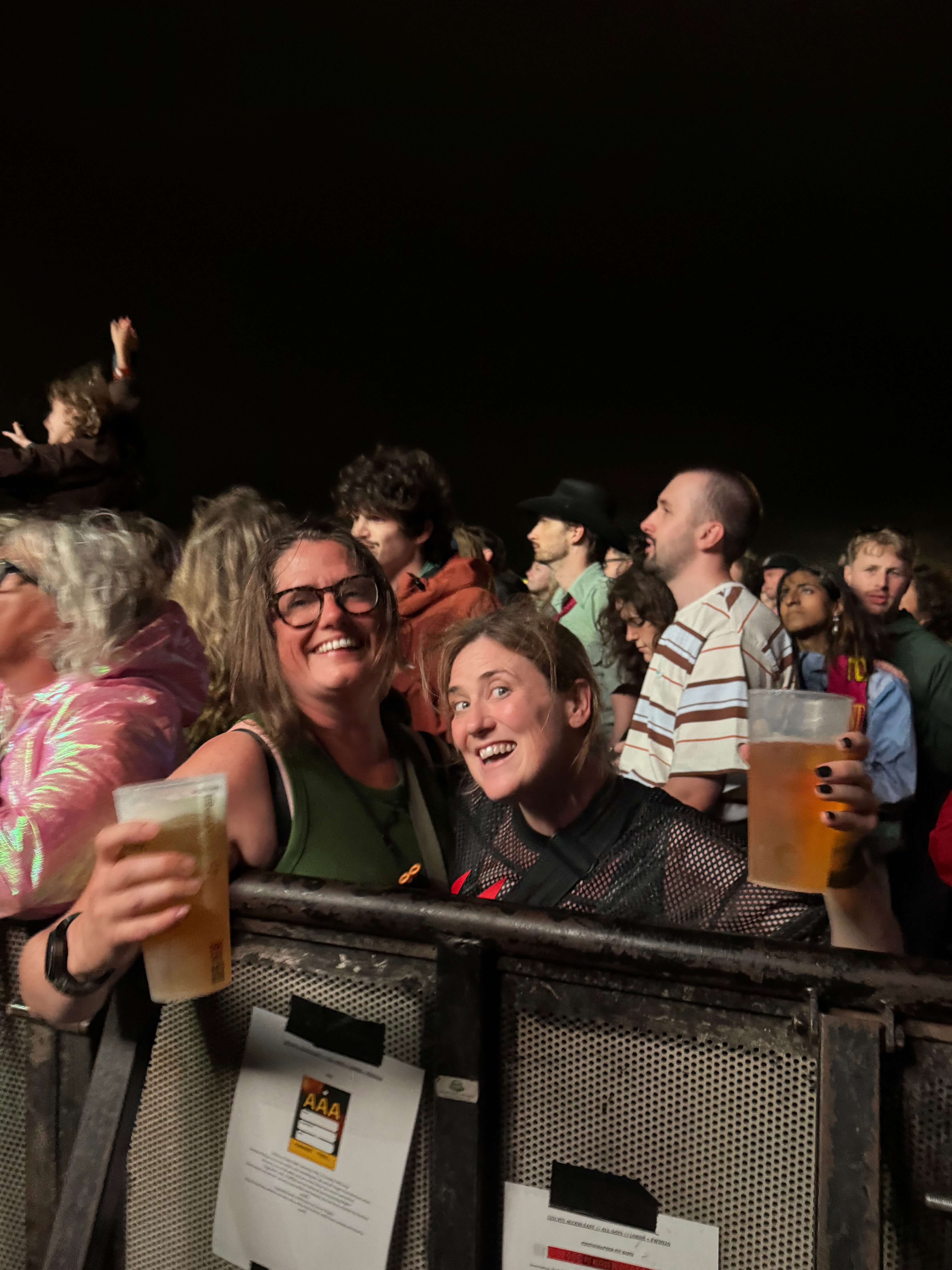
Bristol again, this time for Forwards. There is still nothing better than a weekend in a field with loud music and good friends, and at 46 I think we can safely conclude I’m not going to grow out of it.
The weather did its level best. Once you’ve accepted that you look like a drowned rat and there is no longer anything worth protecting, dancing in the rain turns out to be enormous fun.
Little Simz, Wet Leg, Self Esteem and Viagra Boys all delivered. Tricky did not: weirdly quiet, strange atmosphere, and the peculiar experience of being able to hear his backing singers perfectly while the man whose name was on the poster remained largely theoretical. Princess Nokia was simply bad.
And a Rubicon crossed. For the first time in my life, I had genuinely never heard of one of the festival headliners.
I assume this is how it begins. Next year I’ll be bringing a folding chair.
Consuming
All Dolly, all week, after the news broke on Wednesday. Veering chaotically between bluegrass, the classics and Backwoods Barbie, all bought during a lengthy Dolly phase that followed a trip to Tennessee and a pilgrimage to Dollywood.
Live your life such that when you die the praise is that unanimous.
Coverage
I wrote a piece for Reworked about the Spirit Airlines data sale, which is now the subject of a bidding war involving Google and a startup that builds AI agents to work inside simulated companies. A sentence that would have required considerably more explanation five years ago.
The argument, roughly: we spent a decade telling people to work out loud, on the understanding that persistence would work in their favour. Write things down. Share what you know. Leave a trail somebody else can follow.
What Spirit demonstrates is that the archive can outlive the conversation, the project, the team, your employment and, eventually, the company itself. And the first thing people stop writing down once they’ve noticed that isn’t the decision. It’s the messy reasoning behind it — the disagreement, uncertainty, context and half-formed thinking — which is the only part that was ever genuinely inheritable.
There’s a second half I expected to find harder to write than I did, about why that archive is worth twelve and a half million dollars.
Workplace software gets built by small young companies where twelve people talk to each other constantly, then sold to organisations with shift patterns, works councils, contractors, subsidiaries, six layers of sign-off and thirty years of documents nobody can find. The people building software for large organisations have surprisingly little evidence of what life inside one actually looks like.
Spirit’s archive isn’t a use case. It’s a world.
Which is why the sale is simultaneously creepy and entirely economically rational. Both things can be true at once, which is what makes it an argument rather than a lament.
The whole thing started as a paragraph in a weeknote a fortnight ago. I cut it because it was too much for the space it had. Turns out it was an essay.
Published
I’ve started putting essays on the site as well as these weeknotes. Weeknotes are chaotic by design – whatever happened that week, from day rates to a Dolly Parton deep dive. Some things need more room than that, and one subject at a time.
The first few are up:
- SharePoint is a box of Lego: how to choose an intranet platform SharePoint, intranet-in-a-box, standalone platform or custom build? A practical guide to choosing an intranet platform — and deciding how to decide.
- Designing channels for complex organisations Shared services, contractors and multiple affiliations break traditional channel design. A layer-by-layer approach to internal comms in complex organisations.
- Start with Discovery: how to find out what’s actually wrong with your internal comms Most organisations know something isn’t working. Far fewer can tell you what. Discovery is the distance between those two states — and the reason an audit is the wrong place to start.
Travel
This weeknote comes to you from a characterless, overpriced pub in Bristol Airport, which scores precisely nothing under the LoungeWanker rules.
Home for forty-eight hours, then back to the UK for client meetings.
The glamour of international consultancy remains largely theoretical.
This week in photos