We seem to have decided that the ultimate purpose of technological progress is to eliminate the inconvenience of being alive. Every click is one too many, every pause a productivity leak, every interaction an opportunity to shave another three seconds off the crushing administrative burden of existing. Why read a book with your own eyes when a machine can extract five key takeaways, sparing you the tedious business of encountering an argument, considering it, and perhaps even changing your mind? Why have a conversation when you can have a summary? Why experience anything at all when you could receive a concise, actionable digest of what you would have experienced, had you not been so terribly busy optimising your life?
The logical endpoint is presumably a world in which machines do all our reading, writing, thinking and talking, freeing us to devote our remaining hours to watching strangers reorganise their fridges on TikTok. Somewhere, a management consultant is preparing a slide deck explaining why this represents a 40% improvement in human flourishing.
Except some of the best things about this week were spectacularly inefficient. I travelled to an actual office to meet actual people, schlepped across the Netherlands to watch three Japanese men make an unconscionable amount of noise, and spent an evening with old friends without generating a single piece of content to prove it happened. Meanwhile, at work, I found myself arguing for deliberately making a digital experience less effortless. Not because inconvenience is inherently virtuous — anyone who’s ever tried to change a password on a government website knows otherwise — but because sometimes the bit we’re so desperate to eliminate is the bit that makes the whole thing worthwhile.
Perhaps the problem isn’t that we haven’t yet managed to make everything effortless. Perhaps it’s that we’ve become so obsessed with removing the effort that we’ve stopped asking what any of it was for.
This week at work
One client asked a question this week that sounds like a policy question but is really a design one: can I post this?
The answer we landed on fits on a Post-it. If it could go in the newsletter, it can go in the community. If it couldn’t, it can’t. No flowchart, no twelve-page acceptable use policy, no appendix clarifying whether a thumbs-up emoji constitutes formal endorsement. Just a small, well-placed moment in which someone has to stop and think about who’s going to read what they’re about to publish.
That moment is friction. And friction has had a terrible press.
Anything that slows a user down is a defect to be eliminated, preferably by a product team with a reassuringly expensive job title. Which is all very well until the thing you’ve made effortless is sending the board pack to the wrong Sarah.
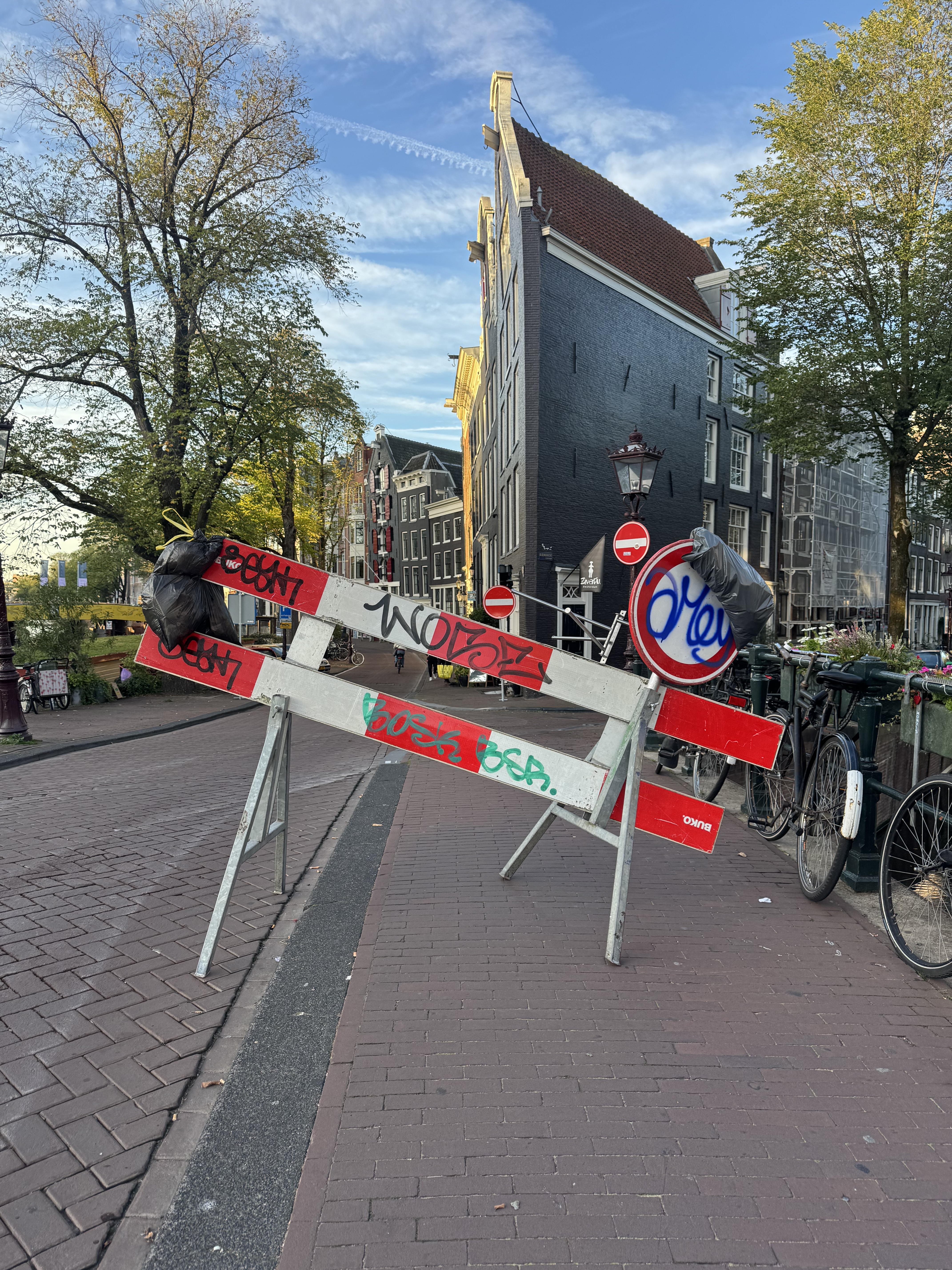
Hans Monderman, a Dutch traffic engineer, spent much of his career taking things away. In Drachten, he removed the traffic lights from the town’s busiest junction, which carried around 22,000 cars a day, and replaced them with a roundabout, a cycle path and somewhere for pedestrians to cross. By one account, crashes fell from thirty-six in the preceding four years to two in the following two. “The trouble with traffic engineers,” he said, “is that when there’s a problem with a road, they always try to add something.”
Which is a devastating assessment of several other professions I could name.
Monderman hadn’t made the road frictionless. He’d moved the friction out of the signage, which drivers had long since learned to obey without thinking, and into their heads, where it could do some useful work. Without a green light assuring you that the universe has granted you right of way, you have to look at the cyclist. The cyclist looks at you. Somebody slows down. Everybody has to acknowledge that other people exist, which is a radical proposition in traffic engineering and, increasingly, online.
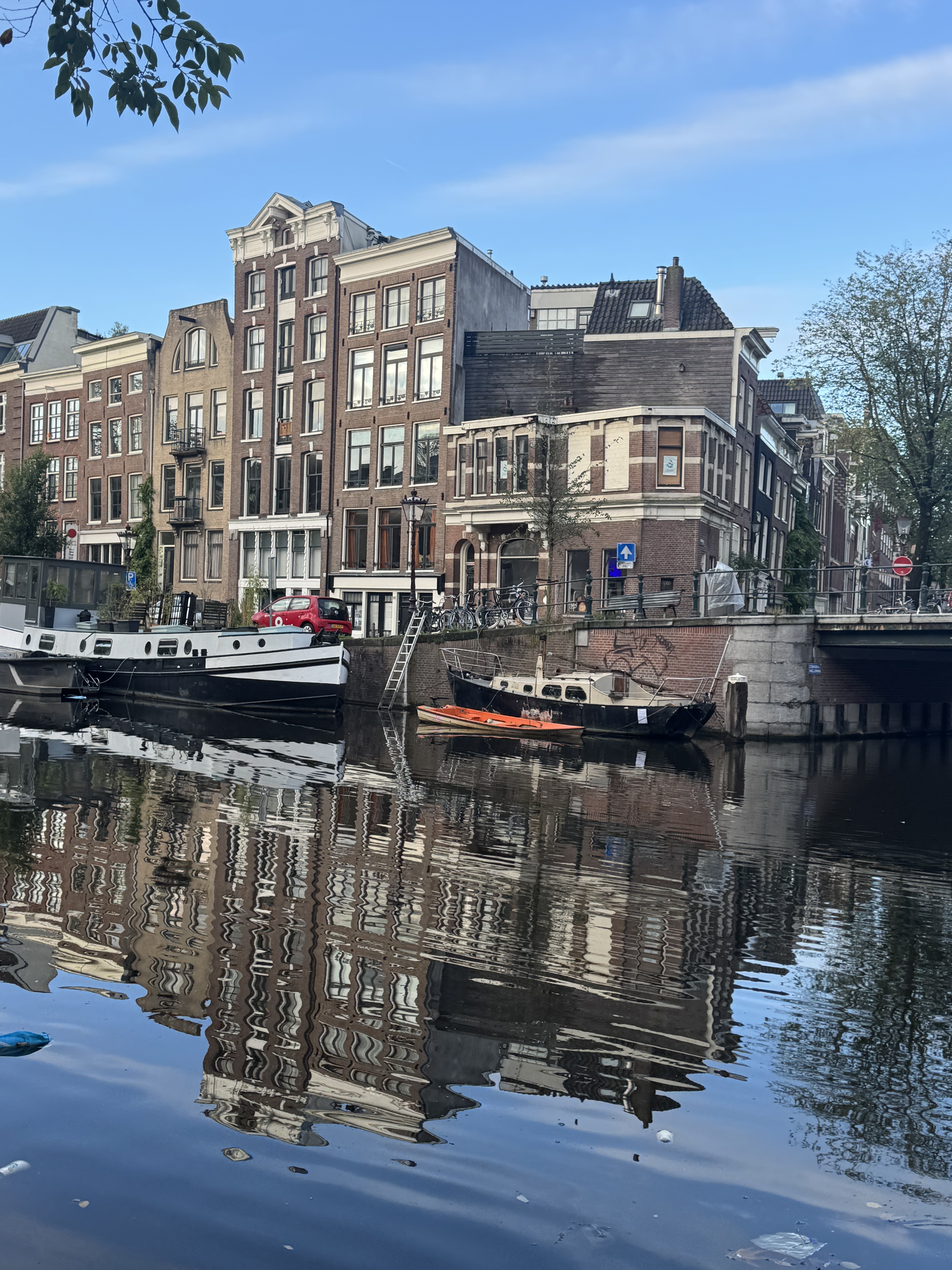
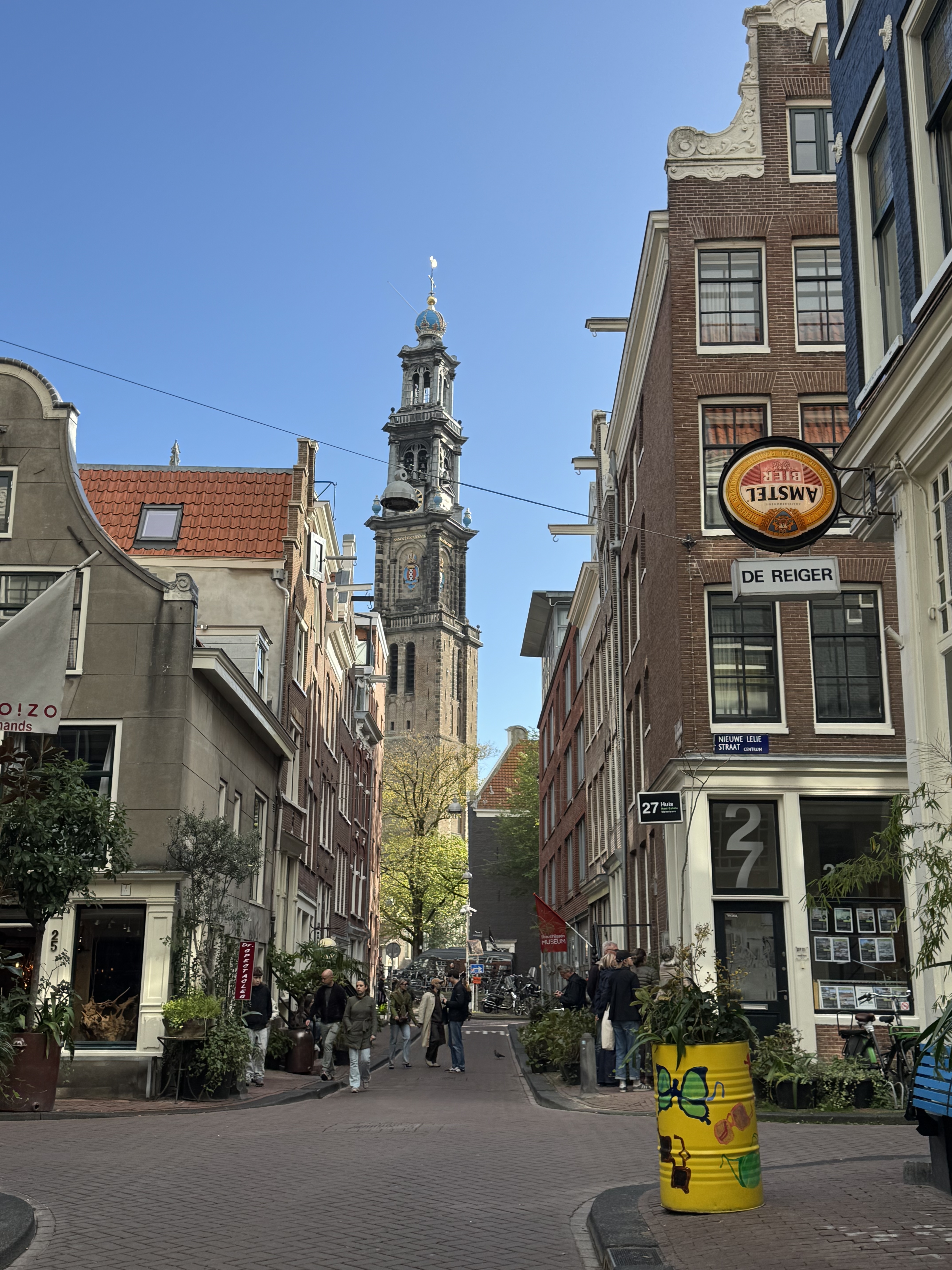
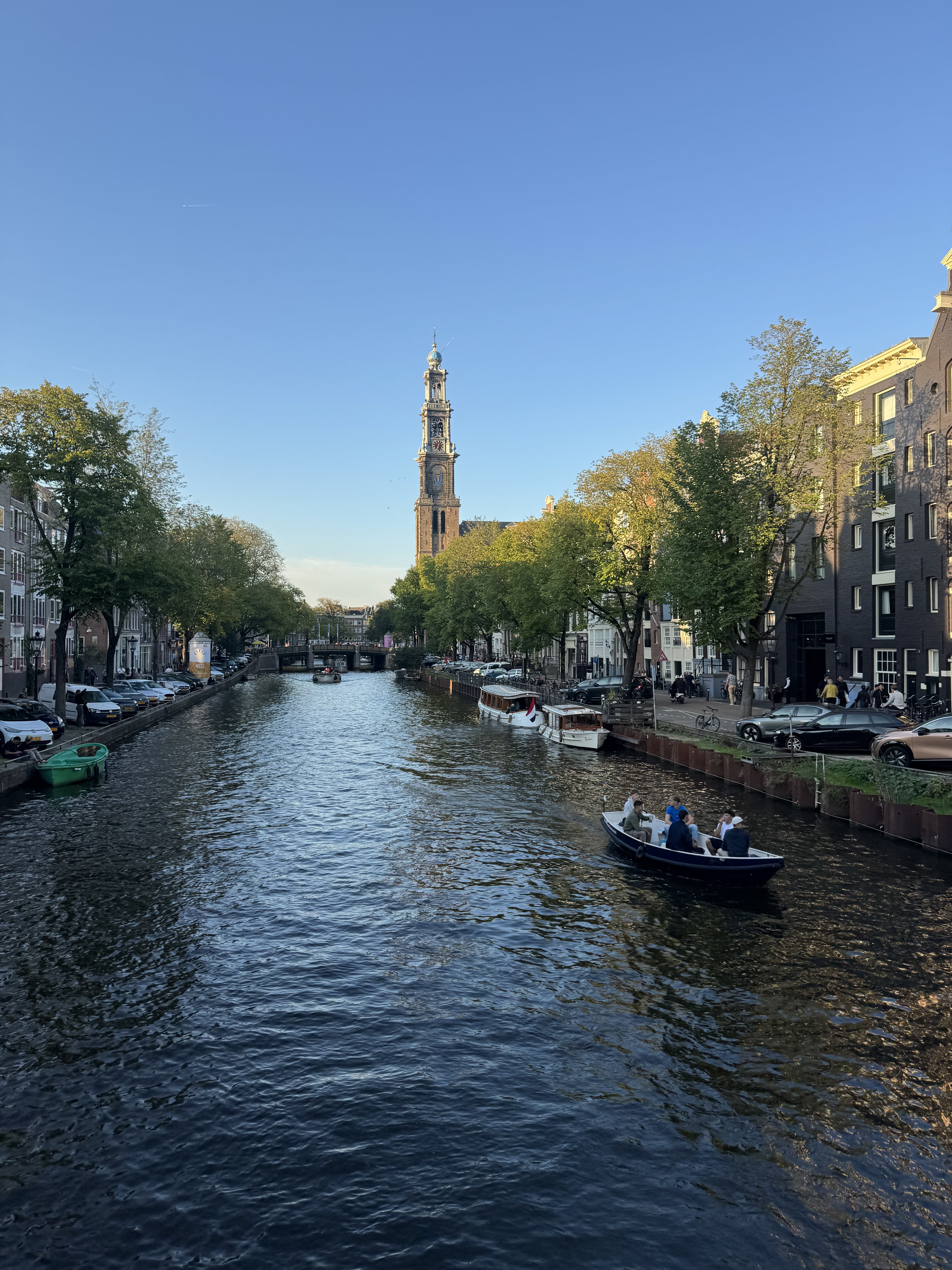
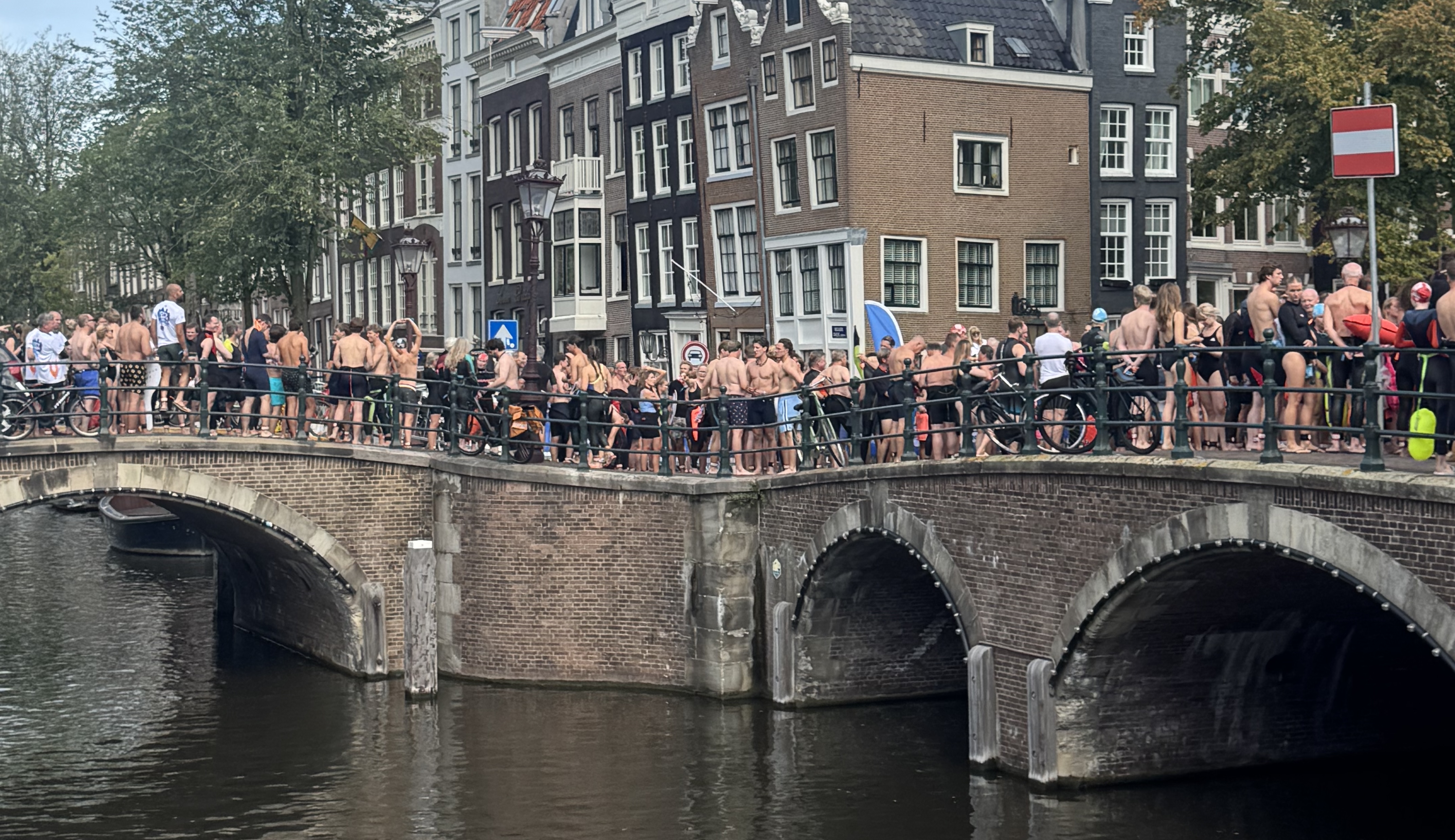
Amsterdam (where I spent an entire week, for once), offers a working demonstration of the full range. The red tarmac of a cycle lane tells you where you are without demanding anything of you. A tram bell interrupts you just long enough to prevent you stepping off the kerb into several tonnes of public transport. A speed bump on a bike path makes you reconsider your enthusiasm. The barrier at a level crossing dispenses with persuasion altogether. Cue, pause, confirm, gate. And for most of the journey, nothing, because most of the journey should be nothing.
The skill is knowing which moment deserves which intervention.
Get it wrong in one direction and you end up with the security warning: an interruption so routine that people have trained themselves to dismiss it before they’ve finished reading. In one study of more than 25 million browser warnings, users clicked straight through 70% of Chrome’s SSL warnings and around a third of Firefox’s. Same risk, different design. A useful reminder that the presence of a warning is not the same thing as the presence of thought.
Get it wrong in the other direction and people simply go somewhere else. At another client, there’s an entirely sensible push to lock down a video tool, because AI note-takers can wander into meetings unannounced, like a wedding guest nobody quite remembers inviting but who appears to be recording the speeches. The same team is wisely leaving WhatsApp alone for now, because the people who are rarely at a desk practically live in it. You can block a tool with the best of intentions, but if you’ve made someone’s job harder without giving them a workable alternative, the work doesn’t stop. It just moves somewhere you have even less control over. Congratulations: you’ve improved compliance by making the non-compliance invisible.
So perhaps frictionless was the wrong ambition all along. The goal isn’t to remove every obstacle, or to introduce a confirmation dialogue every time someone so much as looks at a button. It’s to make the ordinary things easy and the consequential things just difficult enough that someone has to engage their brain.
Monderman put it more bluntly: treat people like idiots, and they’ll behave like idiots.
An observation with applications well beyond Dutch roundabouts.
Also this week
Last week I promised an unsettling experiment in geographical continuity. The results are in: seven consecutive nights in the same bed, and the faint suspicion that I was getting away with something. No airports, no baffling hotel lighting, no trying to remember which country’s plug sockets I was dealing with. An almost indecent level of domestic stability.
I even had a face-to-face meeting with a client. In their actual office. Here in Amsterdam. I signed in at reception, acquired a visitor badge and sat in a room with other human beings, like it was 2018. Going to client offices used to be the tedious bit of consulting, an occupational hazard to be endured in exchange for the interesting work. Now it happens so rarely that I found the whole thing rather thrilling. I came away more energised than I have from any video call this year, which is perhaps something we ought to consider before commissioning another eighteen-month study into the future of hybrid work.
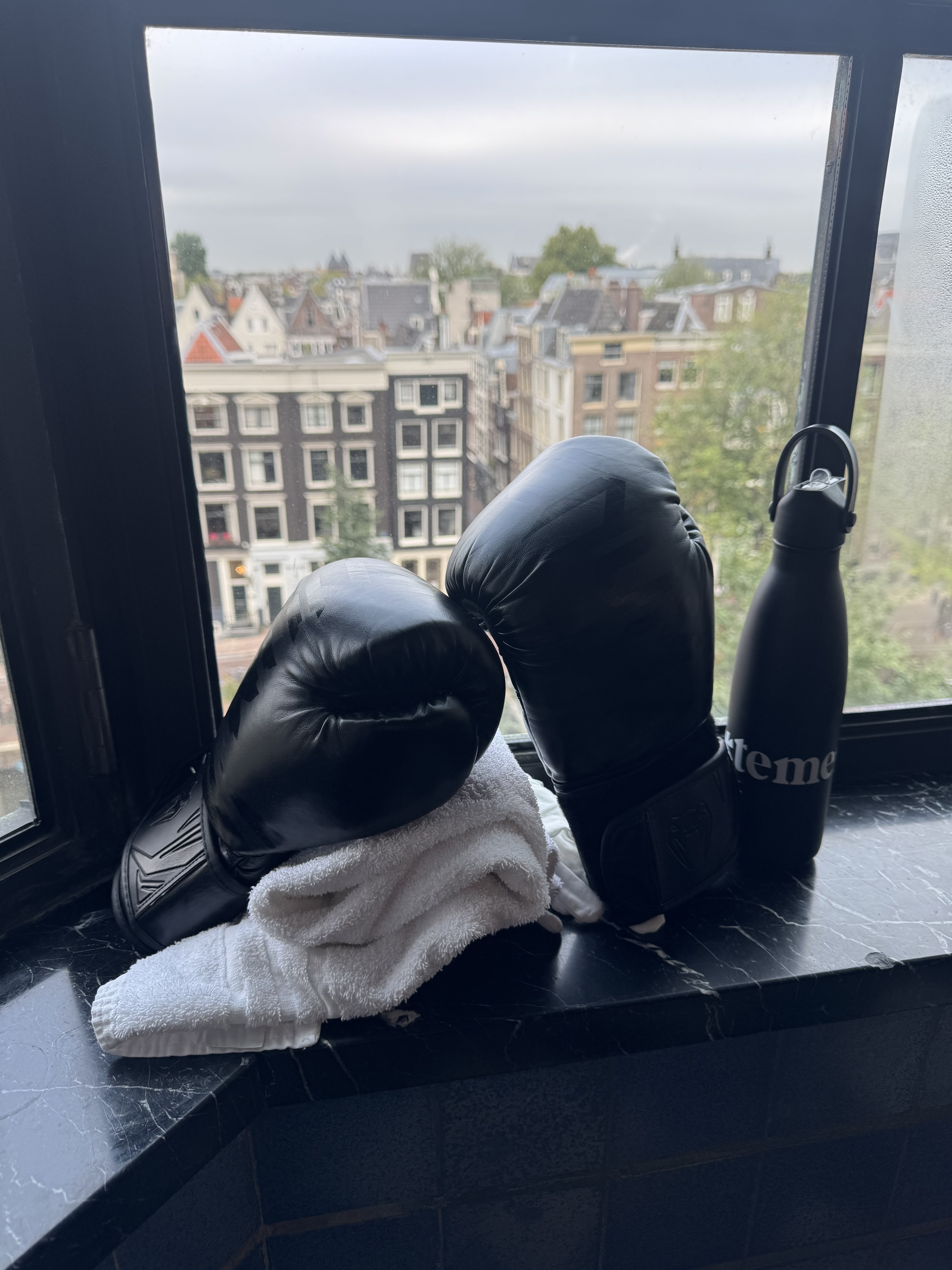
Without an airport to get to, the week filled up with the things I keep meaning to do when I’m not living out of a suitcase. I went to boxing. I went to HIIT. I bought tickets for two gigs at Paradiso in March 2027, which is either the mark of a settled, organised life or a spectacular act of optimism from someone whose travel diary routinely resembles a game of Risk. Apparently there are people who make plans five months in advance and simply expect to be in the country when the date arrives. Fascinating way to live.
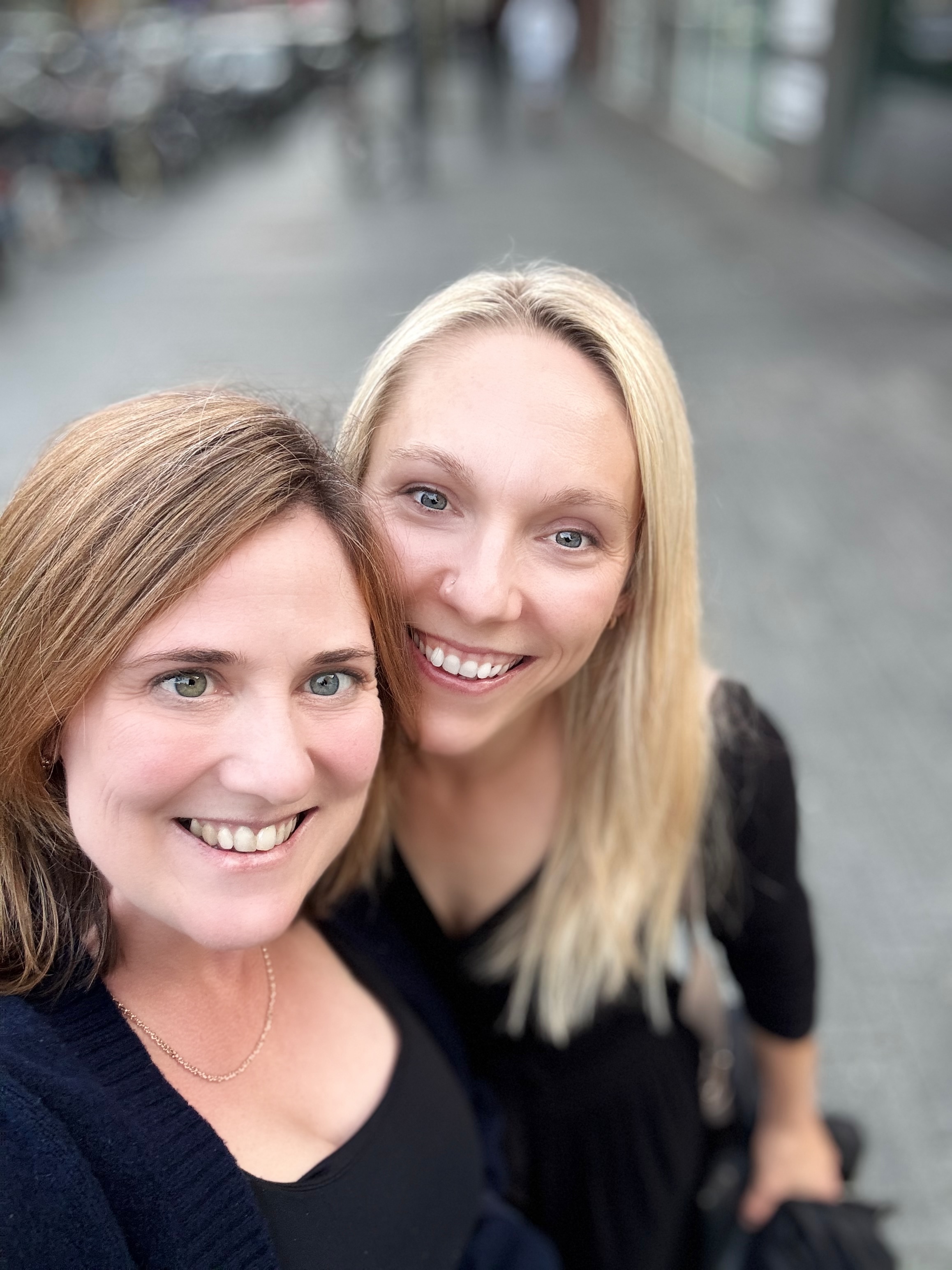
And at the weekend, my best friend Marie turned fifty.
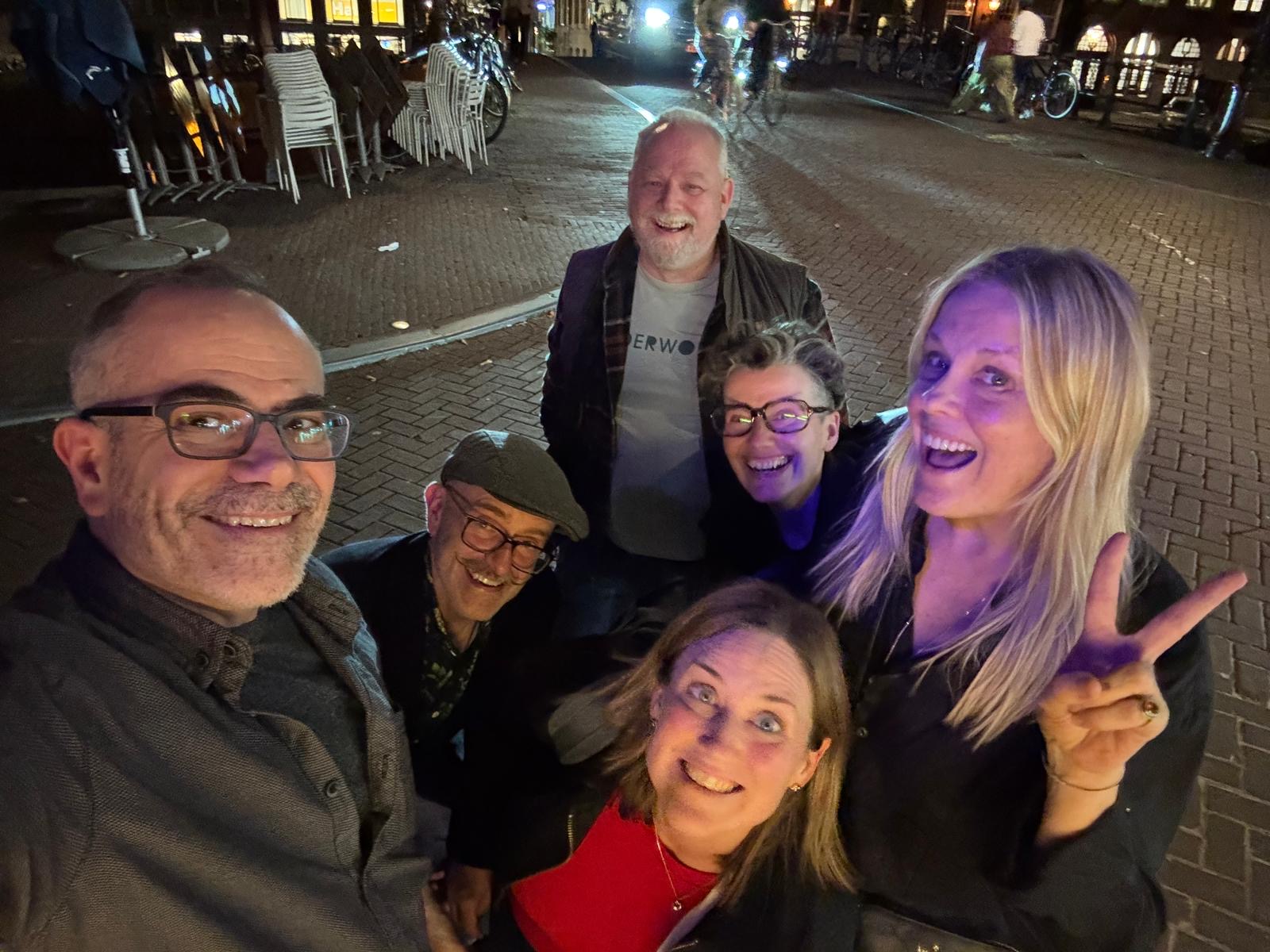
There’s something rather disconcerting about watching your friends reach their half century. Partly because I am quite certain we all turned thirty approximately five years ago, and somebody needs to explain where the intervening two decades have gone. But mostly because it’s wonderful. Here we all still are, with decades of shared history, a frankly unreasonable quantity of stories and absolutely no intention of behaving like respectable middle-aged people.
It was glorious. There are almost no photos, because we were all too busy having a lovely time. Imagine that. An entire social occasion that wasn’t organised around producing evidence of itself.
Consuming
Electric Eel Shock, Japanese garage metal, at Willem Twee in Den Bosch. On a Sunday afternoon, because the live music industry has finally discovered its most lucrative demographic: people who still want their faces melted off by loud guitars but would also quite like to be in bed at a reasonable time.
The band came on at half four. Ninety minutes of filthy riffs at a volume sufficient to rearrange your internal organs, and a drummer who still performs wearing nothing but a strategically placed sock. That’s a level of commitment to the bit most of us couldn’t sustain through a single quarterly business review, never mind an entire international touring career. I can only assume the venue’s risk assessment made for interesting reading.
And then, at six o’clock, it was over. Even after schlepping home from Den Bosch, I was on the sofa with a takeaway by quarter to eight and tucked up in bed by nine. All the joy of a proper metal gig, none of the inconvenience of being awake when the pubs close. No queuing for the night bus, no standing on a platform at midnight wondering whether the last train is a philosophical concept rather than an actual service.
Getting old is fucking brilliant.
Coverage
For UNLEASH, I wrote about AI’s latest change of name, because apparently the technology hasn’t generated quite enough confusion without somebody deciding it needs rebranding. My instinct is to roll my eyes and get on with my life, but unfortunately the people responsible for enterprise technology procurement don’t always have that luxury. My argument: name the tool, not the technology. A useful name tells people what something does. A grand one mostly tells you what somebody would like you to think of them.
Jon and I also joined the Digital Workplace Group’s Digital Workplace Impact podcast to talk about designing channels people actually use. A deceptively simple ambition which, judging by the state of the average digital workplace, remains surprisingly controversial.
Diane Coyle has published a paper arguing that as AI makes knowledge increasingly cheap to copy, relationships become the asset that matters. Meanwhile, the archive of bankrupt Spirit Airlines, including 100 million emails and 500 million Teams messages, has attracted bids from Google and an AI start-up. The accumulated detritus of working life is now a commodity, and a potentially rather valuable one.
Put those two developments together and you have an uncomfortable problem for everyone who spent the past decade encouraging employees to work out loud, share what they know and leave a useful record of their working relationships. We sold people the benefits of transparency without necessarily explaining who might eventually own the transparent bits.
The court hearing has since been pushed to 6 November, so this one has some way to run.
An organisation can own the archive. It can’t compel the candour that made it worth having.
Travel
I’m writing this on the train to Paris, which is certainly an interesting time to visit. The French are once again demonstrating their commitment to making political instability a participatory national sport, though I suppose nobody can accuse them of being indifferent.
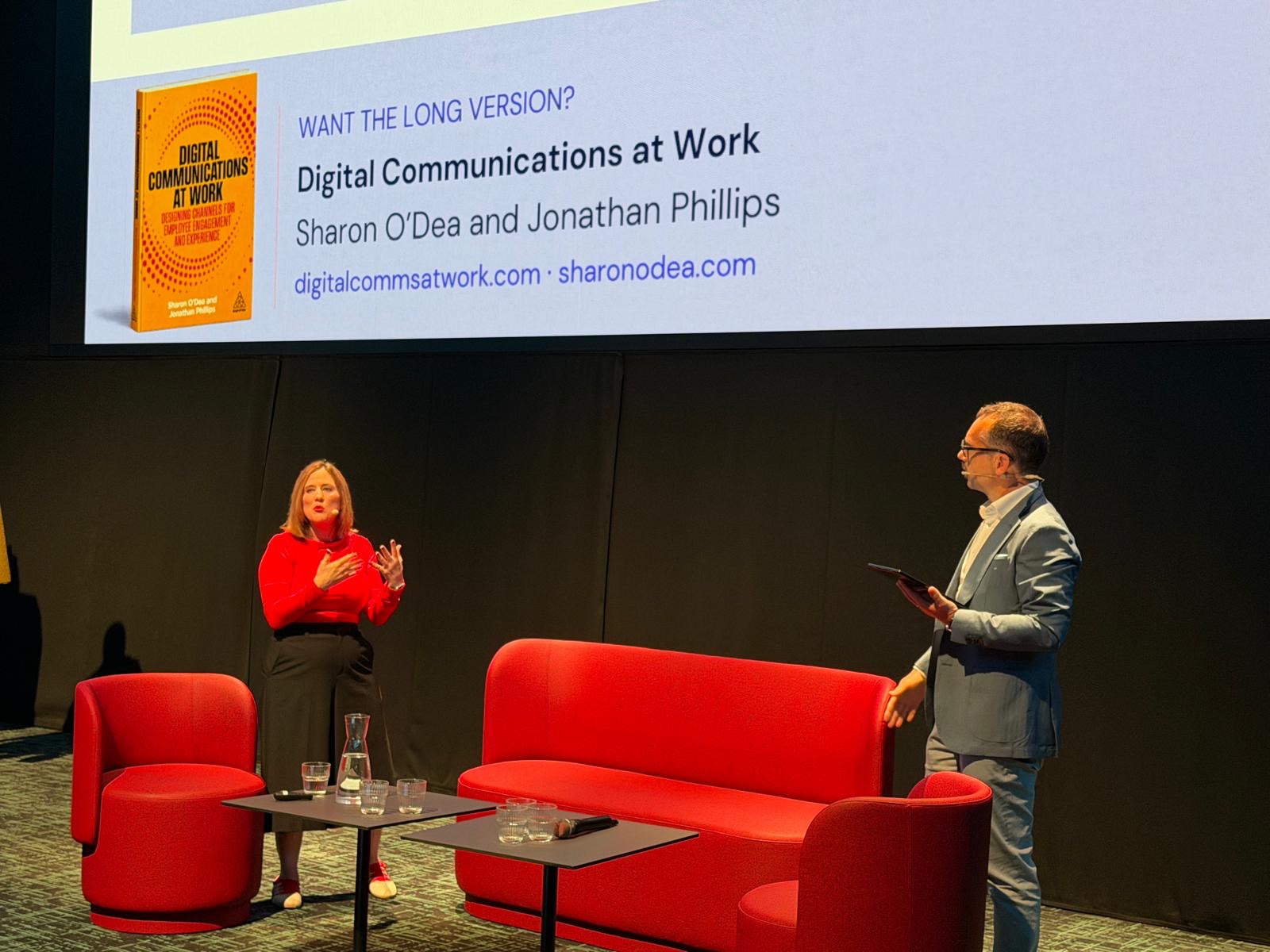
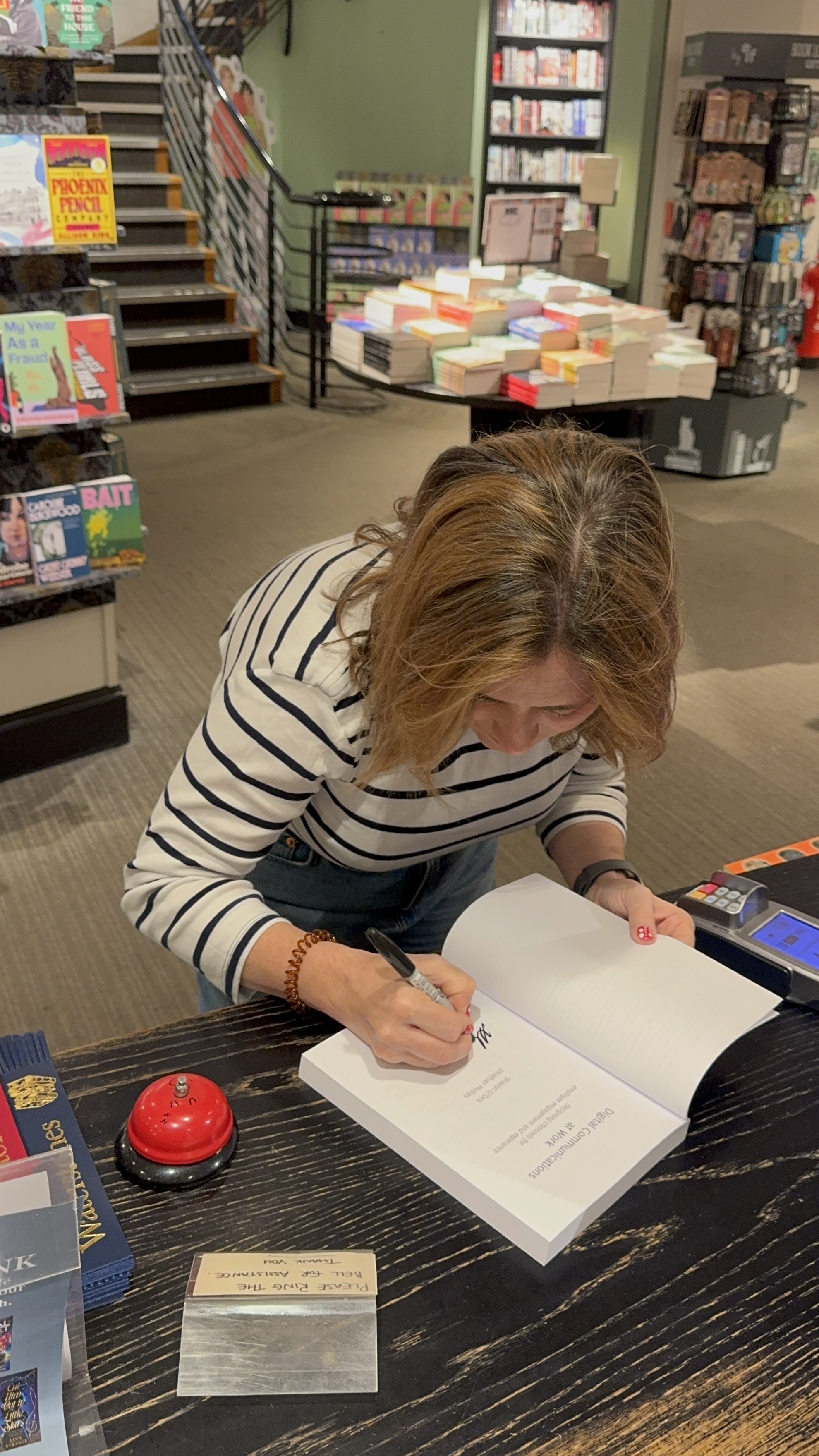
It’s People Connect Club tonight, then UNLEASH World, where I’ll be signing copies of the book with Flip. If you’re there, come and say hello. I promise not to make you discuss friction, unless you start it.
In August I wrote a piece for Reworked about the extraordinary afterlife of Spirit Airlines. The airline had gone bankrupt, leaving behind 100 million emails, 500 million Microsoft Teams messages, and the files, calendars and other records of its working life. Google bid $10 million for the archive. Then micro1, a startup building AI agents designed to work inside simulated companies, made a late offer of $12.5 million.
The airline was dead. Its employees had lost their jobs. But the corporate corpse still had a few organs worth harvesting.
My argument was that an archive holds the residue of work, not the work itself. And that you don’t need to believe the residue is valuable for it to change how people behave. You only need to believe that someone else does.
This week, Diane Coyle, Bennett Professor of Public Policy at Cambridge, published a working paper that arrives at roughly the same place from the opposite direction. I came at it from twenty years of watching people decide what to put in writing. She comes at it from the economics of intangible assets.
Coyle explains why relationships become more valuable as AI makes everything else easier to replicate. Spirit shows what happens when someone decides to strip-mine the evidence of them. And in a particularly elegant piece of economic self-sabotage, the prospect of extraction may make people rather less willing to leave anything worth mining.
Relationships are the moat
Coyle’s paper, The business of business is relationships, opens with a number most comms people will find faintly vindicating. By WIPO’s estimate, intangibles accounted for between 77% and 90% of the enterprise value of large companies in the top ten economies in 2024. Not factories, not stock. Stuff you can’t drop on your foot.
She proposes distinguishing between two kinds of intangible capital.
Knowledge capital is the codified, transferable stuff: software, data, brands, patents, designs. It can be owned, licensed, protected and sold. Its value often depends on being able to prevent other people from using it.
Organisational capital is harder to pin down. Management know-how, internal routines, the relationships that make things happen, and the vast body of knowledge about how the organisation actually works, as opposed to how someone in Transformation thinks it works after spending six months drawing boxes. It’s tacit, contextual and difficult to separate from the organisation that created it.
Her argument is that generative AI will put pressure on the value of codified knowledge while making organisational capital relatively more important.
When everyone has access to the same models, the same automation and the same ability to produce suspiciously familiar PowerPoint decks, competitive advantage has to come from somewhere else.
She models work as a chain of complementary tasks, where the weakest link determines what the whole system can achieve. Making one link spectacularly efficient doesn’t help much if the next one still involves persuading someone in Procurement to reply on Teams.
Who knows whom. Who can get something unstuck. Who understands why a particular process exists, even though nobody has documented the reason since 2014. Who you actually need to speak to in Finance.
These aren’t decorative features of organisational life. They’re part of how economic value gets created.
It’s the most rigorous economic case for internal communication and collaboration I’ve read in years. And it never once uses the phrase “internal communication”.
The afterlife of an airline
Coyle recognises that some organisational knowledge can be digitised and transferred, although much of its value depends on the context in which it was created. AI complicates that distinction because it can learn from digitally recorded activity, acquiring something that looks remarkably like tacit knowledge.
Spirit offers a rather grisly demonstration.
Google’s $10 million bid was selected at auction, although the sale still requires court approval. micro1’s higher late offer has not displaced Google as the selected buyer. And the approval hearing, originally scheduled for 14 October, has now been postponed until 6 November, following objections about employee privacy.
In a letter to Spirit and Google, 121 US lawmakers warned that removing names and other direct identifiers might not be enough to prevent individuals being identified from the records. Unions have also challenged the proposed transfer. Google says personal information will be excluded or de-identified by an independent third party before it receives the data.
There is a particularly revealing distinction in the proceedings. A court-appointed privacy ombudsman has recommended approval following additional safeguards for consumers. Employee privacy, however, fell outside the scope of the assessment.
The passengers have a privacy assessment. The people whose conversations helped run the airline are still fighting over what happens to theirs.
The hearing has been delayed, but the commercial proposition remains: records of an organisation’s working life have attracted substantial bids from companies interested in what AI might learn from them.
That doesn’t mean Spirit’s organisational capital was worth $12.5 million. It means a bidder believed it could extract that much value from the records. Those are different calculations.
An archive might tell you that everyone went to Jane in Finance whenever a procurement decision got complicated. It can’t necessarily tell you why. Was Jane the expert, the person with authority, the person everyone trusted, or simply the only human being who knew how to make SAP behave?
A model might learn to reproduce the pattern without understanding what made it work. Which, come to think of it, is a reasonable description of several corporate reorganisations I’ve witnessed.
This is the distinction that matters. The relationships were valuable because they enabled people to do things together. The records may be valuable because they allow a machine to simulate how those people behaved.
Relational value, recorded value and extractable value are not the same thing. But they overlap, and AI is making the boundaries between them commercially interesting.
The Enron email archive has been used by researchers for more than two decades. The idea that old workplace communications might be useful to outsiders isn’t new. What Spirit makes unusually visible is the market price attached to those communications, and the question of who gets to decide what happens to them.
Which is a problem for everyone who has spent the last decade persuading employees to put more of their working lives into the record.
The bit that goes first
In my Reworked piece I argued that when people suspect their words might become someone else’s asset, the first thing they stop writing down isn’t the decision. It’s the reasoning.
The trade-off. The reservation. The objection that got overruled. The explanation of why an apparently sensible proposal was rejected because somebody tried it three years ago and the results were catastrophic.
You end up with immaculate archives of decisions, stripped of every doubt, disagreement and inconvenient fact that might explain how anyone arrived at them. A corporate memory consisting entirely of the minutes, with none of the meeting.
Read through Coyle’s framework, this is more than a records-management problem. The reasoning is part of what allows organisational knowledge to survive beyond the people who originally developed it.
And when people stop recording it, the reasoning doesn’t necessarily disappear. It goes back into phone calls, coffees, private messages and the heads of people who happened to be in the room. Which is fine until one of them leaves, another gets promoted, and a third decides they’ve explained the same thing to six successive managers and can no longer be bothered.
What disappears is the organisation’s ability to inherit that knowledge.
Access becomes a matter of proximity again: who you know, which meetings you’re invited to, whether you happen to sit next to the person who remembers why the policy says something apparently insane.
Digital working was supposed to make that knowledge more widely available. Instead, we risk rebuilding the old hierarchy with better software.
And there’s a nasty feedback loop here. The more organisations try to extract value from the records of work, the more reasons employees have to keep the interesting parts of work off the record. The archive becomes cleaner, the organisation becomes less capable of learning from itself, and everyone congratulates themselves on their information governance.
Of course, this isn’t an argument for recording everything. Quite the opposite. A permanent, searchable record of every workplace conversation would be an extraordinary resource, provided your ambition is to create the world’s most comprehensive database of things people wish they hadn’t said.
People need room to think aloud, change their minds, disagree and occasionally say something stupid without wondering whether it will become training material for a future product.
The challenge is to preserve the knowledge organisations genuinely need without treating every interaction as something to be harvested.
That requires judgement about what gets recorded, why, for how long and for whose benefit. Not merely another exhortation to work out loud.
Measuring the wrong thing
Coyle ends with a measurement agenda, because economists, like comms professionals, have an unfortunate tendency to want numbers for things that resist being counted.
Her proposed indicators of organisational capital include organisational structures, management practices, employee ratings and investment in technology. They’re a starting point for research, not a definitive framework, and she acknowledges the difficulty of measuring something so contextual.
The trouble with proxies is that they’re wonderfully easy to count, which makes it tempting to forget what you were trying to measure in the first place.
An organogram can tell you how many layers separate the CEO from the warehouse floor. It can’t tell you whether anyone on the warehouse floor trusts a word the CEO says.
We have more sophisticated instruments in the digital workplace: collaboration patterns, organisational network analysis, employee listening. But these have their own limitations. A Teams graph can show you who talks to whom. It can’t tell you whether they’re collaborating brilliantly or engaged in a six-month argument about who owns the spreadsheet.
Interaction isn’t necessarily collaboration. Activity isn’t necessarily value. And a record of communication isn’t necessarily a record of what mattered.
There’s another complication. Measurement changes behaviour, particularly when the people being measured know that their conversations might be analysed, retained or repurposed.
If people become more guarded about what they write, the resulting data may still look comprehensive. There will be messages, meetings, documents and beautifully coloured network diagrams. But the record will increasingly reflect what people are prepared to make visible, rather than how the organisation actually works.
The instrument isn’t necessarily broken. The behaviour it’s observing has changed.
That matters because we are increasingly tempted to treat digital traces as a complete representation of organisational life. AI makes it possible to analyse them at a scale that would have been unimaginable a few years ago. It doesn’t make them a neutral or complete account of reality.
And the more commercial value we attach to those traces, the less neutral the process of producing them becomes.
Who owns the residue?
There’s another question running through Coyle’s paper that Spirit brings into focus: who benefits from organisational capital?
Among the relationships she expects to become more important are those between employers and employees, including the negotiation over how productivity gains from AI are shared.
It’s a pleasingly civilised arrangement, assuming the employees still have jobs, somebody has invited them to the negotiating table, and the table hasn’t already been sold to Google.
At Spirit, the people who produced the archive are no longer working for the airline. The proposed transaction is being negotiated through bankruptcy proceedings, with the potential proceeds forming part of the estate. The people whose conversations make up the archive don’t individually control its sale, and there’s no reason to assume they will personally benefit from the value their records might create for an AI company.
Organisational capital is collectively produced, but the rights to its digital remains are not necessarily collectively held.
This isn’t entirely new. Employers have long controlled substantial amounts of the information produced in the course of work. What has changed is the range of things that information might be used for, and therefore what someone else might be prepared to pay for it.
Spirit makes that imbalance unusually visible. And the privacy objections demonstrate that ownership of an archive does not automatically settle the question of what may lawfully or legitimately be done with everything inside it.
For anyone running internal comms or a digital workplace, this creates an awkward problem.
We’ve spent years trying to persuade people to share what they know, explain their decisions and make work visible. We did so because organisations lose an enormous amount of knowledge when everything happens in private conversations and the heads of people who eventually leave.
We weren’t wrong about that. But we built the systems on an assumption that now looks increasingly quaint: that the record of working life would remain primarily useful to the people doing the work.
So the answer cannot simply be better transparency about retention policies. Telling employees that their conversations might one day be sold to train AI models is admirably candid. It is not necessarily going to encourage them to keep talking.
We need to make deliberate choices about which knowledge deserves a lasting record, how long informal communications should survive, what secondary uses are acceptable, and what meaningful limits apply to the exploitation of workplace data.
Trust isn’t something you can retrofit with an engagement campaign after you’ve designed a system that gives people every reason to keep their mouths shut.
Just because storage is cheap and someone in IT thinks the archive might be useful to an AI model in 2031 doesn’t mean every half-formed thought deserves to be preserved for posterity.
We also need to recognise that employees have legitimate interests in what happens to the records of their working lives, even when those records sit on corporate systems.
Coyle makes a compelling economic case that relationships will become more valuable as AI commoditises knowledge. Spirit shows that the digital remains of those relationships may have a quite separate commercial value. And the people creating both are beginning to notice.
The challenge now isn’t simply to persuade employees to write more things down. It’s to give them good reasons to believe that doing so won’t eventually be used against them, or turned into somebody else’s product.
Because an organisation can own the archive. It can’t compel the candour that made it worth having.
Around 80% of the world’s workers don’t sit at a desk. That’s roughly 2.7 billion people, per Emergence Capital’s much-quoted estimate. They drive, build, nurse, serve, stack, fix and deliver.
And yet almost everything we call “internal communication” was designed for the other 20%. The intranet, the all-staff email, the leadership video, the Teams post: each assumes a screen, a login, a reliable connection and a working day with a few spare minutes in it.
We then describe the majority of the workforce as “hard to reach”, as though the problem were their working conditions rather than our design choices. The workers themselves have noticed: in Microsoft’s survey of 9,600 frontline employees, 63% said messages from leadership simply don’t reach them.
There’s a particular kind of organisational optimism that believes this can be fixed with another bit of tech.
Frontline employees aren’t reading the intranet? Give them an app. They’re not opening emails? Push notifications. They’re not engaging with leadership messages? Perhaps some gamification. A leaderboard, possibly. Everyone loves a leaderboard, particularly when they’re finishing a twelve-hour shift.
The frontline communication problem isn’t really a frontline problem, it’s a design problem. Specifically, we’ve designed communication around the convenience of the sender rather than the circumstances of the person expected to receive it. And the sender, almost without exception, sits at a desk.
It’s a pattern Jonathan Phillips and I kept running into while writing Digital Communications at Work, in hospitals, retailers, charities and manufacturers alike. The sector changes. The assumption doesn’t.
The desk is doing more work than you think
Most internal communication practices carry a set of assumptions that are so deeply embedded we barely notice them.
Employees have an email address. They have a device on which they can access comms. They can check messages during the working day. They can follow a link to the intranet, answer riddles three to authenticate, sacrifice a goat to the god of multifactor authentication, and spend a few minutes reading something that mattered enormously to the person who commissioned it.
For many office workers, these assumptions are broadly reasonable. Even if they don’t always have the inclination to read the latest leadership update, they have the ability to do so.
Now consider someone driving a bus, serving customers, working on a production line or halfway through a hospital shift.
“Check the intranet” is not a neutral request. Neither is “we sent an email”.
Both make assumptions about the employee’s device, access, connectivity, attention and, crucially, who gets to decide what they do with the next five minutes of their working day.
An office worker can usually glance at a notification between meetings. A nurse cannot necessarily interrupt a medication round because Corporate Communications has published an exciting update about the organisation’s strategic priorities.
And this isn’t simply a question of access. It’s also about what people actually need to get their jobs done.
The employee on the production line may need to know that a safety procedure has changed, that tomorrow’s shift starts earlier or that a particular piece of equipment is out of service. They may be less interested in a video of the CEO discussing the organisation’s transformation journey, however handsomely produced.
That doesn’t mean they are disengaged. It could just mean they’ve correctly identified which information is useful to them.
Utility, like beauty, is in the eye of the beholder. And we’re often too happy to mistake our own priorities for everyone else’s needs.
An employee app solves access, not opportunity
The employee app market has done a good job of recognising that traditional corporate channels don’t work equally well for everyone.
Mobile access can be transformative. It can put shift information, payslips, policies, operational updates and support services into people’s hands without requiring a desk or corporate laptop. For employees who previously relied on printed notices or information passed down through managers, that’s a genuine improvement.
But there’s a difference between making communication technically accessible and making it practically usable. In the same Microsoft research, a third of frontline workers said they lacked the tools to do their jobs, rising to 41% among those without management responsibilities, and more than half had been handed new digital tools with no training at all. The access problem hasn’t been solved, it’s just been handed to the employee.
You can give a warehouse employee an app. You cannot assume they are allowed to take out their phone while operating machinery. You can send a notification to a retail worker. You cannot assume they can read it while serving a customer. You can publish a beautifully accessible article for a care worker. You cannot conjure up ten spare minutes in an already overstretched shift.
An app can put information in someone’s pocket. It cannot put five spare minutes in their shift. So an app only succeeds if it’s designed for the ninety seconds someone actually has between tasks, not the fifteen minutes we wish they had.
This distinction gets lost when organisations measure the success of frontline communication primarily through downloads, registrations and monthly active users.
As we say in the book, there is no ROI in launch. It’s all in sustained adoption and use, and use only pays off when it helps people do something. So the question isn’t how many people have the app, but whether they can find what they need, at the moment they need it, in a form they can use. That changes what you measure. How long does it take someone to find tomorrow’s shift pattern? How many “where do I find…” questions still land on supervisors? Did the safety update reach people before the shift it applied to?
A million app downloads would be a magnificent achievement… unless the million people who downloaded it still have to ask their supervisor where to find things.
Those are useful measures of whether the technology is being adopted. They tell you somewhat less about whether employees can access the information they need, at the moment they need it, in a form they can use. It’s the distinction we draw in the book between outputs and outcomes. Downloads tell you whether people have adopted the technology. Outcomes tell you whether it’s made their working lives any easier.
A million app downloads would be a magnificent achievement… unless the million people who downloaded it still have to ask their supervisor where to find things.
Stop confusing communication about work with communication that helps people work
In Digital Communications at Work, Jonathan and I distinguish between broadcast communication and communication aligned with the work people actually do. We separate news from operational and reference content, because each has a different purpose, a different audience and a different lifecycle, and treating them as one undifferentiated stream serves none of them well.
Both have a place. Employees need to understand their organisation, its direction and the decisions that affect them. But they also need information that helps them complete a task, solve a problem, make a decision or respond to something happening right now.
Corporate communication tends to be organised around the former. Frontline employees often have much more immediate needs relating to the latter.
We have reached the peculiar point where an organisation can burn electricity, consume water and summon the full might of generative AI to ensure a warehouse worker receives a hyper-personalised video of the CEO explaining the company’s purpose, while remaining apparently unable to tell that same worker whether they’re on the early shift tomorrow.
The answer isn’t to abandon organisational communication. It’s to recognise that communication which helps people do their jobs can be an important foundation for everything else. A channel that reliably solves real problems earns a place in someone’s working day. A channel that primarily creates additional demands on their attention has a harder case to make.
Means, motive and opportunity: the Fletcher Test
In Digital Communications at Work, Jonathan and I introduce the Fletcher Test, borrowing the detective-story formula of means, motive and opportunity to ask three questions about any piece of communication.
Does someone have the means to receive it? A motive to engage with it? And an opportunity to do so within the reality of their working day?
Frontline communication is where the distinction becomes particularly important. Organisations have a habit of treating the first question as though answering it automatically settles the other two.
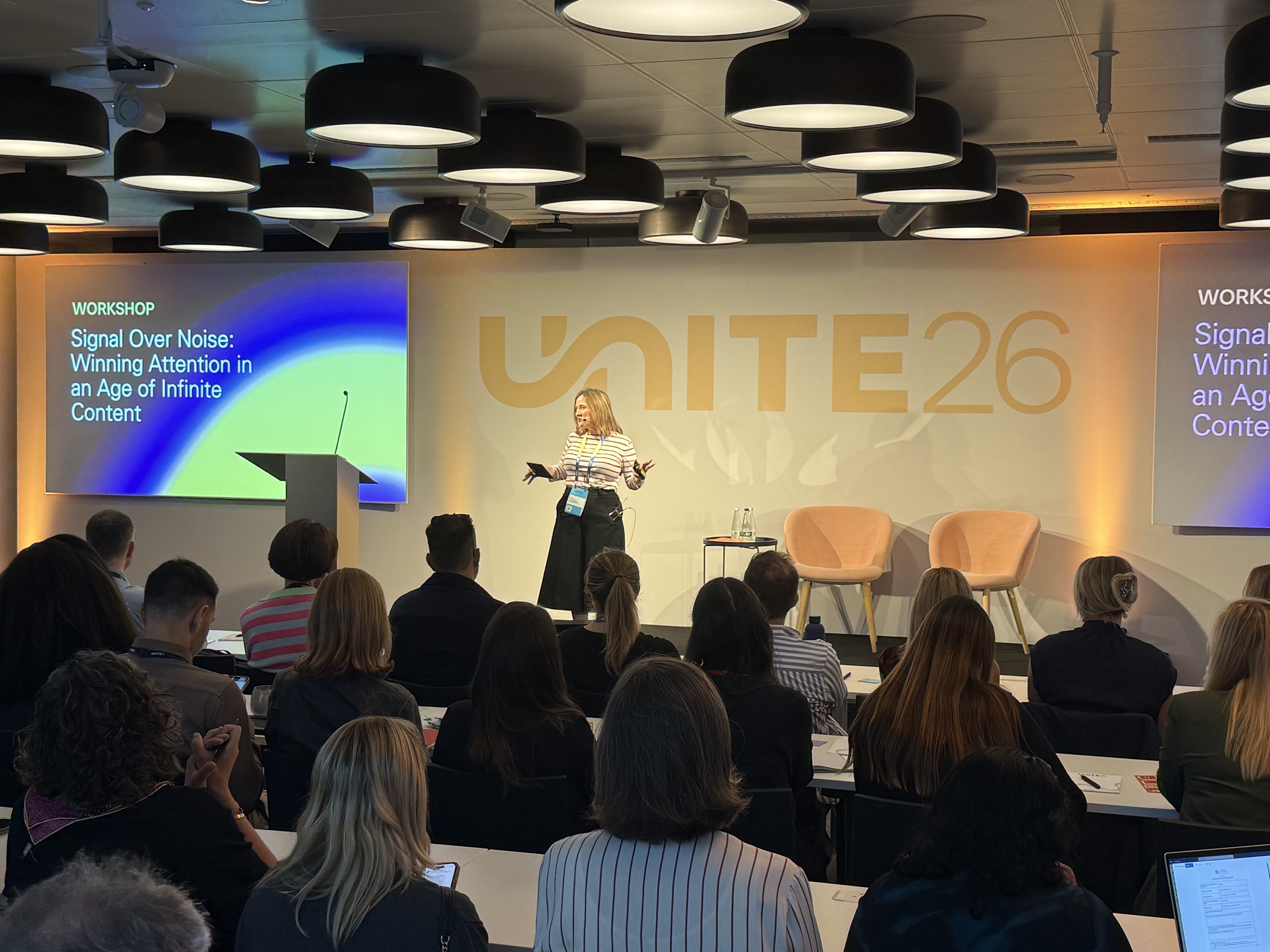
At Unily Unite recently, we put the test to work with more than 100 communications and digital workplace professionals. We gave them a fictional organisation, a week’s worth of internal communications and employee personas ranging from lorry drivers to head-office finance staff. Their job was to judge each message from the employee’s perspective, not the sender’s.
Does this person have access to the channel? Do they have the right device, permissions, connectivity and language support? Can they authenticate without navigating a sequence of systems designed for someone sitting in front of a company laptop?
And does the format work in their environment?
A long article may be appropriate for someone who spends much of their day reading documents. It’s considerably less useful to someone who needs a short operational instruction between tasks.
Means is where technology can make a real difference. But it requires an understanding of the working environment before choosing the technology.
Motive: why would they care?
This is the question communicators sometimes find uncomfortable.
Not “why does the organisation want them to know this?” but “what reason does this employee have to engage with it?”
Those are not necessarily the same thing.
An update to a safety procedure has an obvious connection to someone’s work. A change to shift arrangements may affect their pay, childcare or journey home. Information about a new employee benefit may have direct personal value.
The announcement that the organisation has launched a refreshed set of corporate values may be very important to the people who spent six months developing them. Whether it deserves three minutes of a warehouse worker’s attention is another question. Particularly if the warehouse worker wasn’t consulted about the values, doesn’t recognise them in their own experience of the organisation, and has rather more pressing concerns about next week’s rota.
And motive is shaped by more than the message itself. It’s shaped by the relationship between the employee and the organisation.
In the UK alone, 1.2 million people are on zero-hours contracts, close to the highest figure on record, and over half a million of them are under 25. Asking people in that position to demonstrate commitment to an organisation that has gone to considerable lengths to avoid committing to them is quite an ask. Particularly when the proposed solution is a push notification about company values.
This doesn’t mean every communication must offer an immediate personal benefit. Organisations have legitimate reasons to explain their strategy, culture and decisions. Employees also deserve to understand the wider business they are part of.
But attention isn’t something an organisation is automatically entitled to because it pays someone’s wages. And if the employment relationship gives people little reason to trust what they’re being told, no amount of channel optimisation will manufacture that trust.
We should be able to articulate why a particular audience needs a particular message, rather than assuming that because it matters to the sender it must matter equally to everyone else.
Opportunity: is there a realistic moment when they can engage?
This is the one I think we neglect most.
Even when someone has access to a channel and a decent reason to care, there must be an opportunity to encounter and act on the information.
That might mean building communication into shift handovers, team briefings, existing operational routines or the systems employees already use to do their jobs. It might mean providing paid time to complete essential training or read important updates. It might mean recognising that some information is best communicated by a manager in person, while other information should be available on demand.
And it might mean deciding that a message doesn’t need to be sent at all. As we put it in the book, the most powerful distribution decision is often not sending.
This is the awkward part of the exercise. Communications teams are usually asked to improve reach, increase engagement and make messages more compelling. Much less often are they given permission to question whether the communication deserves to exist in the first place.
Yet attention is a finite resource, and frontline employees have particularly little discretion over how they spend theirs.
If you’re asking someone to stop doing the job they’re paid to do so they can consume something you’ve been paid to produce, the burden of proof is very much on you.
Stop treating frontline employees as one audience
There’s another problem with the phrase “frontline workforce”: it describes a relationship to the organisation, not a coherent set of information needs. And given it covers most of the working population, it’s a remarkably unhelpful one.
A brain surgeon and the person cleaning the operating theatre are both frontline workers. So are an airline pilot bringing 300 people into Heathrow, the bloke delivering your Ocado order, the woman checking tickets on the 7.42 to Waterloo and the person trying to persuade a drunk man to leave Wetherspoons. Their working lives have almost nothing in common, beyond the fact that none of them spends the day sitting in head office being invited to webinars about employee engagement.
They differ in what they need to know, how often it changes and what happens if they don’t know it. They differ in skills, expectations and digital confidence. They differ in the devices they’re issued (or not issued), and in how much say they have over their own time.
And they differ in their relationship with the organisation, even when they work in the same building.
Take the surgeon and the cleaner. One may be a permanent employee with considerable professional autonomy, access to clinical systems and a well-established relationship with the hospital. The other may work for an outsourced facilities contractor, on a different set of systems, with different reporting lines and little access to the organisation’s internal channels. They may work on the same ward, encounter the same patients and be affected by the same operational decisions, yet belong to entirely different information ecosystems.
This is all extremely pertinent when you’re designing communication. Who is responsible for telling the cleaner that a ward has closed? Does the hospital communicate directly with them, or through the contractor? Can they access the relevant information without a hospital login? And if the answer is that their supervisor will tell them, what happens when that supervisor is off sick?
The surgeon needs the safety alert before the operating list starts. The cleaner needs to know which areas require enhanced infection-control procedures before beginning their shift. Both are operationally important. Neither is particularly well served by a generic weekly newsletter announcing that the hospital is delighted to unveil its new strategic vision.
Some frontline workers operate alone. Others are constantly surrounded by colleagues. Some work predictable shifts in one location; others move between sites or spend their days travelling. Some will download an app the moment they’re asked; others haven’t been issued an email address, let alone a login.
The opportunities to communicate are different. So are the consequences of getting it wrong.
A retail worker might receive information through a daily team briefing. A field engineer might need an update integrated into the job-management system. A driver might need something available at a depot or during a scheduled break.
Treating all of them as a single audience because they don’t sit at desks is about as useful as treating everyone who does sit at a desk as having identical needs. Nobody writes a communication strategy for “people with chairs”.
The distinction between desk-based and deskless work matters, but it is only the beginning of segmentation.
Good communication design starts with the work: what people do, where they do it, which systems they use, who they interact with, who actually employs them, how much control they have over their day and what information helps them make decisions.
Only then should we start discussing channels.
Your managers are not a free distribution network
When digital channels struggle to reach frontline employees, organisations often fall back on managers.
“Cascade this to your teams.” Corporate shorthand for making someone else responsible for the bit where communication has to work.
Managers are expected to receive corporate messages, interpret them, decide what matters, translate them into something meaningful for their teams and deliver them consistently, usually alongside the small matter of running the operation.
This assumes a great deal about the people we’ve made managers. Many got there because they were excellent at their previous jobs. The best engineer became the engineering manager. The most experienced nurse became the ward manager. The person who could keep a warehouse running through a minor apocalypse was rewarded with responsibility for twenty other people. Whether any of them could lead, coach or communicate effectively was sometimes a secondary consideration, if it was considered at all.
Some turn out to be excellent managers. Others are indifferent, inept or actively dreadful. Plenty have never received meaningful management training. Yet we construct elaborate communication cascades on the assumption that every one of them possesses the judgement, confidence and interpersonal skills to translate corporate strategy into something useful for their teams. This seems an optimistic foundation on which to build anything, let alone an organisation’s primary means of reaching its workforce.
Even the good ones are stretched. Gartner puts it bluntly: the average manager has 51% more responsibilities than they can effectively handle. And in Microsoft’s frontline survey, 69% of frontline managers said their own leaders don’t communicate with them effectively, which rather undermines the idea of the cascade before it has started. Information is expected to flow effortlessly down a management hierarchy in which the people halfway down don’t know what’s going on either.
Managers can be an exceptionally effective communication channel because they provide something an app cannot: context, interpretation and the opportunity for a conversation. A good manager can explain what a decision means locally, answer questions and spot confusion before it becomes a problem.
But that is precisely why they should not be treated as human forwarding services. In Digital Communications at Work, we treat managers as a channel with its own requirements, including briefing, timing, capability and the authority to adapt the message, rather than the default fallback when digital reach runs out.
If a message requires local interpretation, give managers the information, training, authority and time to provide it. If it simply requires employees to know a fact, consider whether making that fact directly accessible would be more reliable. And if the same information must pass through four management layers before reaching the person who needs it, perhaps the problem isn’t that managers need another briefing pack.
Perhaps it’s that you’ve built a distribution model which only works if every manager is a competent communicator, despite having done remarkably little to ensure that they are.
What a frontline communication strategy should actually do
Before commissioning another platform, I’d suggest establishing what problem you’re actually trying to solve. An unfashionable approach, admittedly, but cheaper than discovering afterwards that you’ve solved the wrong one.
What information do different groups of employees actually need to do their jobs? Which messages require immediate action, which need to be available for reference, and which are primarily intended to build understanding or connection?
Where does information currently move successfully? Where does it get stuck? Which informal routes have employees developed because the official ones don’t work?
What access do people genuinely have during paid working time? What constraints are imposed by safety, security, location, language, devices and working patterns?
And perhaps most importantly, who has the authority to decide what gets communicated, through which channels and how frequently?
These are the questions discovery is meant to answer, which is why Digital Communications at Work opens with discovery rather than with platforms. I’ve also written about how to start with discovery, including a real example of why giving frontline workers access to an intranet isn’t the same as making it useful.
Because a communication strategy that doesn’t make choices about volume isn’t really a strategy. It’s a distribution plan.
The answer may involve an employee app. It may involve digital signage, improved intranet access, operational-system integrations or something as unfashionable as a well-placed noticeboard. It may mean investing in the communication skills of managers and supervisors, giving them proper training, support and time to do the job, rather than another briefing pack and a cheery instruction to cascade.
Most likely it involves a combination, because different information needs call for different approaches.
The important thing is that the channel follows the need, rather than the organisation buying a channel and then searching for enough content to justify it.
There is a particularly expensive form of organisational self-deception in which a new communication platform becomes successful because people are persuaded to use it, rather than because it makes their working lives materially easier.
Adoption is not the same as value. A launch is the starting line, not the victory lap.
Design around the work, not around the sender
An employee can be brilliant at their job, trusted by colleagues, knowledgeable about customers and proud of what they do, while remaining blissfully unaware of whatever the CEO had to say about the organisation’s exciting transformation journey last week.
This is not an engagement crisis. It may simply mean they’ve got a job to do, and are getting on with it. Which, given that you’re paying them to do precisely that, seems a peculiar thing to hold against them.
We’ve spent years measuring whether employees engage with our communication, and less time asking whether our communication engages with their work. When the numbers disappoint, we reach for another platform, another campaign, another nudge. Anything, apparently, except the possibility that what we’re asking people to pay attention to isn’t worth the interruption.
Perhaps the problem isn’t that your frontline employees are hard to reach. Perhaps it’s that you’ve designed communication around a working day they don’t have, priorities they don’t share and time nobody has given them. Then, when they fail to respond as expected, you’ve diagnosed a problem with their engagement rather than your assumptions.
Your frontline employees aren’t hard to reach. You’ve just spent an extraordinary amount of time, money and effort trying to reach them where they aren’t.
A note on interests, and an invitation:this post is part of a paid partnership with Flip AI. I’m working with them as a creator partner around People Connect Club Paris and UNLEASH Paris next week. Flip AI reviewed this piece before it went live, but the argument is mine, including the bits about apps. I’d have written it anyway; the subject has been on my mind for years.
If you’re an in-house communications professional,come and join the argument on the Seine on 20 October, where I’ll be in conversation with Flip AI’s Luke Talbot. I’m particularly interested in hearing where you think I’ve got this wrong. Writing is how I work out what I think; finding people prepared to disagree with me is how I find out whether any of it survives contact with reality.
And if you’re at UNLEASH, come and find me at Flip AI’s booth on 21 October, where I’ll be signing copies of Digital Communications at Work from 14.00-15.30
This year’s Dan PR conference was themed A World Without Stability, which is an awkward brief to hand to someone who has built their entire personality around never staying still. I rarely work in the same place two days running. And the conference photos came back showing me mid-keynote, arms flung out in every direction, like a woman attempting to guide a small aircraft onto the runway.
So: a talk about instability, delivered by a fairly reliable source of it.
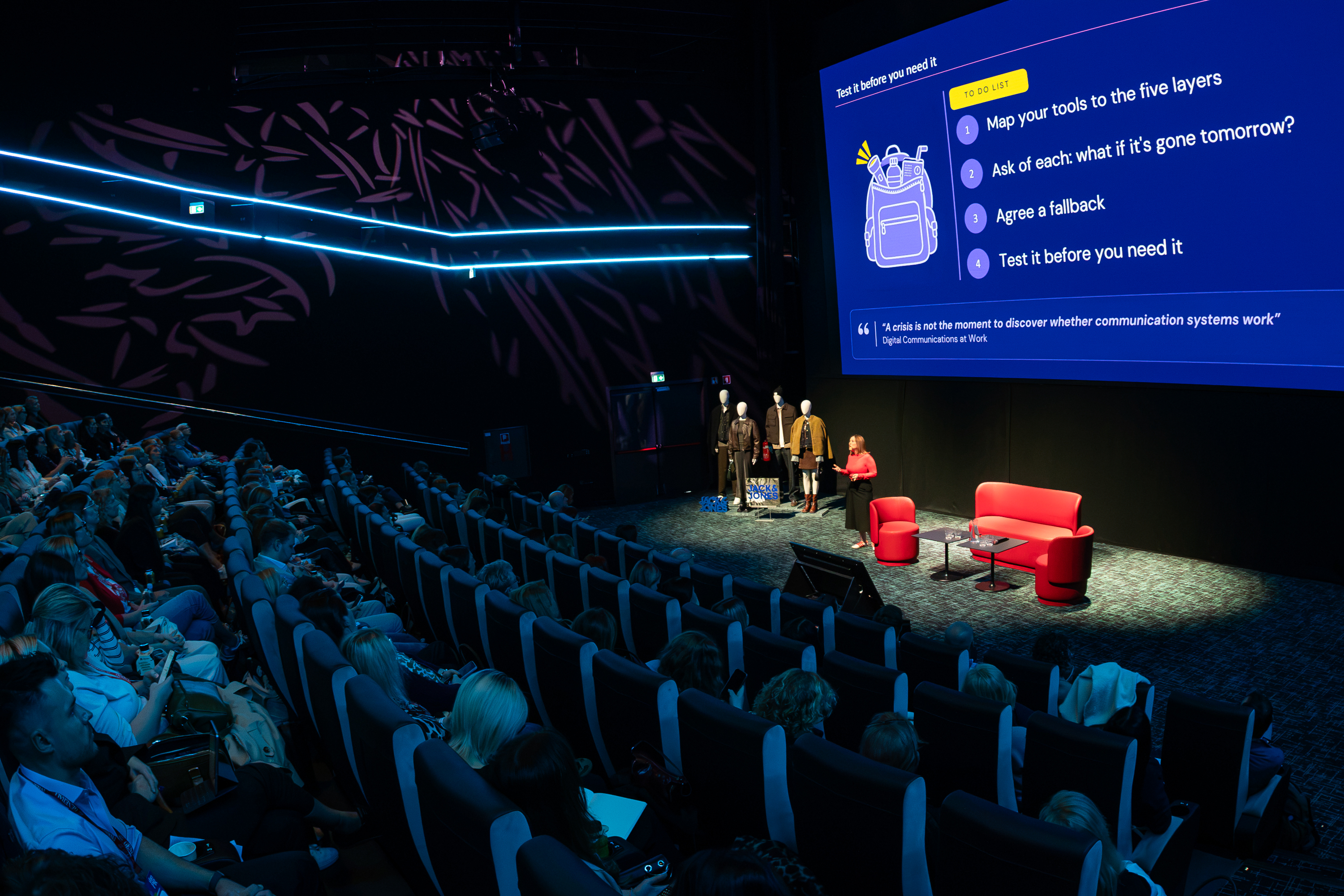
I took a couple of days away from client work to deliver the keynote in Ljubljana, taking the audience on a journey around Japan to explore how the future is already here — just, as William Gibson put it, not evenly distributed. We can’t know exactly what’s coming, but we can prepare for a range of possible futures by building resilience and adaptability into our communication channels and professional practice. Not by predicting the next crisis, but by making sure the next crisis doesn’t require us to invent an entirely new way of talking to one another.
Which turned out to be rather more relevant to the rest of my working week than I’d anticipated.
This week at work
Part of the keynote involved asking the room to do something faintly cruel to their communication channels: try to break them. For every layer — where you plan, publish, distribute and discuss — ask three questions. What do we use? What if it’s gone tomorrow? And where do people go instead?
Then, back on client work, I spent two days hearing the answer to that third question.
Jon and I are in the thick of discovery work at the moment, which means a lot of interviews, a lot of listening, and in my case a succession of video calls from a hotel desk in Ljubljana. And nobody needed a hypothetical outage to tell us where people go instead.
They’d already gone.
Across organisations, the patterns are remarkably familiar. The official collaboration platform that everyone has access to but nobody particularly wants to use. The informal group chat that started as a convenience and yet became essential infrastructure. The knowledge base that accumulated so much information it became easier to ask a colleague than even attempt to navigate it. The shared drive where documents breed, acquire version numbers, and eventually disappear into the sediment. The important information that’s technically available to everyone, provided you know the right person to ask.
Nobody designed this system. It doesn’t feature in anyone’s channel strategy. And yet it’s how a colossal amount of work actually gets done, held together with pipe cleaners, sticky tape and goodwill. An enterprise architecture that would struggle to survive a stiff breeze, but has somehow kept the organisation running for years.
Nobody’s complaining, exactly. They’d simply taken the shortest route. Faced with a choice between following the official process and getting an answer before the heat death of the universe, people had made a rational decision.
And that’s useful intel. Where people go instead isn’t the failure; it’s the insight. One distinction that emerged from the conversations that I’ve been mulling since: different channels carry different social expectations. An email suggests someone has thought about what they want to say. A chat message can feel like someone tapping you on the shoulder and expecting an immediate answer. That’s not a preference about software. It’s a design brief, and a more useful one than anything you’ll get from a vendor’s feature comparison spreadsheet.
On Tuesday I told a conference audience that a crisis is not the moment to discover whether your communication systems work. By Friday I’d been reminded that most organisations have already been told exactly where their systems fall short. The evidence is there in the workarounds, the unofficial conversations and the people everyone knows to ask. You just have to go looking for it.
Also this week
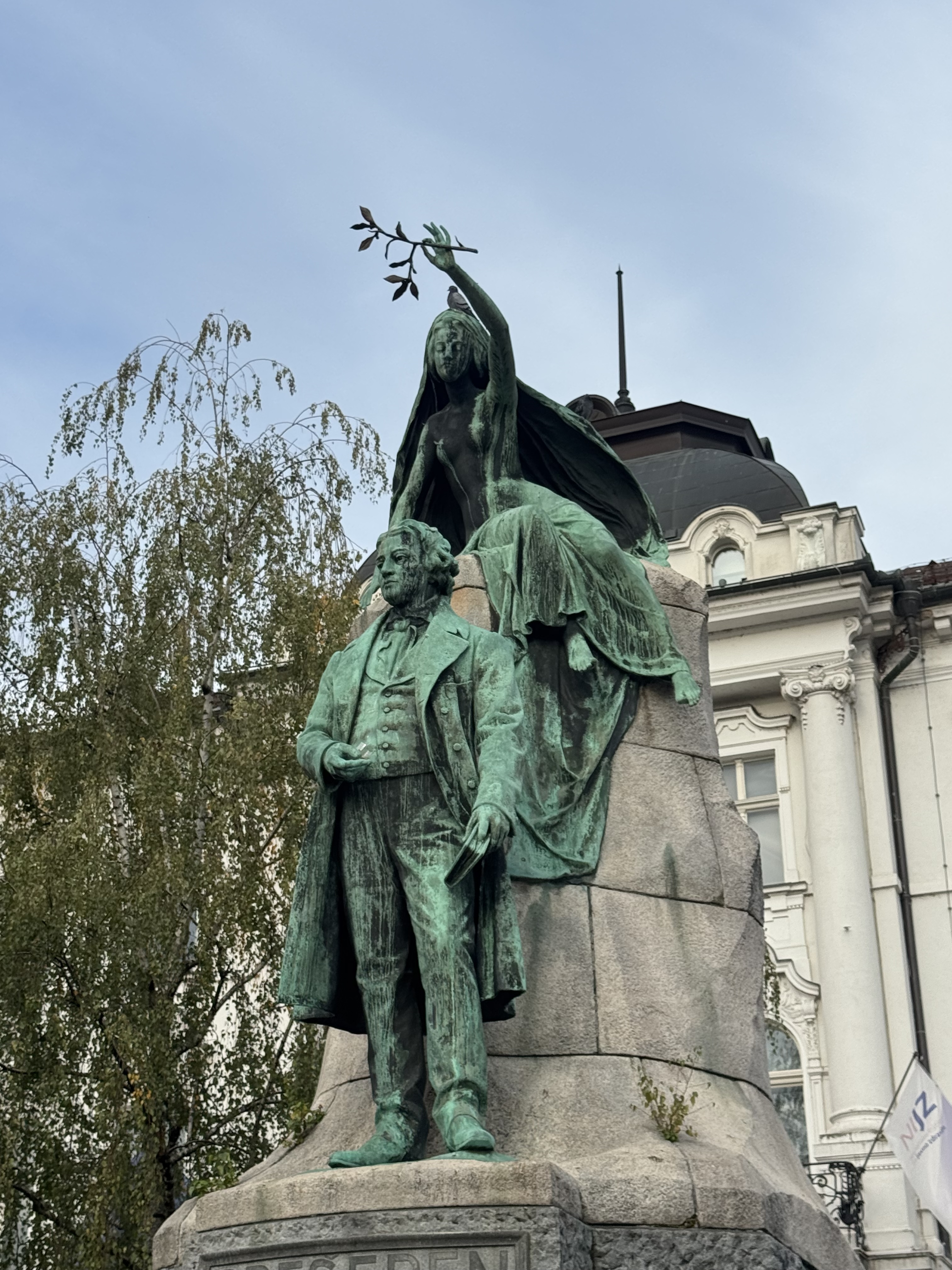
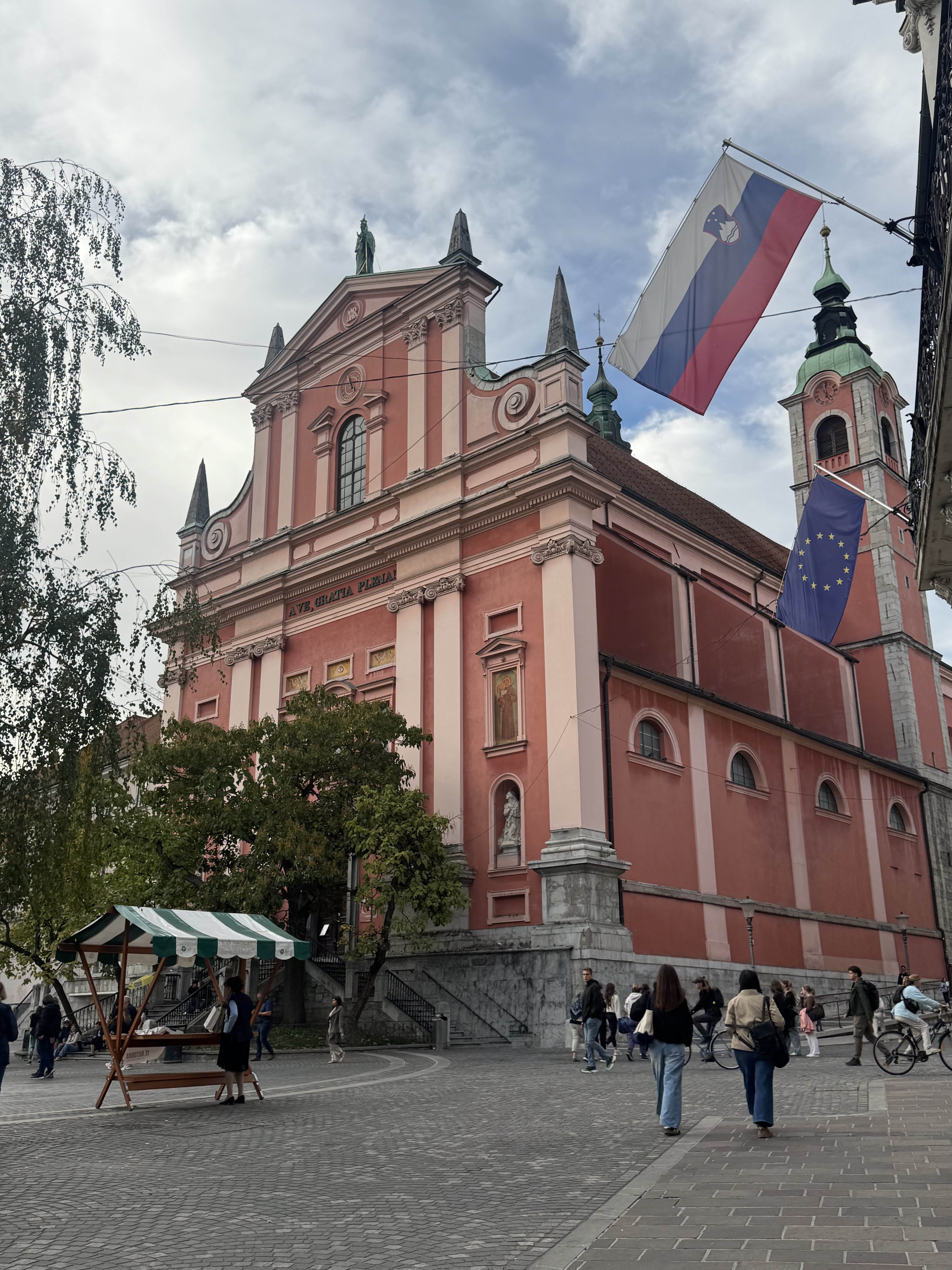
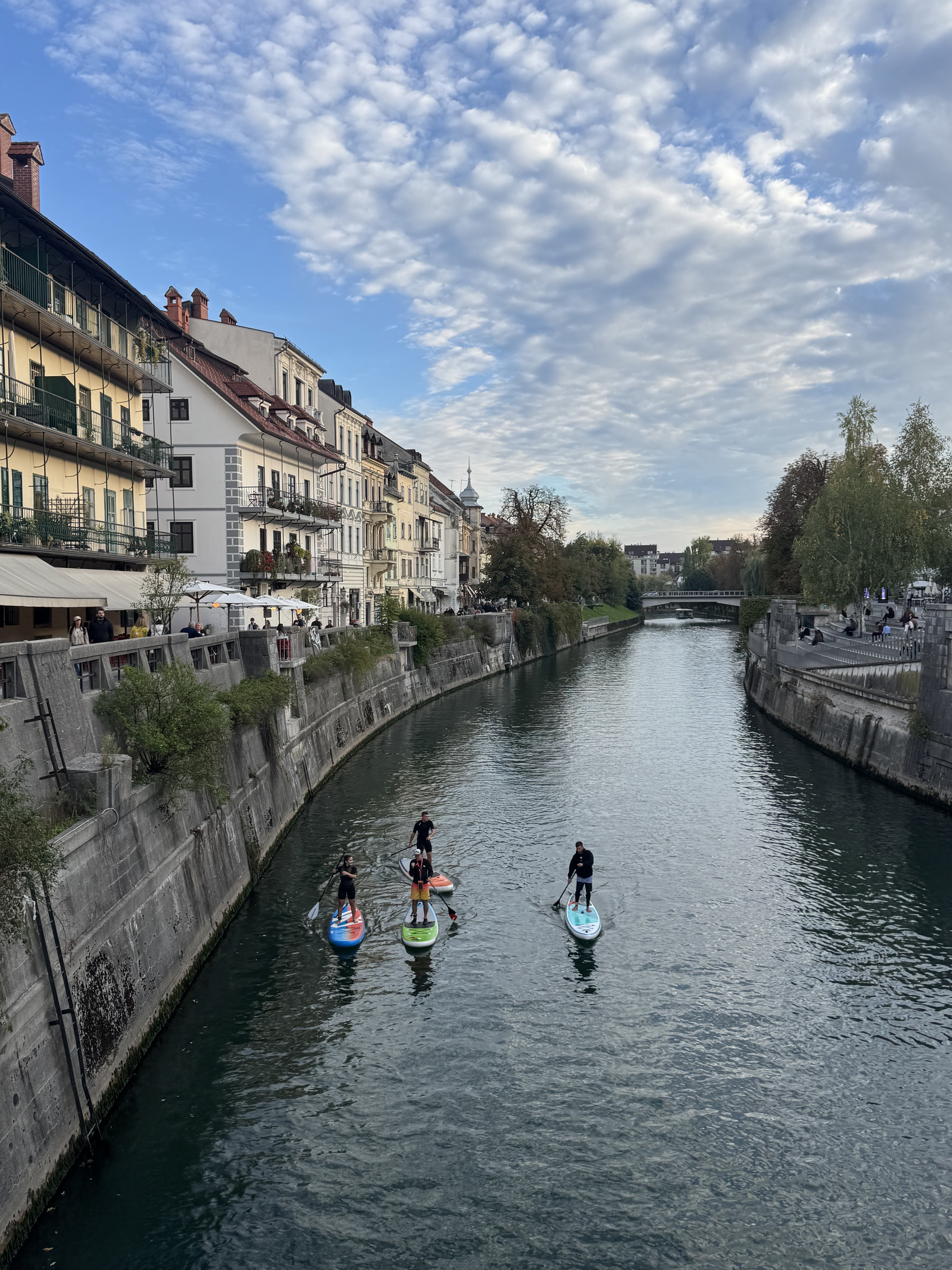
The conference finally got me to Ljubljana, and I’m already certain I’ll be back. It’s a beautiful, relaxed city and — for now — less overrun with tourists than it has every right to be. I’m aware that announcing this on the internet is precisely how the rot sets in, so please consider this paragraph strictly entre nous.
I don’t usually rank my own talks, but Tuesday’s was the best keynote I’ve ever given. Afterwards, the programme director wrote to say I hadn’t simply delivered a keynote, I’d “brought the whole theme of this year’s Dan PR to life”, which I have since reread a number of times that would embarrass me if I were capable of embarrassment.
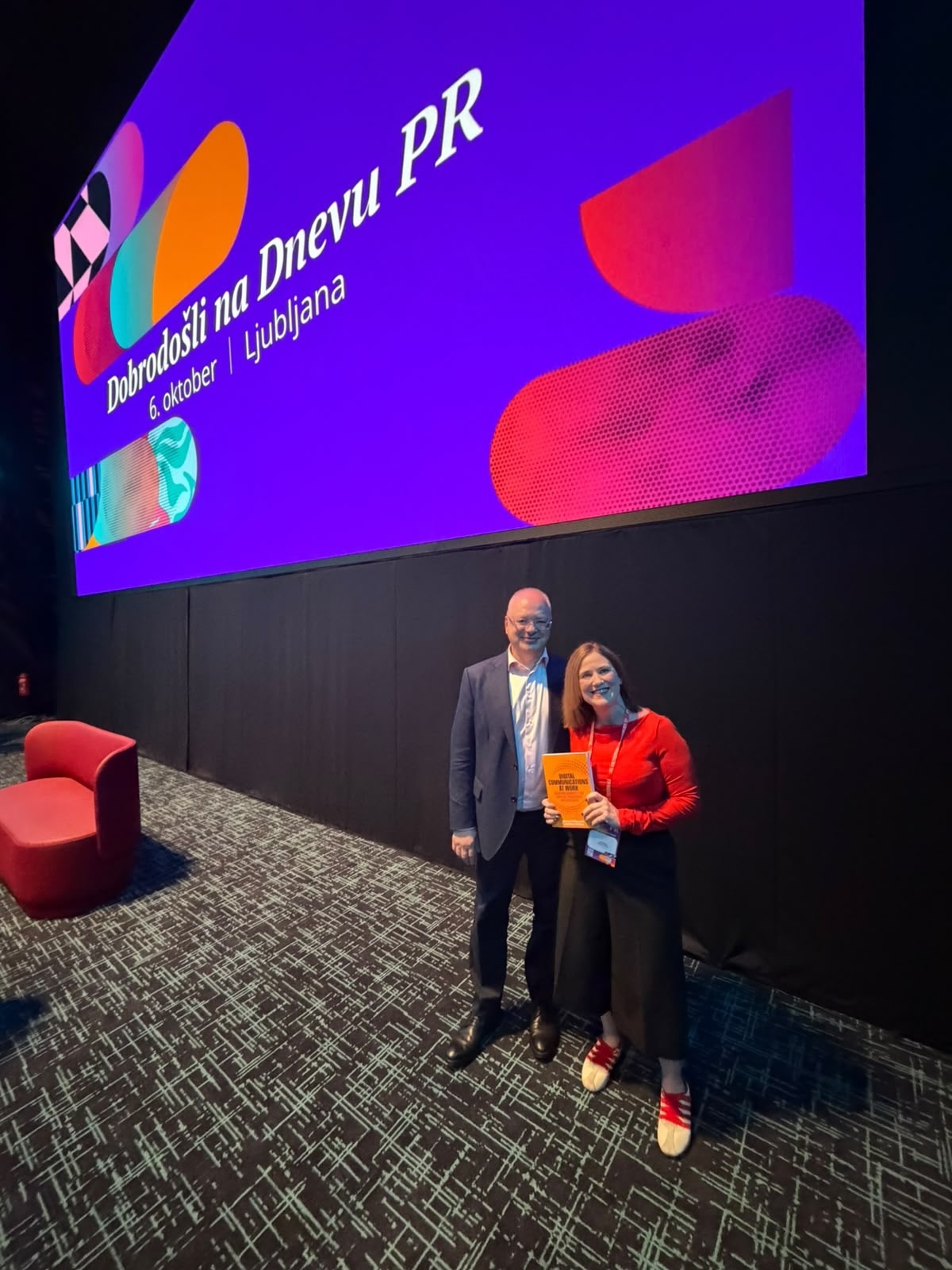
I also got to hand a copy of the book to Dr Dejan Verčič, whose academic work I cite in it. There’s a very particular feeling that comes from presenting an academic with a book that quotes them: pride, accompanied by the sudden fear that you may have misunderstood everything they’ve ever written. German almost certainly has a word for this.
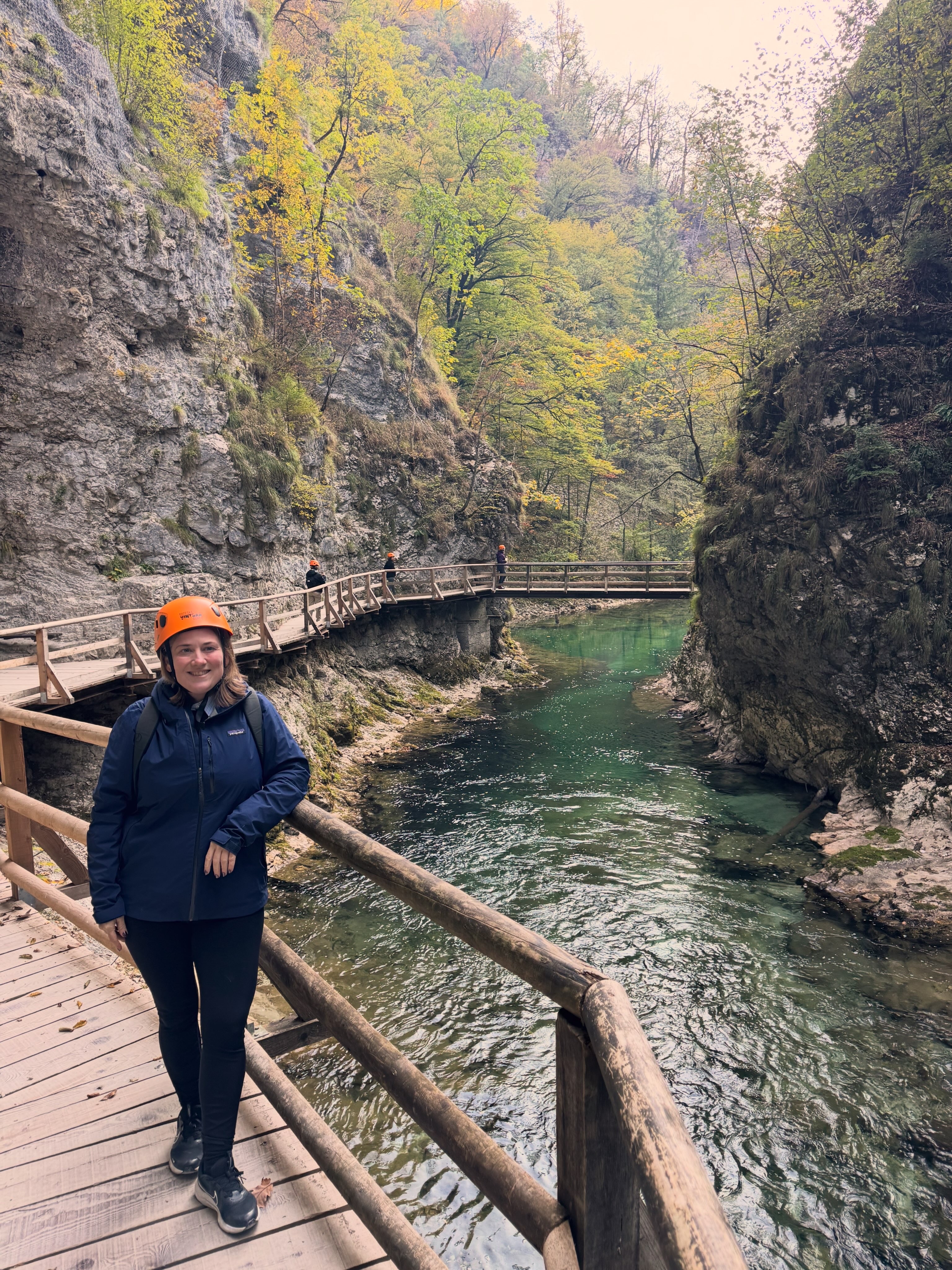
Slovenia then did its best to make the case for not working. The Vintgar Gorge was autumnmaxxing so aggressively it looked as though someone had turned the saturation up to a level normally associated with estate agents’ photographs. Naturally, I spent an unreasonable amount of time examining the rock formations and thinking about clients. I’m told some people visit places of extraordinary natural beauty and simply appreciate them, without attempting to draw lessons about organisational change. I wish them well.
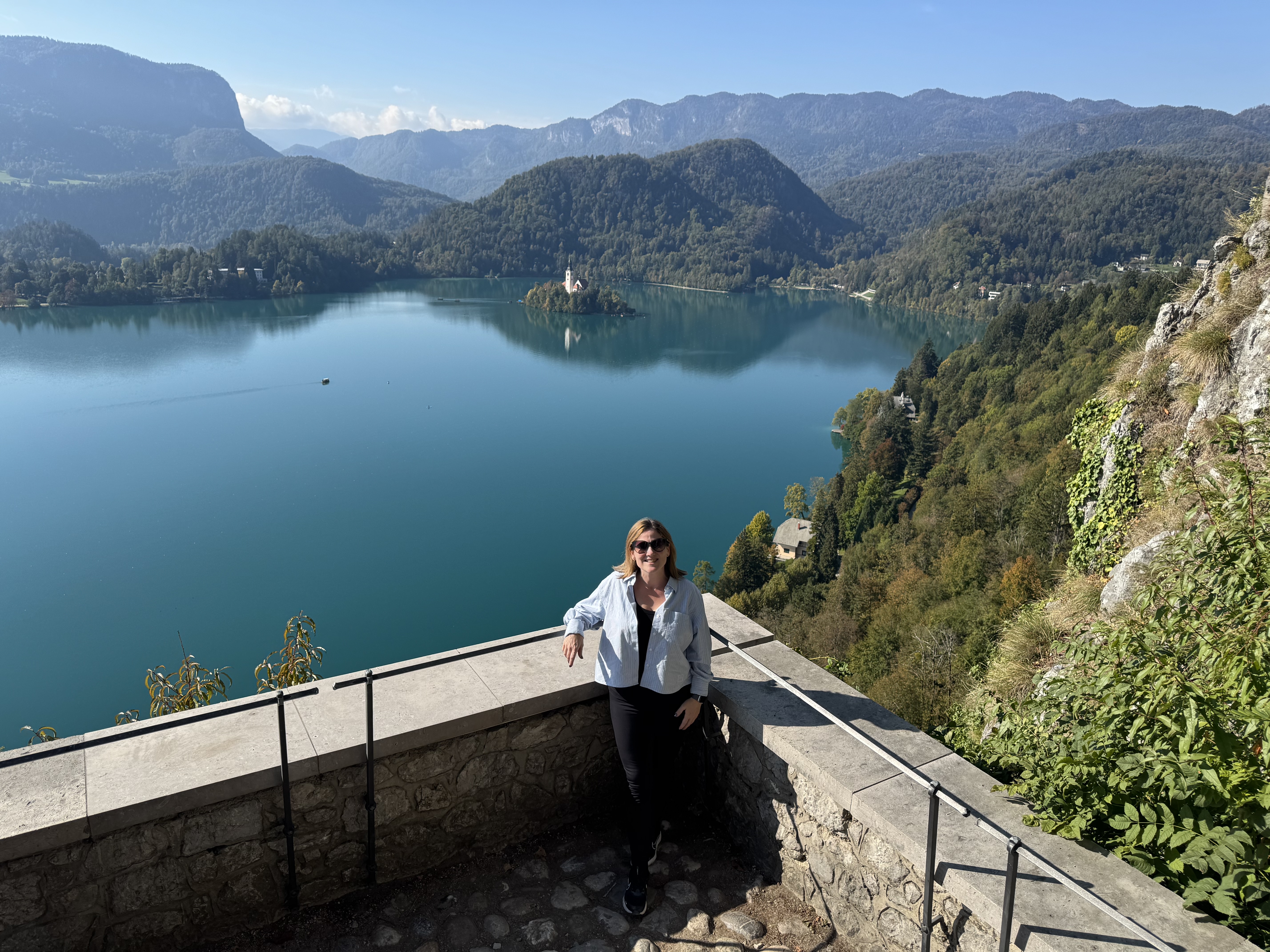
Lake Bled looks exactly like the photographs, which is the highest compliment I can pay a view.
And once the last call of the week had wrapped up, I spent an afternoon wine tasting in the Alps, which strikes me as the correct way to conclude several days of discovery interviews. I’ll be proposing it to Jon as a standard part of our methodology. There’s probably a legitimate business case to be made for it, if I can find someone willing to fund the research.
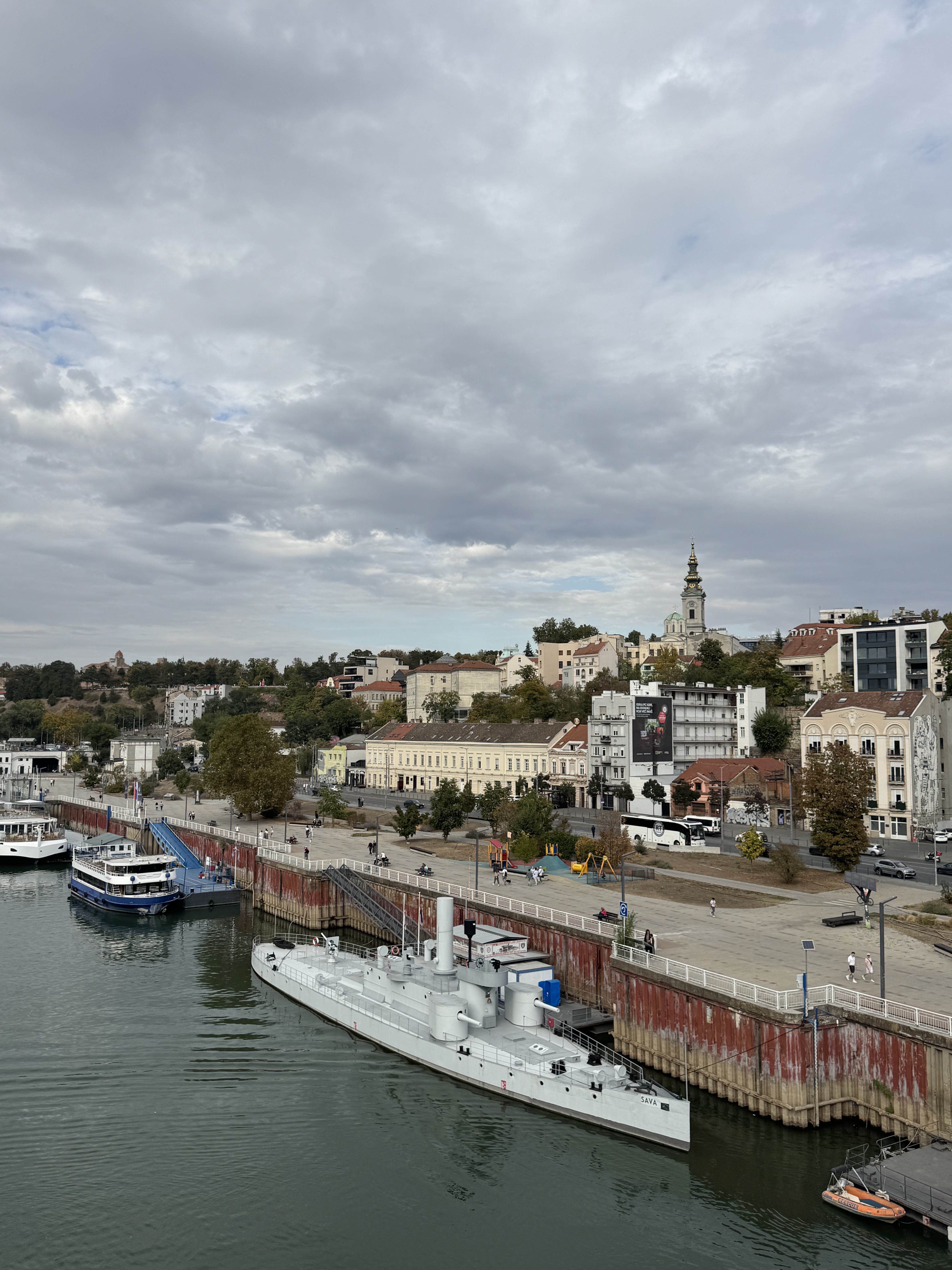
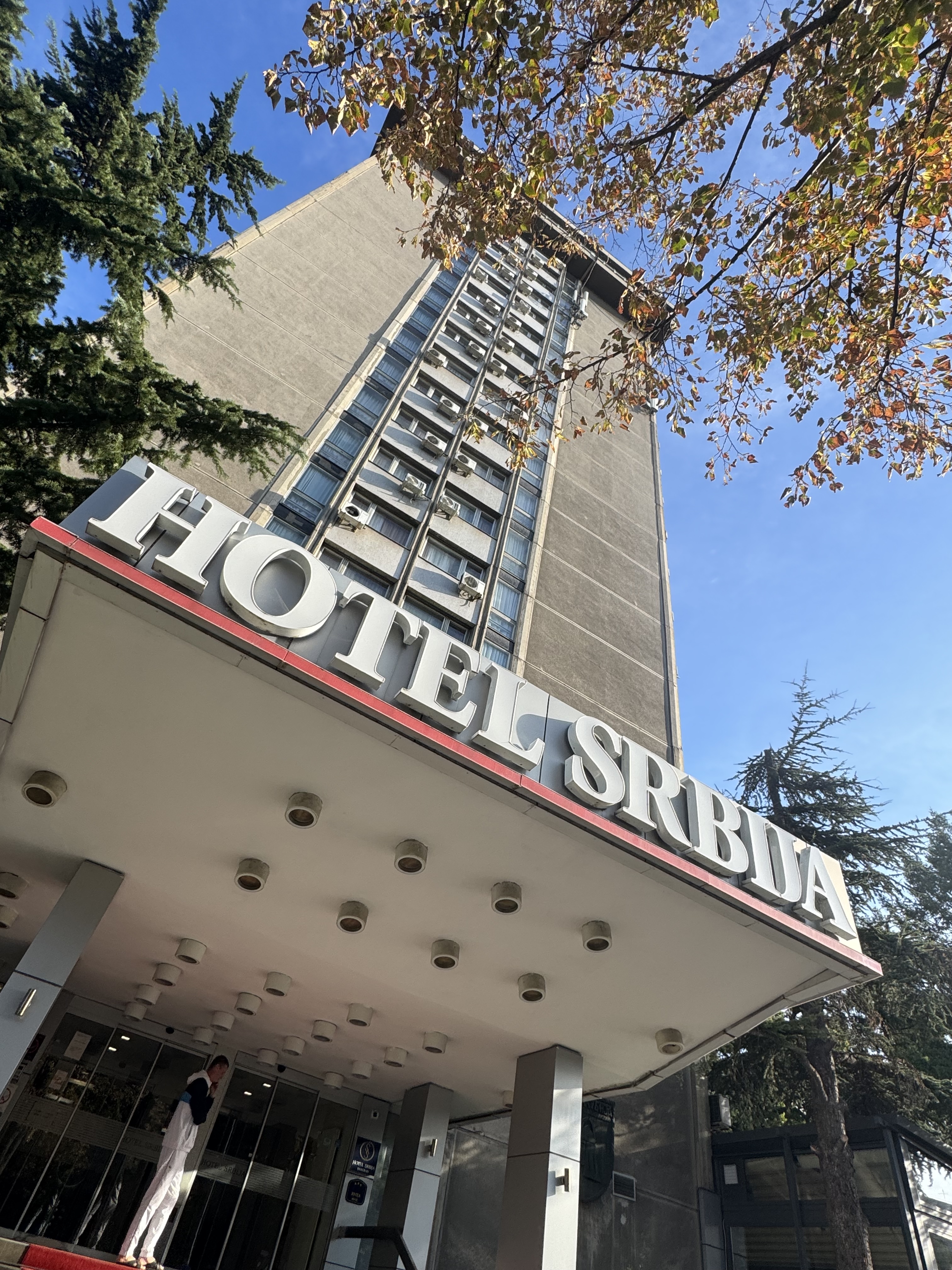
On Friday, Belgrade. Again. Three weeks ago I visited Serbia entirely by accident, when my flight to Mostar couldn’t land and the pilot took us back to Belgrade instead. This earned me an unexpected night in a hotel apparently last refurbished during the Tito administration, complete with the lingering aroma of several decades of indoor smoking. This time I went on purpose, for the weekend, which I guess counts as giving the city a second chance despite it having done absolutely nothing wrong. The plane landed where it was supposed to, and I celebrated with a pub crawl. A considerable improvement on my previous visit, although admittedly the bar was somewhere beneath the shag-pile carpet.
Consuming
Not much, frankly. Work, travel and an unreasonably scenic country accounted for most of my evenings. The exception was Thursday’s Celebrity Traitors, which I streamed live on my phone over a solo dinner, propped against the water jug like a small, treacherous dining companion. I regret nothing, although I now suspect everyone at the next table of being a Traitor.
Coverage
Jon and I kick off the new season of Katie Macaulay’s Internal Comms Podcast with Why better comms starts with discovery. We get into infobesity, writing for AI readers, why the things people can’t find are often more revealing than the things they can, and the peculiar corporate ritual of commissioning an exhaustive inventory of everything in the intranet before asking whether anyone needs any of it. Katie’s a superb interviewer, and she got one of the best conversations about the book out of us yet. If you take one thing from it, make it this: start with the appetite, not the fridge. Otherwise you’ll spend six months cataloguing the contents, reorganising the shelves and buying a very expensive new fridge, only to discover everyone wanted a sandwich.
I also made it into Slovenia’s Marketing magazin, talking about why there isn’t one future of work, but hundreds of them. A longer interview will appear in a forthcoming issue, which I’ll share when it’s out. My Slovenian is limited to hvala lepa, so I’m taking their word for what I said.
Travel
Home today. Then an entire week in one country, which will be an unsettling experiment in geographical continuity, before Paris for UNLEASH.
Most internal communications planning operates on the charming assumption that organisations are fundamentally stable places, occasionally interrupted by change. There’s business as usual, with its newsletters, intranet stories and meticulously colour-coded content calendars, and then there’s The Crisis, during which everyone abandons the calendar and runs around looking for the emergency distribution list. Half the people on it have left, the other half haven’t opened an email all week, and someone from Legal would like to review the holding statement.
This was always a deranged way to think about organisations. Now it’s bordering on wilful denial. Instability isn’t an unfortunate interruption to business as usual. It is business as usual. Yet we continue to talk about transformation as though it’s a journey with a destination, rather than a series of wearyingly unpredictable events punctuated by steering committees. Nobody knows what’s coming next, and the reassuringly precise roadmap presented at last month’s town hall isn’t going to change that.
The job, then, is to build communication that can flex: channels people already use and trust, in a digital workplace designed to adapt as the organisation changes around it. That work happens in the good times. You can’t build trust once the crisis has started, however enthusiastically you update the CEO’s talking points.
This was the argument of my recent keynote at Dan PR in Ljubljana, organised by Marketing magazin under the bracingly honest theme A World Without Stability. I can’t give anyone stability back. Nobody can. What we can do is build communication that holds anyway.
The future arrived wearing a knitted hat
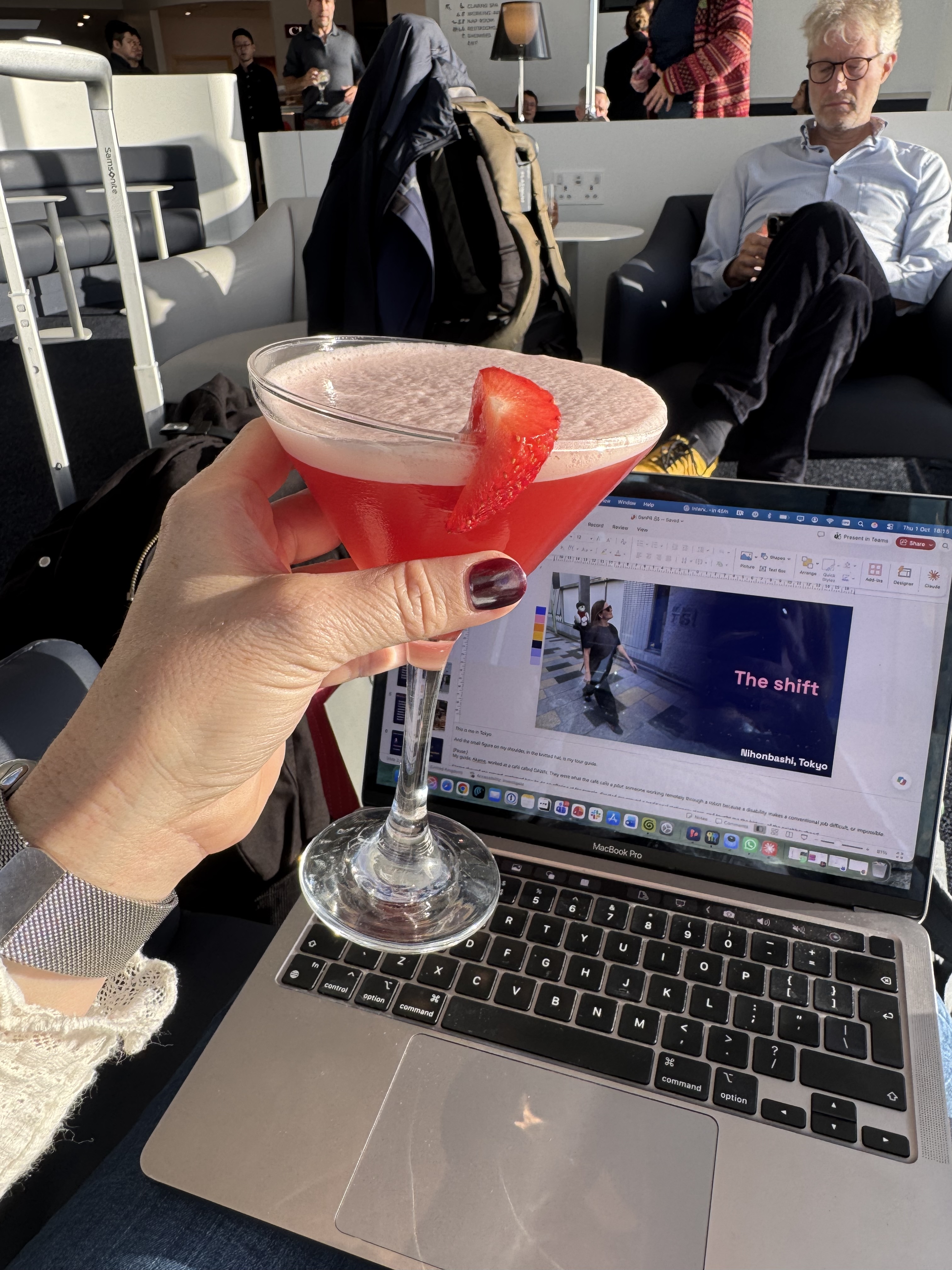
In Nihonbashi, Tokyo, I was once shown around by a tour guide who sat on my shoulder. It was a small robot in a knitted hat, from a café called DAWN, and the person guiding me was a pilot working remotely: someone living with a disability that would make a conventional job difficult or impossible.
Japan has a labour shortage. It also has people who want to work and have been shut out of work. DAWN connects those two problems. Walking around Tokyo with a robot on my shoulder should have felt futuristic. It didn’t. It felt completely ordinary, which is generally how the future turns up: not with a fanfare, but on your shoulder, wearing a hat.
Being shown around Tokyo by a robot guide (photo: Sharon O’Dea)
I wrote much of Digital Communications at Work, the book I co-authored with Jonathan Phillips, in Japan. Many of the forces starting to reshape work in Europe — ageing populations, labour shortages, automation — aren’t the future there. They’re already the present. Japan is a useful corrective to the sort of futurism that involves putting 2035 on a PowerPoint slide alongside a stock photo of someone prodding a holographic interface.
And these forces aren’t arriving one at a time. Demographic change, geopolitical volatility, AI, eroding institutional trust and the fragmentation of work are accumulating and colliding. None is going to wait for the previous transformation programme to finish, or for the steering committee to approve the next phase.
Look at who counts as ‘internal’ now. Employees, yes, but also contractors, frontline workers, supply-chain partners, remote workers and people who move between organisations and projects. Access to information becomes uneven. Context becomes inconsistent. Some people feel close to the organisation; others barely feel part of it at all. Yet plenty of internal communication still assumes an employee sitting at a desk, logged into a company laptop, with enough control over their working day to read a message whenever we decide to send one.
As we put it in the book, “A communication strategy that assumes equal access will, inevitably, exclude.”
The robot in Tokyo wasn’t interesting because it was a robot. It was interesting because somebody had designed a way for a person to participate who would otherwise have been excluded. The technology was infrastructure, not the purpose. Any industry rather more interested in selling technology than asking who it actually helps might want to reflect on that.
Build something that holds
Many organisations still approach communication as a publishing operation. They have messages to distribute, channels to fill and calendars to maintain. The success measures tend to reflect that: how many things went out, how many people opened them, how many clicked. We’ve become tremendously sophisticated at measuring the production and distribution of material without really establishing whether any of it made a blind bit of difference.
But when the ground moves, nobody cares how many intranet stories you published last quarter. They care whether they can find out what’s happening, understand what it means for them and reach someone who can help. An impressive open rate tells you very little about whether someone understood the message, trusted it or could do anything useful with it. You can open an email halfway through a shift, discover you need to complete a task on a system you can’t access, and still count as a communications success story on somebody’s dashboard.
That’s an infrastructure problem, not a copywriting problem.
In Digital Communications at Work, we describe five layers of a communication ecosystem: Plan, Collaborate, Publish, Distribute and Discuss. It’s a way of seeing how information moves around an organisation, rather than looking at each channel in isolation, which is what happens when every department has its own platform, its own budget and a persuasive account manager.
Once you’ve mapped those layers, you can ask an uncomfortable question: what if one disappears tomorrow?
We worked with a human rights charity whose people operate across countries run by authoritarian regimes. They know that social networks can be switched off, sometimes along with the entire internet. For them, relying on a WhatsApp group wasn’t just a question of convenience; it was a vulnerability.
They reduced their dependence on platforms most likely to be withdrawn and made regular local backups of essential materials, so people could still access what they needed without a connection.
Most organisations aren’t operating under those conditions. But the underlying question applies to everyone. If email and Teams disappeared tomorrow morning, where would your people go? If your intranet was unavailable, how would you reach your people? And how many of your supposedly business-critical processes turn out to depend on a spreadsheet maintained by someone who’s currently on holiday?
If the answer is ‘I’m not sure’, you’ve found something worth fixing (ideally before the next incident review).
Resilience isn’t something you buy during an emergency. It’s built through the dreary work of mapping dependencies, agreeing fallbacks and testing whether they work. Nobody gets excited about a backup distribution list until the day they need one, by which point it’s a little late to discover that nobody owns it.
Holding isn’t enough
It’s relatively easy to notice when something breaks. Far harder to notice when it stops being useful. Communication also has to adapt to changes that happen slowly enough for everyone to convince themselves that nothing much is changing.
Working patterns shift. New technologies appear. Organisations merge, restructure and acquire new populations of employees. The channels that worked brilliantly five years ago become less useful, while the people responsible for them continue filling them with content because that’s what the communications plan says they should do.
This is where organisations tend to confuse the channel with the job it was supposed to perform. The intranet, the newsletter, the employee app: these are ways of meeting people’s information needs, not ends in themselves. Yet we become extraordinarily attached to them, particularly after spending eighteen months and a substantial amount of money getting them approved.
In Digital Communications at Work, we argue for separating publishing from distribution. Keep a reliable source of truth, with content that’s accurate, owned and maintained. Then allow the channels carrying that information to change as people’s needs and working habits change. The information should be dependable. The means of reaching it should be adaptable.
That matters even more as AI assistants and agents become another way people access workplace information. Your content may increasingly be consumed and interpreted by machines before it reaches a human. If your policies are duplicated, contradictory or three years out of date, AI won’t magically fix the problem. It may simply repeat the wrong answer more efficiently, with the sort of confidence previously reserved for a senior manager explaining a system they’ve never used.
Flexibility isn’t an annual technology strategy exercise. It’s a habit of asking whether the channels you have still serve the people using them, and being prepared to stop doing things that no longer earn their place. Which sounds straightforward until you discover how many apparently indispensable communications exist primarily because somebody important once asked for them.
Resilience without adaptability leaves you maintaining an increasingly obsolete system. Adaptability without resilience gets you chaos with a new logo.
You need both.
Prepare the ground before you move the tree
On the Goto Islands, I stayed at Ako House, an old Japanese house restored by a man who bought it for one reason: to save the enormous old ako tree in the garden. He didn’t buy a house and happen to get a tree. He bought the tree and took on the house to protect it.
Japanese has a word for preparing a tree to survive being moved: nemawashi. Literally, it means digging around the roots, loosening the soil and preparing the tree so it has the best chance of surviving the move.
In organisations, the same word describes the work of consulting people before a decision becomes official. Talking to the people affected, understanding their concerns and allowing their input to shape what happens next. Not the ceremonial consultation that takes place once the decision is effectively irreversible, but the kind where somebody might actually have to change their mind.
We tend to do this backwards. Leaders make a decision, communications is brought in to prepare the announcement, and the people whose working lives are about to change hear about it once everything is settled. Then everyone is terribly surprised when they resist, and comms is asked to develop an engagement campaign to address the negativity. Perhaps with a colourful graphic explaining the benefits.
The groundwork isn’t the announcement. It’s the conversations that should have happened before it.
This is where trust becomes infrastructure too. People are more likely to believe what they hear during uncertainty if they’ve had reasons to trust the organisation when things were relatively calm. That means channels that work, information they can rely on and leaders who communicate even when they don’t have a polished answer. It also means being prepared to tell people things they might not want to hear, rather than treating every difficult message as a problem to be solved with more positive language.
Three sentences do an enormous amount of work: here’s what we know, here’s what we don’t know yet, and here’s when you’ll hear more.
‘We don’t know yet’ isn’t weakness. In a period of instability, it can be one of the most reassuring things a leader says, provided they do follow through on the third sentence. It’s certainly more useful than an elaborately worded assurance that the organisation remains committed to its people while declining to explain what is actually happening to them.
The same principle applies to the communication systems themselves. Agree what people absolutely must know, how you’ll reach them and who’s responsible for making sure it happens. Do it before the emergency, because when everything is moving, there won’t be time to build the relationships, the governance or the distribution mechanisms from scratch.
And no, buying an emergency notification platform is not a substitute for people believing the messages it sends.
Our robots are not AI
Back in Tokyo, there’s one detail about the robot in the knitted hat that I haven’t mentioned. The café’s website makes a point of saying: “Our robots are not AI.”
In an industry currently determined to put AI into absolutely bloody everything, including things that were working perfectly well before, this feels positively subversive.
Everything valuable about that tour was deeply human: the planning, choosing what to show me, the conversation we had, the connection we built. The technology’s job was simply to carry a person to where they were needed.
That’s a useful way to think about workplace communication, too. Technology can carry information further, faster and in more formats than ever before. AI is making that easier still. But carrying information isn’t the same as helping people make sense of it, and producing more content isn’t the same as building trust. If it were, the average organisation would have achieved perfect mutual-understanding nirvana by now.
I can’t tell you which change is coming for your organisation. Neither can your CEO, your IT department or your favourite LinkedIn futurist, although the latter will probably sell you a framework for it. What you can do is prepare for a range of possibilities, rather than betting everything on one prediction.
Build channels people actually use. Keep the information behind them reliable. Make sure the system can survive the loss of a platform and adapt when working habits change. And establish the relationships that will carry communication when people most need to trust what they’re hearing.
None of this can be bolted on after the ground has moved. It’s built in the calm, through the deeply unglamorous groundwork that rarely makes it into a conference keynote but determines whether communication works when it matters. It’s considerably less exciting than announcing a new platform or launching a transformation programme, which is probably why organisations keep doing those instead.
The ground will keep moving. The question is whether what you’ve built can move with it.
This essay draws on my keynote at Dan PR 2026 and ideas explored inDigital Communications at Work, co-authored with Jonathan Phillips. If you’d like me to explore these ideas at your event or with your leadership team, see myspeaking page.
We do love a metric. Confront an organisation with anything complicated, human or fundamentally unknowable and within minutes someone will ask if we can put it on a dashboard, preferably with a traffic light, a percentage and an arrow pointing reassuringly upwards so everyone can go home.
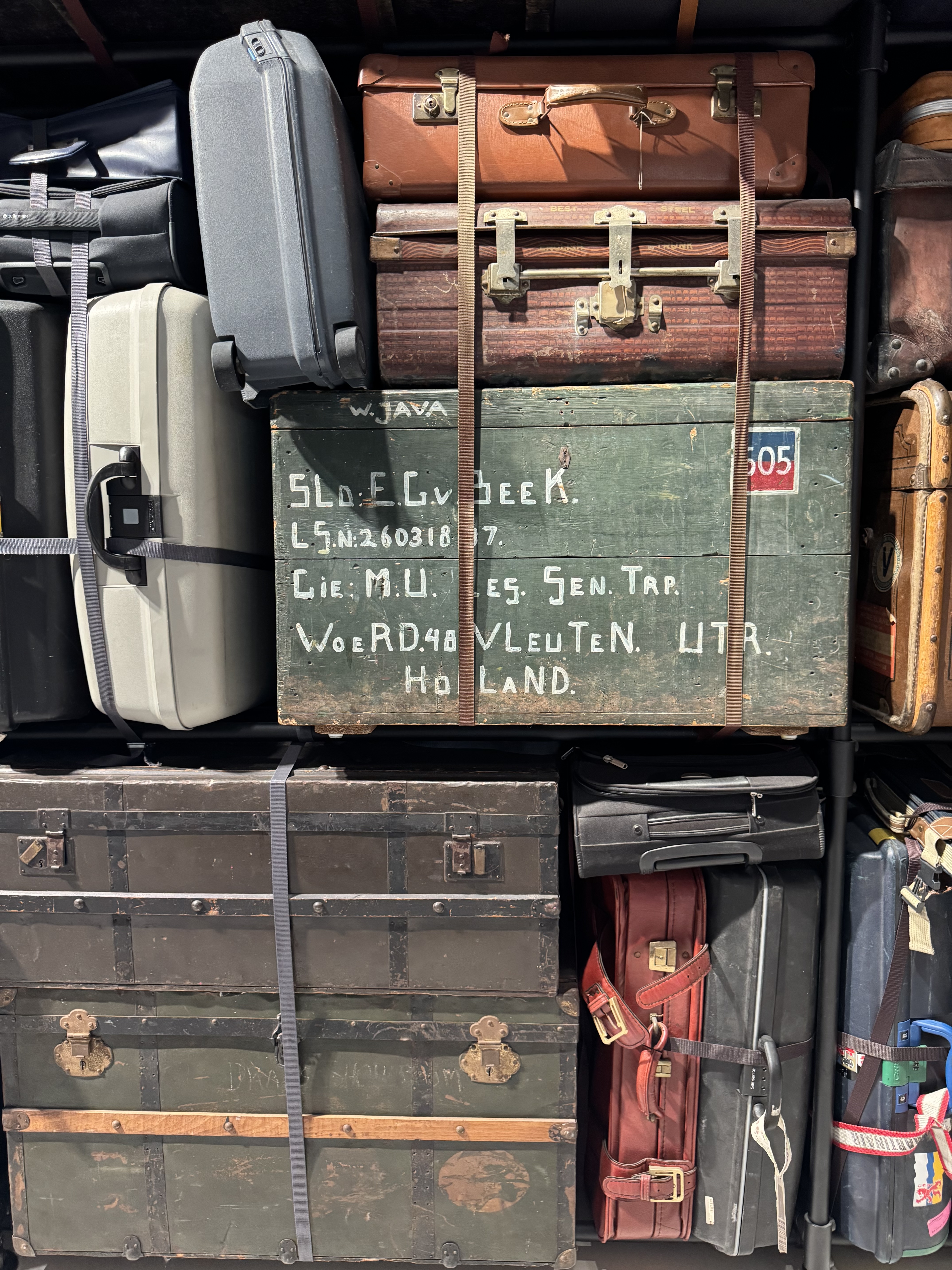
This week I spent two days talking about AI, where we’ve built machines capable of producing an answer to almost anything but haven’t yet worked out how to measure whether the answer is any good. The most useful parts of those two days were conversations in corridors that will never appear in the event analytics. Then I went to a museum about migration and found myself thinking about suitcases: identical objects carrying wildly different amounts of consequence.
Some things are easy to count. Some things count.
Unfortunately, these are rarely the same things.
This week at work
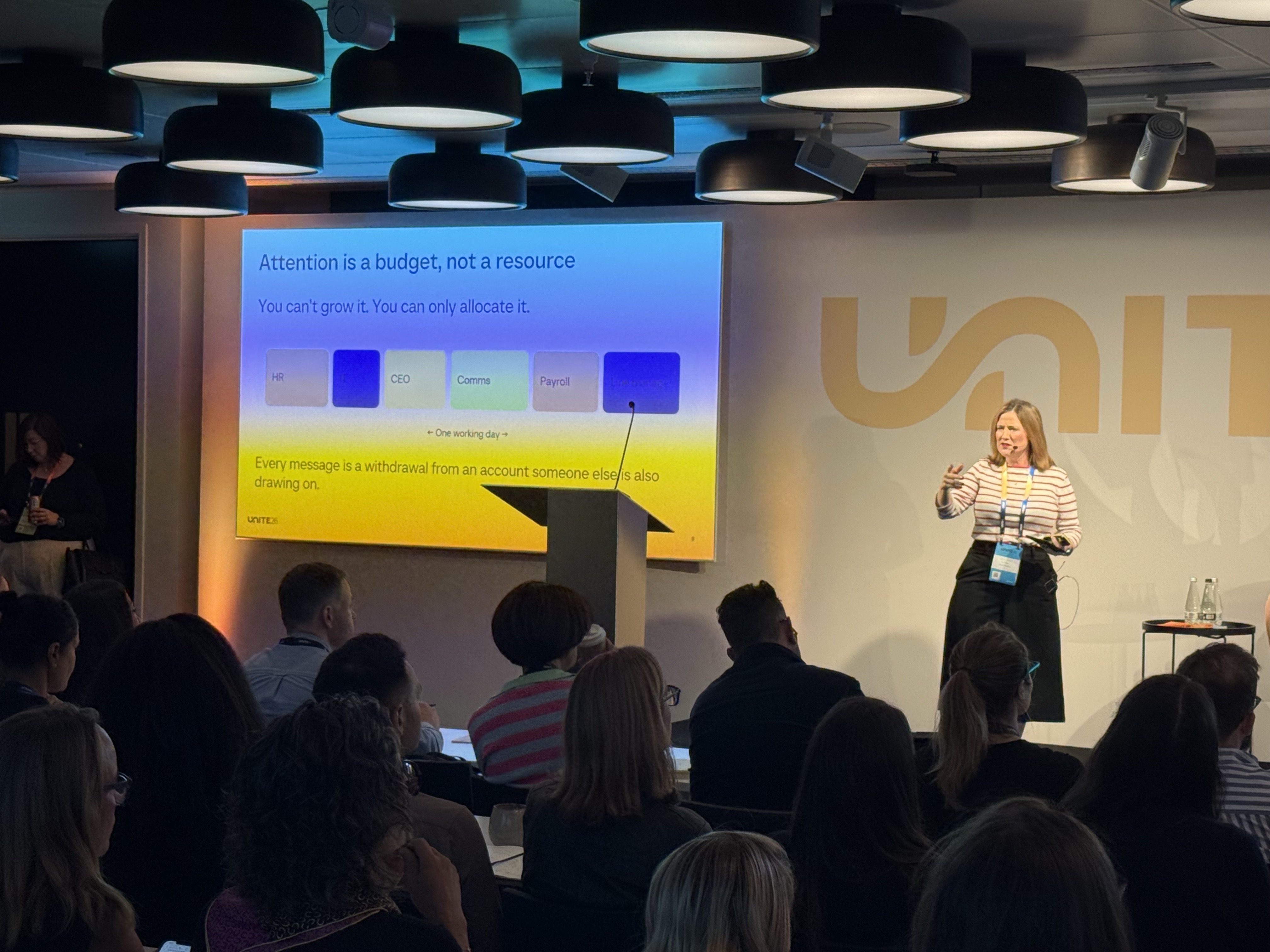
Unite was two days heavy with the AI chat, which is roughly what every conference is now. You could have played bingo with the phrases — transformation, guardrails, human in the loop — although you’d have had a full house by 10.15 on day one and then had to spend the remaining fourteen hours pretending you still wanted to hear about agents.
But beneath the mandatory layer of AI conference mulch, some of it was genuinely good.
Charlene Li named the bind most organisations are in: FOMO, the fear of missing out, pulling against FOGI, the fear of getting it wrong. Her advice was to write the strategy in ink and the AI roadmap in pencil. This seems wise when some companies are rebuilding their entire AI stack every three months, presumably while maintaining a PowerPoint somewhere describing it as a five-year transformation programme.
Adecco described a year of rolling out AI at a service centre with no headcount reduction. Their favourite milestone wasn’t a productivity number or an enormous graph pointing north-east towards Shareholder Value Valhalla. It was a previously reluctant senior leader using Copilot, entirely unprompted, to accept a meeting invite. Somewhere, a transformation programme manager quietly shed a tear.
And a Microsoft researcher shared an A/B test that I haven’t stopped thinking about. When a senior leader emailed staff each week about how they’d used AI themselves, usage jumped 37% the next day. Not telling people to use it. Not another training deck. Just being visibly seen figuring it out themselves.
In one session I asked how we’re supposed to measure the quality of what AI produces. The honest answer from the stage was that we can’t yet. Our metrics were built for technology you give commands to, and this is technology you have a conversation with. How do you put a number on a great conversation?
Which brings me to the best part of the two days.
Unite was full of comms people I’ve known for years. As ever, the best bit of the conference was the corridor catch-ups: chewing over what we’d just heard, catching up on what we’ve been doing, and debating the existential crisis AI has helpfully dropped into the industry’s lap while vendors stand nearby explaining that everything will be fine because there’s a copilot now.
It all ended with cocktails, a great deal more talking, and dancing to bangers at a party DJed by Sophie Ellis-Bextor.
None of that will appear in the event dashboard. There’s no percentage uplift for the conversation in the corridor that changes your mind, no KPI for reconnecting with someone you’ve known for years, no ROI calculation for dancing badly with people you like.
Also this week
The only thing I managed outside Unite was a trip to Rotterdam to visit Fenix, the city’s new museum of migration, on a beautiful sunny early-autumn day.
The building alone is worth the trip. It’s a 1923 warehouse that was once the departure point for millions of people leaving Europe for North America. Rising through the middle is the Tornado, a double-helix staircase of polished steel that climbs out through the roof to a 30-metre viewing platform. One flight juts out on a cantilever, so for a moment you’re standing over the water, which is exhilarating provided you don’t allow the phrase “cantilevered staircase” to complete its journey through your brain.
The piece that stopped me was Daria Khozhai’s Pravda, a recreation of her childhood bedroom in Kyiv. In Soviet-era apartment blocks, people insulated their walls with old copies of Pravda, the state newspaper whose name means “truth”, sometimes nearly a foot thick, then papered over them. When Russian bombs blew those walls open in 2022, the newspapers spilled out.
Khozhai’s room has Pravda on the outside. Inside, the walls are lined with front pages about the invasion.
The official truth, holding the house up. The other truth, on the walls of a child’s bedroom.
A few days earlier I’d flown into Heathrow on one of those rare approaches that takes you right over central London. I spent twenty minutes with my face pressed against the window picking out landmarks, then suddenly spotted the house I grew up in.
Home, in one of the several increasingly complicated senses of the word.
Downstairs is the Suitcase Labyrinth: 2,000 donated suitcases, each with its owner’s story playing through a speaker. Some are a century old. Some were packed recently, for lives that haven’t quite started yet.
Today I unpacked my own suitcase from the last trip and immediately packed it again, because I’m off tomorrow. Passport in my Uniqlo bag, as ever. Laptop charger. Too many pairs of shoes. Packing sudoku. The familiar little choreography of leaving.
I didn’t give the passport a second thought. That’s the privilege: not having to.
Consuming
The Celebrity Traitors is back. I cleared Friday night and had a friend round to watch the first two episodes back to back with a bottle of supermarket cava and a face mask, which is the only correct way to do it.
Two episodes in and it is already must-watch television. Richard E Grant’s gambit. Amol Rajan, my pick to win the whole thing, murdered immediately, thereby demonstrating the predictive power I normally reserve for technology markets. And Claudia Winkleman’s mathematically perfect fringe, no doubt of professional interest to Professor Hannah Fry.
No notes. Apart from quite a lot of notes, loudly, at the television.
Coverage
For Reworked, I commented on Meta’s third attempt at the enterprise market with Meta Enterprise Platform, after Workplace and Horizon Workrooms. My argument is that both earlier products started from Meta’s idea of how people ought to interact rather than how work actually gets done — and that enterprise deals are won in the deeply unsexy plumbing of data, identity, governance and risk.
Published
The produce button: It turns out I had a lot of Thoughts and Opinions about Unily’s Content Studio announcement. I sent some comments over to Reworked, then sat down to dash off a quick LinkedIn post.
Fifteen hundred words later, it was clearly not a LinkedIn post.
The argument, roughly, is that AI has demolished the cost of producing content without doing anything whatsoever to increase the amount of attention available to consume it. This may turn out to be something of a problem.
I had a lot of fun writing it. Only real ones recognise the PTSD of the corporate video years.
Travel
Tomorrow I’m off again, this time to Ljubljana for Dan PR, where I’m giving a keynote: When the Ground Keeps Moving: Building Communication That Holds. It’s my first time in Slovenia, so I’m staying on for a few days to explore.
Yes I burned a tree to generate this pic in CanvaAI, the irony is not lost on me.
At Unily’s Unite conference this week I watched someone turn a set of source documents into a podcast, an infographic and a video in the space of a few minutes.
This was Content Studio, Unily’s new AI-powered tool for taking trusted company information and turning it into different formats for different audiences: podcasts, videos, infographics and more, grounded in the original sources and with humans still in control of what goes out.
It was impressive. Genuinely impressive.
And I could immediately see the use case. Take a health and safety update written centrally, turn it into a visual explainer for factory workers, translate it into the languages spoken at that site, make an audio version for people who spend their working day away from a screen. Do in minutes what would previously have required designers, translators, video editors and several increasingly desperate emails to an agency.
There was, though, a rather lovely irony to the timing.
At the very same conference, I was running a workshop called Signal Over Noise: Winning Attention in an Age of Infinite Content. We’d expected about 40 people. More than 100 turned up.
Either internal communicators have suddenly developed an unexpected passion for information theory, or having too much stuff and nobody paying attention to it has struck a nerve.
So there we were. In one room, demonstrating how astonishingly easy it has become to produce more content. In another, communicators were crammed around tables trying to work out how to stop drowning people in the stuff.
Welcome to internal communications in 2026.
Because the interesting thing about Unily’s new Content Studio isn’t whether it’s good. It is. The interesting thing is what happens when tools like it collide with a communications system that already produces far more than people can reasonably consume.
Unily’s own framing gets to the heart of it: content is abundant, impact isn’t. And now, having identified the abundance problem, we have invented a machine for making abundance virtually free.
This is what we’ve been asking for
Credit where it’s due, because there is a lot to like here. The central argument of Digital Communications at Work is that communication needs to be designed around how people actually work. Not around the org chart, and certainly not around what’s convenient for the communications team.
A frontline employee on a twelve-hour shift does not have the same information needs, available time or working context as someone sitting at a laptop in head office. Yet for years we’ve routinely given them the same 800-word intranet article and called the job done because technically everyone could access it.
Congratulations. It’s responsive.
The problem with doing this properly has always been partly practical. Adapting communication for different roles, languages, locations, channels and contexts takes time and money. Most internal comms teams simply don’t have the capacity to make twelve versions of everything.
AI changes that equation. One source can become an infographic for a factory screen, an audio summary for someone on the move, a short article for the intranet and a translated version for a local team. The underlying information remains grounded in approved source material while the presentation changes to fit the person receiving it.
That’s not gimmicky personalisation. That’s good communication design.
For years we’ve said we should meet employees where they are. Now we actually can.
Which makes the next question rather important: How often should we?
We are already drowning
The communications problem inside most organisations isn’t that employees need more information.
It’s that they are surrounded by it.
Emails. Teams messages. Intranet news. Town halls. Newsletters. Notifications. Communities. Videos. Podcasts. Viva Engage posts. PDFs attached to emails summarising PDFs attached to other emails, with Copilot in the same window offering to summarise the summary.
Then we look at falling engagement figures and ask how we can persuade people to read more. Wrong question.
Information overload isn’t a personal failing by employees who need to manage their inbox better. It’s a design outcome.
Organisations have built systems in which hundreds, sometimes thousands, of people are independently authorised to demand everybody else’s attention. Every function has something important to say. Every project needs visibility. Every leader has an update. Every initiative has a launch. Every programme has a newsletter.
Individually, almost all of these decisions are reasonable. Collectively, they amount to being trapped in a lift with the entire organisation barking its priorities at you.
And then along comes AI and removes one of the few remaining constraints: making the stuff.
Attention is a budget.
Every communication spends some of it. Every notification asks someone to stop doing one thing and pay attention to another. Every beautifully personalised two-minute video is still two minutes in which they aren’t doing the work they’re ostensibly employed to do.
Personalisation can make each individual item more relevant.
It does nothing, by itself, to reduce the number of items.
And when the cost of producing those items approaches zero, I have a nasty feeling we’re about to discover that the natural volume of organisational communication, when freed from all physical constraints, is infinite.
The problem with removing friction
The first risk is obvious: volume.
Production cost has always acted as a crude form of governance.
Making a video used to be sufficiently expensive and annoying that someone, somewhere, had to believe the subject warranted a video. You needed a camera, an editor, perhaps an agency, a budget, and the particular form of psychological collapse that comes from hearing the same thirty seconds of Intro by The XX for the twenty-fourth time while someone adjusts a crossfade.
That’s not an especially sophisticated editorial process, but it was a brake.
Remove the friction and suddenly almost everything clears the production bar. Why wouldn’t we make a podcast version? It takes three minutes. Why not an infographic too? Why not a video? Why not six localised versions, translated into eight languages and personalised for four employee groups?
Soon the organisation hasn’t solved information overload. It has achieved information overload in twelve beautifully targeted formats, each carefully optimised for the precise demographic characteristics of the person ignoring it.
And I don’t think employees will become cynical about AI-generated communication simply because a machine made it. Most people have better things to worry about.
They’ll become cynical if there’s more of it, especially if all of it starts to sound eerily similar.
The signal that somebody bothered
The second risk is trust.
Part of the signal carried by communication is that somebody bothered. The medium is the message and all that.
Someone wrote the note. Someone chose the words. Someone stood in front of a camera and said the uncomfortable thing. Someone decided this mattered enough to spend some time on it.
Effort itself communicates importance.
If the CEO records a five-minute message after a difficult restructuring, that act carries information beyond the words themselves. They showed up. They put their face to it. They had to look into a camera and say “I know today’s news will be hard for many of you” out loud, while arranging their face into the internationally recognised expression for I am not, in fact, a sociopath.
If software turns their announcement into a jaunty three-minute podcast, the information may be perfectly accurate.
But something has changed.
Communication isn’t simply information transfer. If it were, internal comms would have been solved by SharePoint in about 2003 and we’d all be doing something else now.
Who said something, why they said it, what they chose to emphasise and how much effort they were prepared to expend saying it are all part of the message.
The cheaper communication becomes to manufacture, the more valuable those signals of human intent may become.
There’s an odd possibility here that the more polished content we can generate, the more we’ll value the slightly awkward video of an actual person saying actual words into a camera without three keywords sliding smoothly into view beside their face while ambient electronica burbles underneath.
Human imperfection may yet become a premium feature.
Month six is the bit that worries me
The third risk is complacency.
I’m actually less worried about hallucination here than I am about habituation.
In month one, everyone will scrutinise the generated storyboard. They’ll check every sentence against the source. They’ll debate the emphasis. They’ll inspect the images. Someone will zoom in to 400% and discover the reassuringly diverse group of colleagues in the background includes a woman with seven fingers and a security pass apparently growing directly from her sternum.
By month six?
Yeah, you know how this works.
You’re late for another meeting. Teams is flashing. Somebody needs this published by four. You’ve generated versions of this sort of thing dozens of times before and they’ve always been fine.
You glance.
Looks alright, dunnit?
Publish.
Grounding a system in approved sources is important because it reduces the risk of invention. But a communication can contain no invented facts whatsoever and still be wrong.
It can emphasise the wrong thing. Bury the caveat. Miss the thing employees actually care about. Turn a complicated and politically sensitive decision into something technically accurate yet completely tone-deaf.
Those are judgement problems, not generation problems, and no amount of source grounding removes the need for judgement.
Governance needs to happen before the produce button
This is why I’m not convinced the most important governance question is who approves AI-generated content.
By that point, we’ve already made it.
The more useful question comes earlier: Should this communication exist at all?
In my Signal Over Noise workshop at Unite, I used what I call the Fletcher Test: Means, Opportunity, and Motive. I stole the method from the iconic Jessica Fletcher, because I did a sufficiently wishy-washy arts degree to spend three publicly funded years of university watching an enormous amount of trashy daytime television. Murder, She Wrote taught me that every murder needs three things: the means to do it, the opportunity to do it, and a motive.
(It also taught me that Cabot Cove had a murder rate that really ought to have attracted federal attention, but this is not the time, nor is it the place).
The same test turns out to be surprisingly useful for internal communications, with fewer suspiciously well-dressed corpses.
Do we have the means to reach this audience effectively?
Do they have the opportunity to pay attention to it?
And, most importantly, do they have a motive to care?
AI makes the Means bit astonishingly easy.
That’s precisely why Motive and Opportunity become more important.
If I can make you a personalised video in your preferred language, beautifully formatted for the device you’re holding, I have solved the delivery problem. But I have not magically made you care.
I’d go further. Communications teams should start thinking in terms of attention budgets for audiences. Not simply how much content a team produces, but how much attention it’s reasonable to demand from the people receiving it.
Approval shouldn’t just ask whether something is accurate, on-brand and compliant. It should ask whether this thing is worth interrupting people for.
What if we’ve got the direction wrong?
There’s another possibility I find much more interesting. Most enterprise personalisation still starts with the organisation.
We have a message.
We have twelve audiences.
We will create twelve versions and push the appropriate one towards each person.
It’s cleverer broadcasting, really. But generative AI opens up another model entirely. Imagine a housekeeper sees that the CEO has published a long update and asks:
What does this mean for me?
The system knows enough about their role and context to answer usefully. It draws from the original, approved communication. It explains what’s relevant and leaves the rest alone. If they want more detail, they ask another question. The original remains there, intact, as the source.
That’s pull rather than push, and I think that’s potentially much more transformative.
Instead of communications teams trying to anticipate every conceivable information need and manufacturing twelve versions just in case, employees interrogate trusted information when they actually need it.
That doesn’t eliminate broadcasting. Some things genuinely need to be pushed. Emergencies exist. Mandatory information exists. Leaders sometimes need to speak to everyone. But most organisational information isn’t an emergency, however enthusiastically its owner filled in the comms request form.
Pull changes the economics of personalisation because we don’t need to manufacture every possible version in advance.
And if we’re going to personalise proactively, our understanding of audiences needs to get much better too. Personas shouldn’t simply be lovingly hand-crafted descriptions of what we imagine “frontline Fiona” wants, replete with a stock photo of a suspiciously cheerful woman in a hi-vis jacket.
We have years of behavioural and engagement data telling us what different groups actually use, ignore, search for and respond to. Use it.
The scarce skill is restraint
AI is going to have us hammering the produce button with the glassy-eyed enthusiasm of a Vegas gambler who’s three hours past bedtime and halfway through the children’s inheritance.
That’s inevitable. And, mostly, it’s useful.
But the interesting consequence is that production itself becomes less valuable. If everyone can turn a policy document into a podcast, infographic, video, article and six translations before lunch, doing so is no longer much of a skill.
Knowing whether to do it is.
Which brings me back to the bigger question I came away from Unite thinking about: what exactly is the internal communications job becoming?
A significant chunk of communications work has historically been production. We write the article. Build the newsletter. Edit the video. Create the campaign. Polish the CEO post. Turn the strategy into an infographic. Then, because we’ve made the thing, we need people to consume the thing, so we spend another chunk of time trying to persuade them to click on it.
It’s an entire professional ecosystem built partly around the fact that making things used to be difficult.
Now it isn’t. Or increasingly, it won’t be.
And I don’t think the answer is to reassure ourselves that AI simply frees everyone up to do more valuable, strategic work, as if there’s a vast strategic nature reserve somewhere waiting to receive several thousand newly liberated newsletter editors.
There may well be fewer traditional communications jobs. The production layer is getting thinner. Pretending otherwise won’t make it thicker.
But the work that remains becomes more judgement-heavy, not less.
What deserves attention?
What doesn’t?
When does personalisation make something genuinely more useful, and when does it simply manufacture more noise?
When does a leader need to show up themselves?
When should an organisation speak, and when should it make good information available and trust people to find it when they need it?
And perhaps most uncomfortably: if we no longer need quite so many people to make the content, are we prepared to define the value of communications by something other than the amount of content we make?
For a long time, communications teams were constrained by what they could produce. This week I watched that constraint disappearing in real time.
Then I walked into a room designed for 40 people and found more than 100 communicators waiting to talk about how to produce less. There’s probably something in that.
The produce button is the easy bit. The difficult bit is resisting the obvious next step: pressing it over and over until the entire organisation disappears beneath a perfectly personalised slurry of podcasts, infographics and three-minute videos explaining why nobody has time to get any work done.
There is a great deal of stuff in the world that is technically there.
I briefly thought the theme of this week was dark matter: things we know are there largely because of the effort involved in detecting them. But this is unfair to dark matter, which appears to perform an important structural function in the universe. The same cannot necessarily be said for the 95% of SharePoint content nobody has touched in the last ninety days.
I’ve been thinking about the gap between being present and having an effect. The information exists. The capability exists. The feature exists. Someone has carefully written it, approved it and uploaded it to the place where the governance document says it should go. Whether anybody has looked at it since is an entirely different field of study.
This week I’ve encountered that gap in client content, in a research method we put in a book published less than three months ago, in the 270 messages competing for the average worker’s attention every day, and in my own ability to speak Dutch, which turns out to exist but requires mild peril to activate.
Presence is not effect. Existence is not utility. And there is an astonishing amount of organisational dark matter just taking up space while everyone insists the answer is probably another platform.
This week at work
This week Jon and I went from nought to a hundred on two discovery projects at once. That is not a speed anyone recommends. It is also, apparently, the only speed there is.
For one of them we now have a board with ninety-nine hypotheses on it, pulled from desk research and a small mountain of documents. Every one is coded and tracked.
This is not, I should admit, what our book tells you to do.
In the book, we recommend running hypothesis-led research on a Kanban tool like Planner. We add that you could use a relational database if you had the time and the skills, in the tone of someone mentioning that you could also build your own boat. Probably overkill, we said.
AI has since made the overkill option an afternoon’s work.
So that’s what we use now, and it’s better. The method hasn’t changed. What counts as a practical way to execute it has.
It’s the second thing in the book to age since July. One of our case studies has since changed its approach completely. This is the problem with writing a printed book: you spend eighteen months making it as current as possible, hand it to the printer, and reality immediately begins issuing corrections.
None of the ninety-nine hypotheses are in the ‘proven’ column yet. That’s the job of the survey going live today and the interviews after it. But a few patterns are already difficult to ignore.
A tiny fraction of the organisation’s SharePoint content has been touched in recent months. On another platform, the overwhelming majority of activity is concentrated on a vanishingly small proportion of pages.
This isn’t at all unusual. Do this exercise on almost any mature content estate and you’ll find the same thing: a small amount of content doing almost all the work, surrounded by an enormous sedimentary layer of stuff somebody once thought important enough to write.
Somebody wrote all of it. Somebody approved it. In some cases several somebodies probably discussed the title.
An audit is a very thorough inventory of the fridge. It will tell you there are three jars of mustard, half a lemon and a yoghurt of uncertain vintage. It is accurate, complete and eminently conditionally formattable.
It will not tell you what anyone wants for dinner.
Discovery starts at the other end. Who’s eating? What are they hungry for? Who’s allergic to what? Who works nights? Who has four minutes between shifts to eat anything at all? Some of the answers will be in the fridge. Most won’t.
And you’d never discover that half the household quietly stopped eating in two years ago if all you did was count the jars.
In between all this I’ve been writing two talks, both about attention.
The average worker gets 117 emails and 153 Teams messages a day: an interruption roughly every two minutes. The first talk, for Unily Unite on Tuesday, argues that attention is finite and organisations spend it as though it isn’t. The second is for Dan PR in Ljubljana, on what makes communication hold when everything around it keeps moving.
To write it, I did what anyone who has studied workplace distraction closely would do.
I went into the office on a Saturday.
The co-work was, unhelpfully, busy, because someone was holding a party downstairs. But my floor was empty. Nobody was going to email me. Nobody was going to Teams me. I turned the music up and got more done in a few hours than I had in several days of attempting to concentrate alongside the normal digital woodpecker of working life.
Sometimes the universe is a little heavy-handed with the symbolism.
Also this week
I did an improv class. In Dutch.
This combines two things I dislike: improv, and speaking Dutch in front of people who can hear me. Two fears for the price of one.
It was, against all my expectations, strangely enjoyable. More surprising still, it turns out I can speak Dutch when I need to. This is not the same as speaking it when I want to, when every noun immediately leaves my head and the word order becomes a hostage situation, but it’s closer than I’d thought.
I would do improv again, a sentence I did not expect to type this week.
Improv people call this ‘yes, and’. I’ve since signed up for Dutch conversation classes.
This is how they get you.
I also went to the Yayoi Kusama retrospective at the Stedelijk. I’ve seen her work in London and Tokyo, but never much of the early stuff: what she was making before she became Kusama, before the pumpkins, dots and infinity rooms became recognisable from fifty paces.
What I loved was seeing the evolution. Not one grand idea arriving fully formed, but an artist repeatedly changing materials, scale and approach as the world around her changed too. The recognisable thing is the endpoint we see looking backwards. Living through it presumably felt much messier.
There’s probably a lesson in there about changing your approach as the times change.
But mostly her work is just joyful, and I loved it.
Consuming
I watched 70 Up on catch-up. The series has followed the same group of people since they were seven, returning every seven years.
It’s extraordinary television. The ambitions at seven. The certainty of 21. The marriages and divorces, careers, children, disappointments, surprises and gradual accommodation with the person you turned out to be.
One participant looks back over a life that took him from a farm in the Yorkshire Dales to a career in the United States. At 70, he concludes quite matter-of-factly that he probably won’t be around to do this again in seven years.
He died days after filming.
I got quite emotional.
There’s something almost unbearably moving about watching people become themselves in seven-year increments, then realising that eventually there isn’t another increment.
Connections
I met up with Liz McCarthy from Oxford University. We’ve worked with Oxford for several years, including with Liz, and always got on well with the team there. Well enough that some have escaped the client category entirely and become friends.
Liz and I had a long, lovely lunch and talked about… well everything, really.
It’s quite a vote of confidence when people who have experienced you professionally still choose to spend their weekends with you.
Coverage
Three book appearances in two days, each opening with the time ChatGPT invented two books I hadn’t written. By the third, I could hear myself doing the voice.
ClearBox Hot Seat: Jon and I joined Suzie Robinson to talk about building employee experiences in a more complicated world. I argued that the conversational intranet has a whiff of the search-first intranet about it: bad content sank that idea, and the bad content has not subsequently been taken away by the content fairy. Jon was more bullish. We’ll see who’s right.
Meet the Author with VMA Group: a longer conversation covering why the book exists, why governance is deeply unsexy but matters more than almost everything people prefer talking about, and why you cannot communicate your way out of bad management.
The Internal Comms Podcast: recorded with Katie Macaulay, out when Season 16 launches in October. More then.
It started with the information architecture work I wrote about a couple of weeks ago, for a client whose intranet works perfectly well and on which people still can’t find things.
‘I can’t find anything’ turns out to be one complaint doing the work of at least five. The information isn’t there. It’s there but called something nobody would search for. It’s filed somewhere nobody would look. There are six plausible versions. Or nobody has agreed which version is true.
Only the second is really a search problem.
The rest are content, structure and governance problems, which is why organisations can upgrade their search, rebuild their navigation and still get exactly the same survey result eighteen months later, only now with nicer filters.
The essay covers how to work out which problem you’ve actually got, and why the research still won’t hand you the answer. It also explains why putting an AI assistant on top of three contradictory process pages isn’t solving the problem.
It’s asking a chatbot to referee your governance dispute.
Travel
On my way to London today for Unily Unite. I’m in town for four days, and looking forward to seeing familiar faces at the event and meeting some new ones.
If you’re in or around the City and fancy a coffee, let me know.
Above Sarajevo, at the top of the Trebević cable car, there’s a bobsleigh track built for the 1984 Winter Olympics. On Tuesday, I skived off work for the afternoon to walk down it.
When it opened, it was state of the art: a triumph of Yugoslav engineering, built for the country’s first Winter Games and beamed around the world as evidence of a modern, confident state that could pull off the technically difficult business of firing people down a mountain on a tiny sled at 80 miles an hour.
And it worked. That’s the important bit.
There was nothing wrong with the track. Nobody had cheaped out on the concrete or forgotten to consult the bobsleigh stakeholder group. It did precisely what it had been designed to do, extremely well.
Eight years later, the country it had been built to showcase was tearing itself apart.
The front line ran across Trebević and the track acquired a rather different use, as an artillery position for the forces besieging Sarajevo. The curves built to shave hundredths of seconds off an Olympic run turned out to offer useful cover in a war. You can still see the bullet holes in the concrete.
Now it’s more than a kilometre of cracked track curling through the trees. Moss grows over it. Graffiti covers almost every surface, new layers appearing over old ones. People walk it, cycle it, spray-paint it, photograph it. Nobody bobsleighs.
There’s something almost indecently neat about the timeline. State-of-the-art Olympic infrastructure. Artillery position. Ruin. Tourist attraction. All in forty-odd years. Most enterprise software doesn’t manage that many changes of purpose without a rebrand and a licensing review.
The people who designed the track weren’t wrong about what it was for. They just couldn’t design for what happened next.
I’ve been thinking about that a lot this week.
We have a habit of looking at old systems and assuming their current state tells us something about the quality of the original decision. Look at this mess. Who designed that? What idiot thought this was a good idea?
Plenty of today’s messes began as perfectly sensible answers to yesterday’s problems. The organisation changed. The technology changed. People found new routes through it. New requirements arrived; old ones developed the organisational equivalent of squatters’ rights. Somebody added a workaround, then a platform to fix the workaround, then another platform to join up the platforms, and eventually everyone forgot which bit was the workaround.
Nobody sat down with a blank sheet of paper and designed the resulting horror. It accumulated. That’s the bit we tend to miss. We judge inherited systems as if they were commissioned yesterday in their current form, rather than deposited gradually, layer by layer, by years of individually defensible decisions. Organisational geology.
Eventually you end up looking at something nobody would build today and wondering which idiot designed it like that.
Quite possibly, nobody did.
The bobsleigh track certainly wasn’t badly designed. It was exceptionally well designed for a world that ceased to exist.
This week at work
We kicked off a discovery with a new client this week. Their channel mix has grown the way most do: one thing at a time, each added for a perfectly good reason, almost nothing ever taken away. No villain. No single terrible decision. Just years of reasonable people solving the problem immediately in front of them until, collectively, they’ve created something nobody would ever design from scratch.
It works, sort of. It’s just not designed for what comes next.
Discoveries are my favourite kind of work. Many projects start with an answer: build this, launch that, write the strategy. A discovery starts with a question, and you’re being paid to take it seriously. You get to look at the platforms and the data, then at how people actually find things rather than how the org chart, governance deck and person who bought the software insist they do.
You nearly always find the thing that wasn’t in the brief.
That’s usually the thing that makes the difference..
Obviously I would say bringing in an outsider is a good idea. I run a consultancy. Please apply the appropriate discount for vested interest. But hear me out.
People inside an organisation have learned the routes. They know which channel really means it, which folder contains the actual version, which search result to ignore, and who to ask when all three fail. This knowledge is hard-won, enormously useful and almost completely invisible to the people who have it. After you’ve stepped over the same loose floorboard every day for five years, you stop thinking of the floor as broken.
An outsider walks in and immediately trips over it. That’s useful intel.
We can ask the obvious question without looking daft. We have no emotional attachment to the SharePoint site somebody spent eighteen months getting approved. People tell us things they’d never say in the meeting where its owner is sitting three seats away. And because we’ve looked inside a lot of organisations, we can tell a problem peculiar to you from one that practically everyone has.
It’s usually the second, which people find oddly reassuring.
Timing matters too. The moment to look is before the next thing gets added: the new platform, the new app, the new channel promising to tidy up all the other platforms, apps and channels. This is the workplace technology equivalent of buying another storage box because the cupboard is full.
You have not solved the storage problem, you have simply purchased more storage problem.
Another big piece of work this week sits at the opposite end of the lifecycle. This organisation’s intranet is relatively new. The paths are still clean and not many people have wandered off them yet. They’ve asked for advice on structure now, before it grows, which is rarer and smarter than it sounds.
Most organisations only ask for directions once they’re lost.
Partly this is for the humans. Increasingly, though, it’s for the machines.
Everyone wants AI that can answer staff questions. Fine. But the answer will only ever be as good as the information the machine is pointed at. Clear structure. A named owner on every page. A date somebody last checked it. An agreed source of truth, rather than six documents called FINAL_v7_USE_THIS_ONE.
None of this is sexy. Nobody is putting “we know who owns the expenses policy” on the keynote stage at an AI conference (but if you really want to, you know where I am). For years we’ve called it housekeeping, which is perhaps why organisations have been able to avoid doing it with such determination.
Now it’s AI infrastructure.
People eventually learn to stay on the paved path. They know Dave’s folder is ancient, that the policy on the old intranet is only there because nobody has the permissions to delete it, and that “FINAL” is, at best, an expression of optimism.
An AI assistant has none of this institutional scar tissue.
It will cheerfully wander off-trail, find the 2019 expenses policy in a folder everyone else knows to ignore, and read it back to you with the serene confidence of something that will never personally have to explain the rejected claim.
Also this week
Bosnia: Mostar, then Sarajevo. Country 93.
I was eleven when the war began and fifteen when it ended, which means Bosnia occupies a very particular bit of my mental filing system: the evening news of my childhood. Sarajevo was one of those place names I knew long before I had any idea where it actually was. Mostar. Banja Luka. Srebrenica. Snipers. Siege. UN peacekeepers in blue helmets looking variously concerned.
Occasionally the war escaped the television and turned up at school, when a new kid with little English arrived from a place I’d previously only heard about from a man standing in front of some rubble on the Six O’Clock News.
Thirty-odd years later, I went to five museums about it in three days. This is, even by my standards, quite a lot of museum-based misery.
Three were in Mostar: the Museum of War and Genocide Victims, the War Photo Exhibition and the Mandate of Memory. Two were in Sarajevo. Much of what they showed looked exactly as I remembered it: grainy and grey, all mud and smoke and rubble, filmed from a distance or shot through a long lens. War as it arrived in a British living room in the 1990s, somewhere between John Major’s cones hotline and the nation’s apparently endless wait for Wet Wet Wet to relinquish the number-one spot.
Then, early one morning in Mostar, before the day trippers arrived, I squeezed through a gap in a fence and climbed the old sniper tower.
It wasn’t built as a sniper tower. It was a bank.
The Ljubljanska Banka building was a modern office block on what became the front line, tall enough to command a view across the city. During the war, that made it useful for something its architects presumably hadn’t included in the requirements.
Today it’s a shell: cracked concrete, exposed floors, bullet holes, broken glass. No reassuring visitor-centre arrows telling you where to stand or laminated panel explaining what you’re looking at. Getting in involves climbing through a hole in a fence, which is generally a fairly reliable indication that your travel insurer would prefer you didn’t. Mostly, these days, it’s where people with nowhere else to go end up sleeping, and using.
The whole building is covered in graffiti now. Huge, lurid, constantly changing graffiti, in colours the footage never had. At the top there was nothing between me and a perfectly clear blue sky.
I stood where the guns had been and looked down at the streets I’d watched on the news, on a beautiful sunny morning.
It was troubling in a way I still haven’t quite found the words for. Perhaps because the pictures in my head had always been grey. History had helpfully stayed there, in the grainy footage, where I’d filed it. Finding the same streets sitting under a blazing blue sky, full of people drinking coffee and going to work, made the distance between something that happened on television when I was a child and something that happened to actual people in this actual place collapse rather abruptly.
Sarajevo kept doing this to me.
The War Childhood Museum is built around objects donated by people who were children during the war, each accompanied by a few lines of their story. No grand sweep of military history. No arrows moving across maps. Just the stuff children had.
Amina was born in 1980, the same year as me. For her thirteenth birthday, in 1993, her friend Jelena made her a soft toy out of old clothes, because you couldn’t just go to a shop and buy a present. They were both too old for toys by then, Amina wrote, but she kept it somewhere she could see it. Its bright colours made the war days more beautiful.
I turned thirteen in 1993 too. I couldn’t tell you what I got.
I was holding it together until the binder clip.
Damir was younger, born in 1986. One summer he got hold of a permanent marker, which gave him a certain status among his friends. His friend Mirnes, a year older, offered to swap it for a binder clip, the way their parents swapped a bag of flour for a lamp. Before handing the marker over, Damir used it one last time to draw a smiley face on the clip.
Mirnes died a few years later.
That’s when I started crying.
There is something particularly brutal about seeing a war through the things children decided were valuable. History deals in borders, armies, treaties and casualty figures. Children deal in permanent markers, homemade toys and the important business of whether a binder clip constitutes a fair swap.
Two days later I walked past the Genocide and War Crimes Museum and kept going. It turns out even I have a limit on misery museums.
Consuming
Whenever I travel I try to read something set where I’m going. For Bosnia, on Emma Duke’s recommendation, that was Black Butterflies by Priscilla Morris.
It’s set in Sarajevo in 1992. Zora, a painter, sends her family to safety in England and stays behind, sure it’ll all be over in a few weeks.
It isn’t.
Halfway through the trip I visited Vijećnica, the old National Library, which has an exhibition about its burning and rebuilding. A few days later I reached that part of the book: the library in flames, its books drifting across the city as scraps of black paper. That’s where the title comes from.
Normally reading something set in a place gives me a better picture of it.
This time it worked the other way round. I didn’t have to imagine the room, or the building, or where it sat in the city. I’d stood there, and that hit hard.
Connections
On Tuesday I hosted an IABC EMENA session on communicating with digital nomads. Tony Stewart joined from Hong Kong, Simon Cavendish from London, and I dialled in from an apartment in Sarajevo, which felt like either excellent commitment to the premise or an elaborate tax-deductible visual aid.
The audience was a mix of people already working on the move, the nomad-curious, and communicators trying to work out what happens when someone on their team announces they’re going to spend six weeks working from another time zone.
At home this week, prepping for two talks. After that I’m heading to London for Unily Unite, then Ljubljana for Dan PR, Slovenia’s top communications conference, where I’ll be talking about building communication that holds an organisation together when the ground keeps shifting.
Amsterdammers lining up to begin the City Swim (Photo: me)
We place far too much faith in the first verb.
Launch the intranet. Start the business. Join the platform. Introduce flexible working. Take off.
They’re pleasingly definite things. They have dates and project plans and announcements. You can put a tick next to them and briefly enjoy the sensation that something has been achieved.
Unfortunately, almost none of the interesting problems live there.
They live in what happens afterwards. Whether anyone can find anything on the intranet you launched. Whether the business you built ten years ago still fits the person running it. Whether the platform you joined actually rewards the kind of communication you’re trying to do. Whether “work from anywhere” still works once anywhere is seven time zones away. Whether an aircraft that took off shows any comparable enthusiasm for landing where you expected.
This has been a fortnight of second-order problems: the things that appear only after the first-order problem has been triumphantly declared solved.
Which is irritating, because those are generally the ones that require the actual work.
This week at work
Last week came and went without much time to reflect, still less to write. So this is two weeks in one. Not so much a bumper edition as the usual edition with the middle taken out.
Most of it has gone on information architecture for a client we’ve worked with, on and off, for several years. They launched a new intranet a couple of years back. It works. People still can’t find anything.
That’s less damning than it sounds. In an organisation of any real complexity, findability isn’t a problem you solve so much as a collection of compromises you choose deliberately. Ten teams have a legitimate claim on the same page. Three of them call it something different. The structure that makes perfect sense to the people who own the content is almost never the one that makes sense to the person frantically hunting for it while trying to do something else. There are no clean answers, only trade-offs — and the work is deciding which ones you can live with.
Hence card sorts. Open first, then closed.
An open sort gives people the content and no categories at all. They group it however they like, then name the groups themselves. You learn what belongs with what in their heads rather than on the org chart — and, just as usefully, where their heads disagree. The naming is the gift. Nothing exposes the alleged obviousness of a category quite like asking five people to name it and getting six answers.
The closed sort comes next, and it isn’t simply the open sort with the answers filled in. New cards this time, and the categories we’ve derived from the open sort, already named. People file content they haven’t seen before into labels they didn’t write. That’s the harder test: not whether the structure accommodates the set we happened to start with, but whether it survives contact with the next thing somebody publishes into it. Cards that land consistently are settled. Cards that scatter are contested, and those are the ones worth having an argument about.
Then a tree test, which asks the other question entirely: not where you’d put something, but whether you can find it after somebody else has put it there.
Between them, you end up knowing not just where to compromise but why — which is the difference between an information architecture you can defend and one that lasts until the first person with strong opinions, edit permissions and a free half-hour in their calendar.
The rest of the fortnight has gone on preparing for a heavy run of talking. Unite in London at the end of the month: a working clinic on attention and overload, which means building something people actually do rather than sit through while discreetly answering email. A keynote in Ljubljana for Dan PR, on building communication that holds when the ground keeps moving. And before either of them:
This Tuesday I’m doing a fireside chat for IABC with Tony Stewart on communicating with digital nomads — 12:00 UK, 13:00 CEST, 19:00 HK — with Simon Cavendish joining as a third voice.
Tony will be in Hong Kong. I’ll be in Bosnia, Simon in London. None of that should be remarkable. The fact we have to design communication differently because of it, rather than simply pretending we’re all sitting in the same office with slightly worse Wi-Fi, is very much on point. Sign up to join us here
Also this week
A trip back to London: a client catch-up, a certain amount of prospective-client schmoozing, and a long-overdue few days with my parents, which is the item that should have been top of that list and wasn’t.
Took my mum to the Frida Kahlo exhibition at Tate Modern. I’ve seen a great many Frida shows over the years — I’ve been to the Casa Azul three times — and she still hasn’t worn out on me. Familiarity doesn’t seem to do to her what it does to other artists. Perhaps because the work was so relentlessly about the same person changing underneath it.
Also went to an evening called Owning Our Becoming at Soho House, run by Ten with Veuve Clicquot, with Fabienne Chapot and Marthe de Groot. Fabienne started her label at 24 on instinct and not much corporate experience, took investment, and grew it from €3m to €30m in six years — then stepped down as CEO to become founder and shareholder instead, focusing on culture, storytelling, key clients and mentoring. Marthe arrived at much the same conclusion from a different direction. Their advice, distilled: everything will be okay. Just jump.
Which I did, ten years ago, though I’ve written about how little it resembled a jump at the time. I left because staying had stopped being survivable, without a plan or much of a cushion, and it took a long, unglamorous middle before any of it looked retrospectively like a brave decision rather than a sequence of things I somehow kept getting away with.
The more useful reminder was the bit after the jump. The thing you leapt to isn’t necessarily the thing you’re supposed to keep doing forever. The role you carve out for yourself when the business is new has to change as the business does, otherwise eventually you’ve just built yourself another job you’re slightly annoyed about having.
That’s more or less where I landed at the end of that series: orientation rather than arrival. Expect the ground to move; build accordingly. Easy enough to write in December. Slightly different to hear it said out loud by someone who’s just voluntarily moved the ground again.
Connections
Caught up with Ezra Butler, last seen in New York in 2019. Over brunch we covered the etymology of colour, whether Robin Hood was Jewish, and the missing pieces in the creator economy — a conversational range I’d normally spread across three separate people and at least one WhatsApp group. Seven years is too long.
In London, I put the world to rights with Janet Hitchen over wine, and had a brief catch-up with regular co-conspirator Lisa Riemers. A last-minute let-down then turned into a spontaneous and splendidly decadent lunch with Steve Chambers, which is clearly the correct response to a cancellation and one I intend to make policy.
Coverage
Quoted in Finextra’s long read on how social media became a fintech antihero, alongside a solicitor, a market analyst and several people worrying about finfluencers. My contribution was the structural bit: organic reach has been in decline since around 2014, and social without both excellent content and paid promotion is now functionally invisible. Which makes it advertising, not conversation.
Attention is the only currency on there, and outrage and aspiration are the cheapest ways to buy it — neither of which sits particularly comfortably with products that are boring, slow, probabilistic and occasionally required by law to explain fourteen different ways you might lose your money. There is no native social format for “this is moderately sensible and, assuming several things nobody controls, may work out quite well over thirty years”.
Answering their questions shook loose rather more than would fit in a quote, so I wrote the rest of it up: The communication mismatch. Finextra’s piece is about the advice consumers get; mine is about the organisations trying to compete with it, and why they can’t.
Platforms reward speed, certainty and strong opinions. Regulated sectors deal in qualification, edge cases and several legally significant ways this might all go tits up. That’s not a gap a better copywriter closes. It’s the nature of the thing being communicated, and being bad at social might therefore be information rather than a problem to solve.
The argument I suspect will annoy the greatest number of people is that employee advocacy is an organisational trust strategy with a social media output, rather than a distribution plan with a toolkit. If your people don’t trust the organisation enough to say useful things about it in public, another webinar about optimising their LinkedIn profiles is unlikely to be the missing ingredient.
Travel
This one comes to you from Bosnia, by way of Belgrade, which was not on the itinerary.
The flight made two attempts at landing, neither of which resulted in the traditional outcome of being on the ground, and then returned to where it had started — an experience I’d describe as mildly terrifying while it was happening and extremely tedious for the subsequent 24 hours.
Country 92, therefore, ticked off in perhaps the least satisfying manner available: transit, unexpected return, then being decanted into a hotel that appeared to have been sealed in 1974 and reopened specifically for me.
The room had wood panelling to waist height and curtains the colour of weak gravy. Dinner was a buffet of such profound pallor that the chicken, mashed potato and vegetables — boiled to the outer limit of their structural integrity — were all, and I want to be absolutely clear about this, paler than me. The waiters had the manner of men serving out a sentence.
And everyone was smoking. Indoors. Everywhere. At all times. With the serene absence of self-consciousness you only see in people who have never once been asked whether they might perhaps take that outside.
I’d forgotten how much the 1980s smelled of cigarettes. Twelve hours in a Belgrade hotel and it all came flooding back, along with the light nausea and a powerful urge to watch Bergerac.
I did eventually make it to Mostar, 24 hours later than planned. More on which next week, once I’ve recovered my sense of humour and everything I own no longer smells faintly of Marlboro.