Paracelsus, the 16th-century physician who helped invent toxicology, gave us one of those annoyingly reusable ideas: the dose makes the poison.
He was talking about arsenic. Modern life has broadened the category considerably.
This week featured debates about how many emails someone should receive, how much governance is enough governance, how much exercise compensates for too much travel, and whether every problem can be improved by adding another notification. The answer, as it often is, appears to be: less than whoever designed the system had in mind.
A surprising amount of adult life turns out not to be choosing between good things and bad things. It’s deciding when a good thing becomes too much of a good thing, then trying to hold that line while the world keeps moving underneath you.
This week at work
The question that ate most of the week wasn’t a glamorous one: what’s the right number of emails to send someone?
Every app now offers a digest. A tidy little summary of what you might have missed. And they’re useful, genuinely. They surface the thing buried three days back that you’d never have gone looking for. But each one also lands on top of an inbox that was already too full, and the cumulative effect is more noise, not less. So we spent the week on the unglamorous work: mapping what fires by default, how that lands inside the client’s particular context, and how to test our way toward a balance that actually serves people. Because the default is rarely set for the user. It’s set for some product manager’s Daily Active Users target — a number that measures the vendor’s health, not yours. Getting it right means treating “how often do we interrupt you” as a design decision rather than a checkbox.
Also caught up with a former colleague — now scaling a fast-growing, globally distributed organisation — about how comms and collaboration hold up under that kind of growth. The interesting part: the things that used to happen on their own, the hallway fixes, the overheard niggle defused before it became a feud, now have to be deliberately built. Scale doesn’t just add people. It removes the accidents that used to do the quiet work.
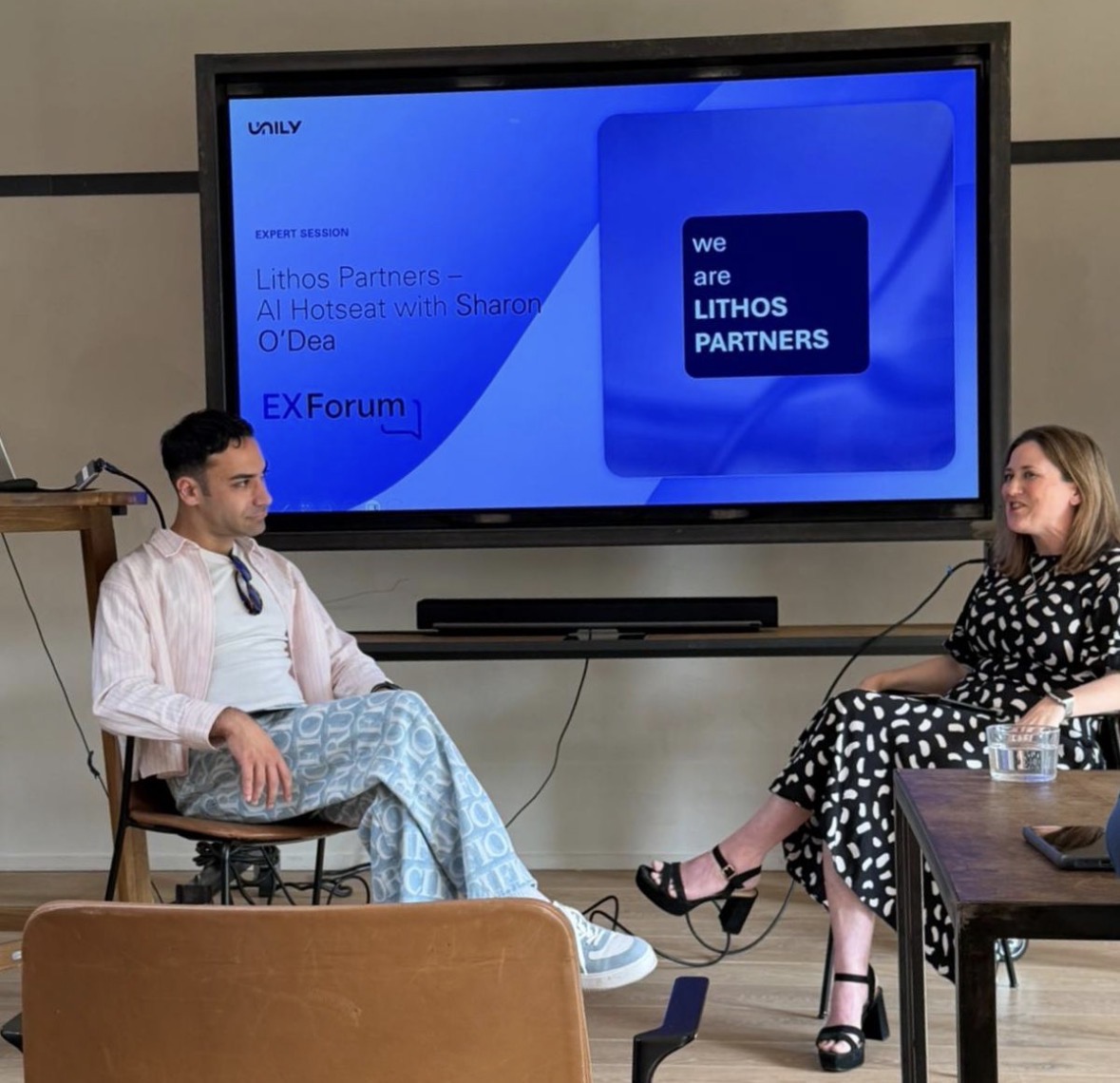
And I spoke at a Unily event, which was a splendid use of a morning. I’d prepped a bunch of talking points: start by actually understanding the problem you’re trying to solve, and — the less fashionable one — that governance has become more critical, not less, as the thing that maintains trust in an AI age. Reassuring, then, that ASML’s session right before mine had arrived at exactly the same place from the practitioner’s side. Always better to be the second person to say a thing.
Also this week
The gym, relentlessly. Strength, HIIT, boxing, four spin classes (two back-to-back). This is, I’ll admit, not a regime so much as a series of overcorrections. On the road I’m too busy and too tired to do anything. Then I come home and attempt to settle the debt in one go, as though the human body operates on the same accounting principles as an Amex card. It does not. But I have become the sort of person who has opinions about kettlebells, so something is working.


The rest of the week was just Amsterdam doing its thing. The sun came out, and the whole city rearranged itself around it — terraces full by four, everyone suddenly somewhere with a drink and nowhere to be. There’s a version of this place in February that tests your commitment. This was not that version. When the weather turns, I’m fairly sure it’s the best city in the world, and I say that with the smugness of someone who gets to keep living here.
Consuming
A pal and I went to see The Devil Wears Prada 2 at the cinema, which was jolly fun. Tl;dr: Script: 6/10. Styling: 10/10. Aircon: 11/10.
Good for the diehards, a fun one-time watch that doesn’t match the aura of the first. But the part I enjoyed most was Justin Theroux playing a spray-tanned tech billionaire with a receding hairline, trying to buy Runway magazine for his girlfriend after divorcing his altruistic philanthropist ex — the ex, played by Lucy Liu, then going off to solve the world’s problems with her divorce windfall. Remind you of anyone? The film isn’t even coy about it: the girlfriend wants him to buy the magazine so she can run it, which is the Condé Nast rumour with the numbers filed off.
And the script does still spark when it matters, mostly because the best lines go, as they should, to Emily. “May the bridges I burn light my way” is the one doing the rounds, and rightly so. But Miranda’s “You’re not a visionary, you’re a vendor” may be the most useful line I’ve heard all year. I’m trying very hard not to deploy it professionally.
Anyway. The styling is where it earns its ticket. The clothes are smarter and less mockingly ridiculous than the first film. Nobody’s here for the script. We’re here for a dark room, a cold breeze, and Meryl Streep in an iconic coat.
Connections
Dinner this week with Natalie Pereira, who I worked with at Standard Chartered in Asia more than a decade ago and who was in Amsterdam for Money20/20 — along with what felt like half the finance industry.
The bank itself could be a challenging place to work, but it had a remarkable talent for hiring smart, internationally minded people. Natalie was one of them. Back then she showed me around her home city of Kuala Lumpur; this week I got to return the favour, more or less, on the other side of the world.
One of the unexpected dividends of spending years inside global organisations is the network you accumulate: smart, generous people scattered across the map, ready to be caught up with whenever work or life deposits one of you in the other’s city.
We spent most of the evening talking about starting over. Natalie is rebuilding a life in Canada; I’m doing the same in the Netherlands. Different countries, same experience: the paperwork, the cultural recalibrations, the slow business of turning somewhere you live into somewhere that feels like home.
It struck me that we’d landed on the same question that seemed to run through the rest of the week. How much is enough? How much work, travel, ambition, routine, belonging? And how do you hold that balance when the ground keeps moving underneath you?
No conclusions reached, obviously. Just good food, good company, and the comfort of talking to someone a decade and a continent removed from where you first met, and somehow not removed at all.

Published
A little over a month until the book is out, and this week’s teaser is on a subject close to my heart: Why intranets fail: governance, not technology.
The post starts with a familiar story. An intranet is struggling, people are unhappy, and the hunt begins for a culprit. Usually the technology gets arrested first. Wrong platform. Bad search. Over-promised implementation. Time to buy something else.
The trouble is that technology is where problems show up, not necessarily where they begin.
Most digital workplace failures aren’t caused by one catastrophic decision. They’re the cumulative effect of dozens of perfectly reasonable ones. An exception granted here. An ownership gap there. A standard ignored because everyone was busy. Over time, the system becomes harder to manage, harder to trust and harder to change.
Which is why I’m increasingly convinced that governance gets more important as technology gets more capable, not less. AI doesn’t remove the need for guardrails. It raises the stakes when they aren’t there.
My favourite line in the piece is one I’ve shamelessly recycled all week: governance should be cycle lanes, not roadblocks. The goal isn’t control. It’s confidence.
And when it’s working properly, nobody notices it at all. Which is, rather inconveniently, how you know it’s succeeding.
Travel
Nothing this week. I stayed in Amsterdam and, for once, resisted the urge to turn every free weekend into a boarding pass.
Which, given the theme of the week, may have been the correct dose.
A few days at home. Some decent weather. A city that reminded me why I chose it. Not every problem requires a flight.
The reprieve won’t last long. The IABC World Conference in Toronto is suddenly less than a fortnight away, and my preparations remain at the classic stage of “flight booked, details pending”. If you’re in Toronto, Ottawa or Montreal and fancy talking comms, intranets, AI, governance or any adjacent flavour of workplace geekery, give me a shout.
The human side is always the real reason to cross an ocean for a lanyard.
This week in photos