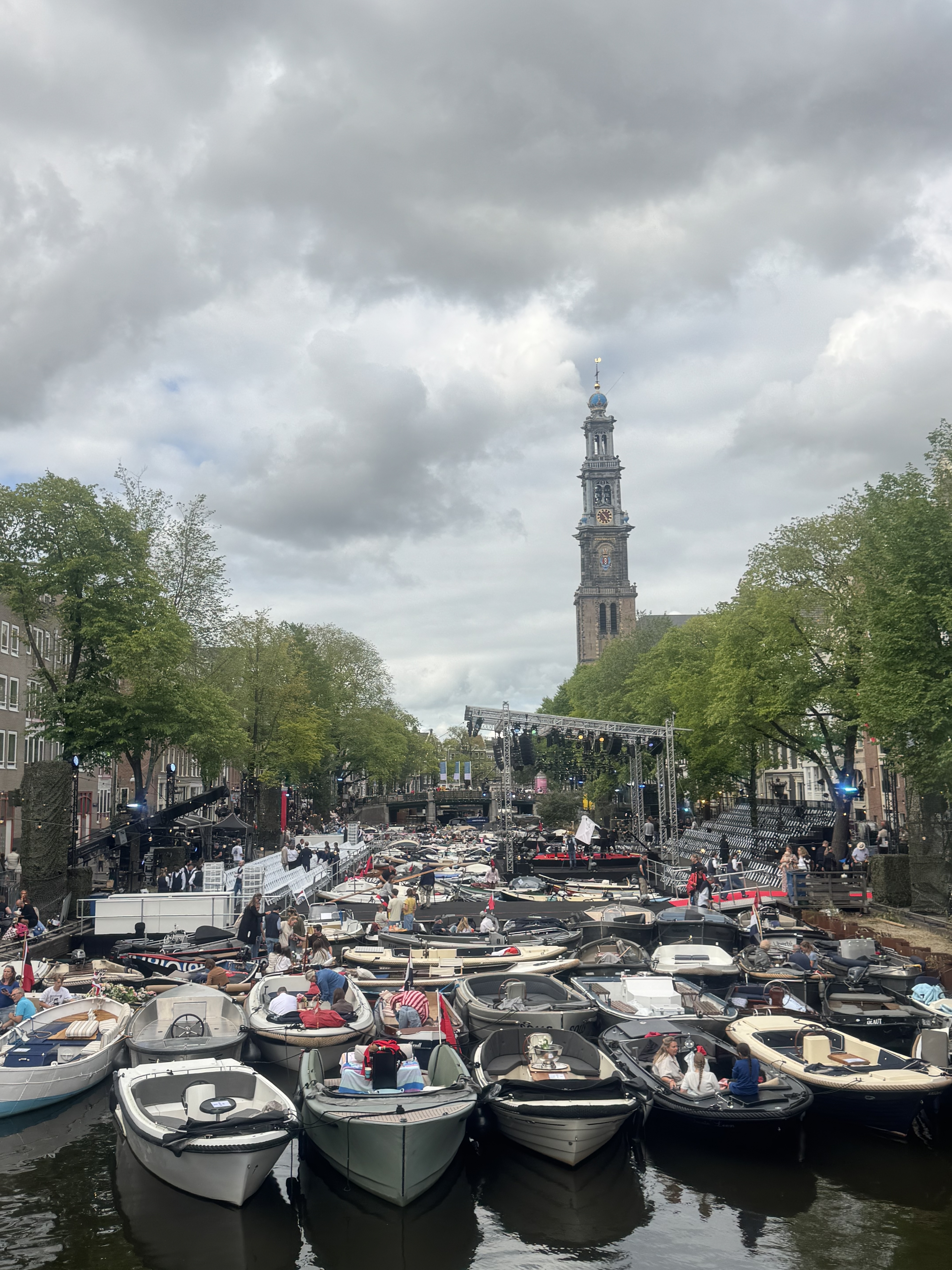
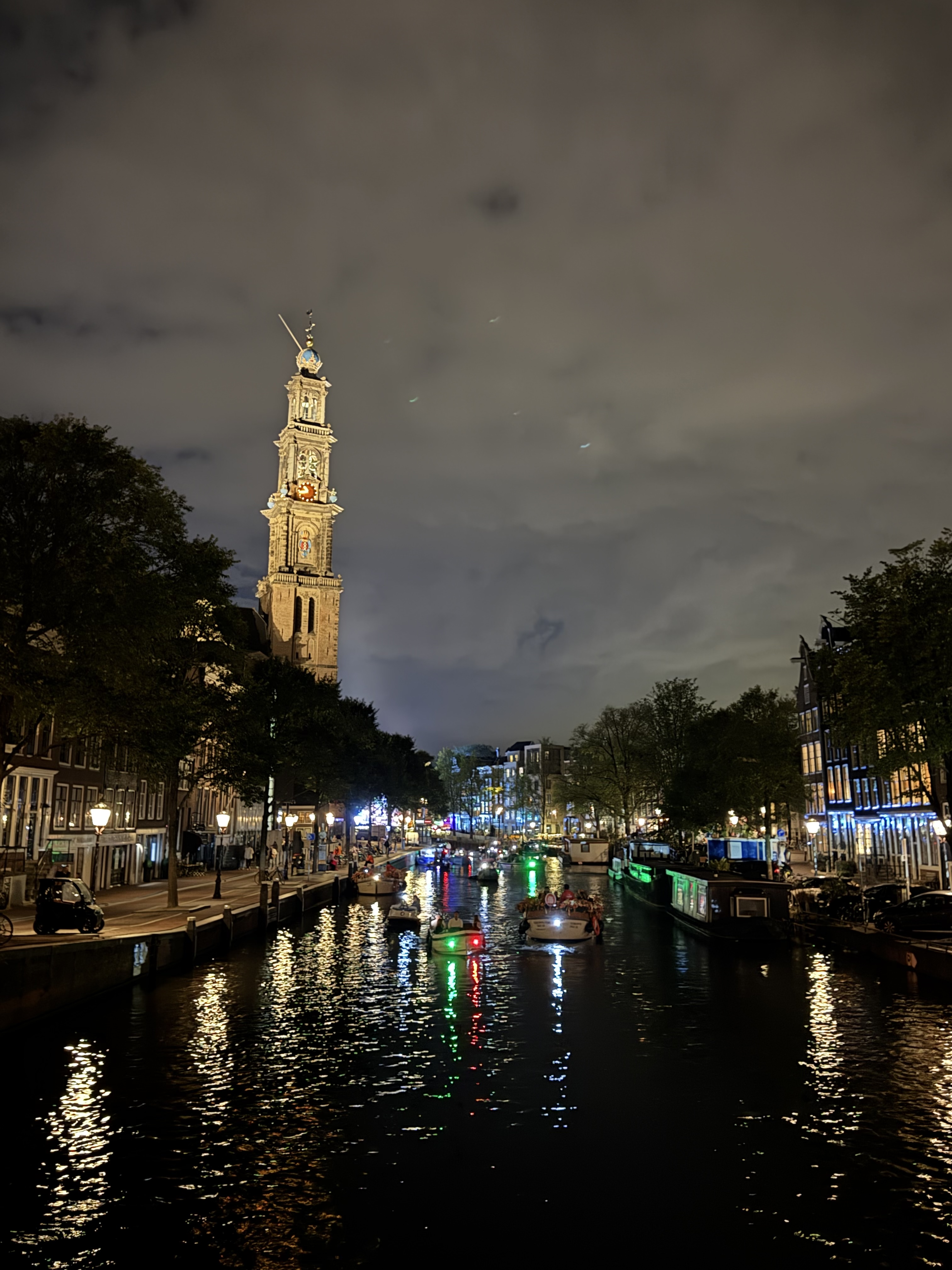
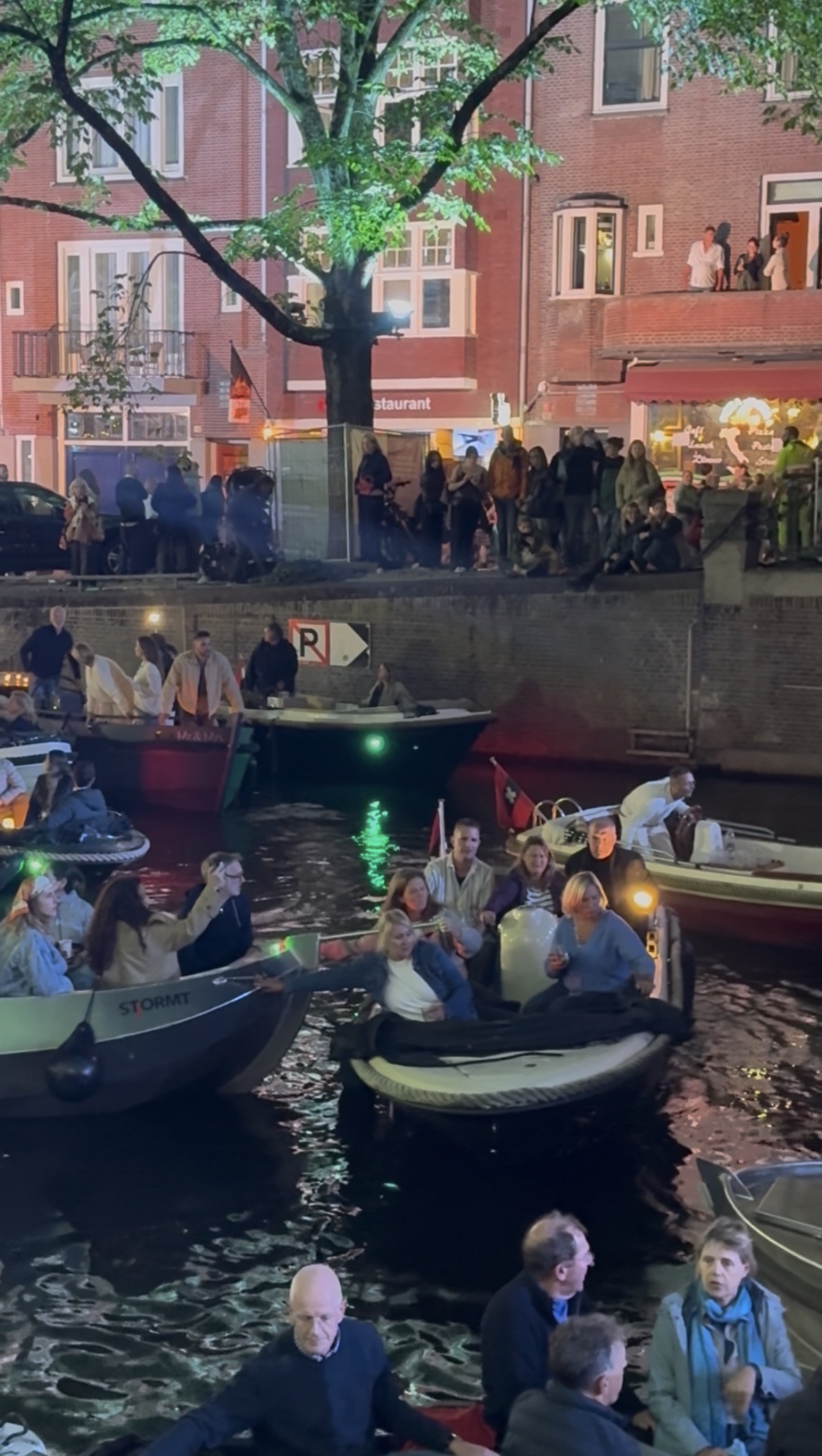
My second favourite part of the Prinsengracht Concert, after several thousand people singing Aan de Amsterdamse Grachten together, is what happens immediately afterwards.
Hundreds of boats have spent the evening crammed into the canal, several deep, wedged against one another in a configuration that suggests nobody gave much thought to the concept of leaving. Then the concert ends and, simultaneously, everyone would like to go home.
It is magnificent.
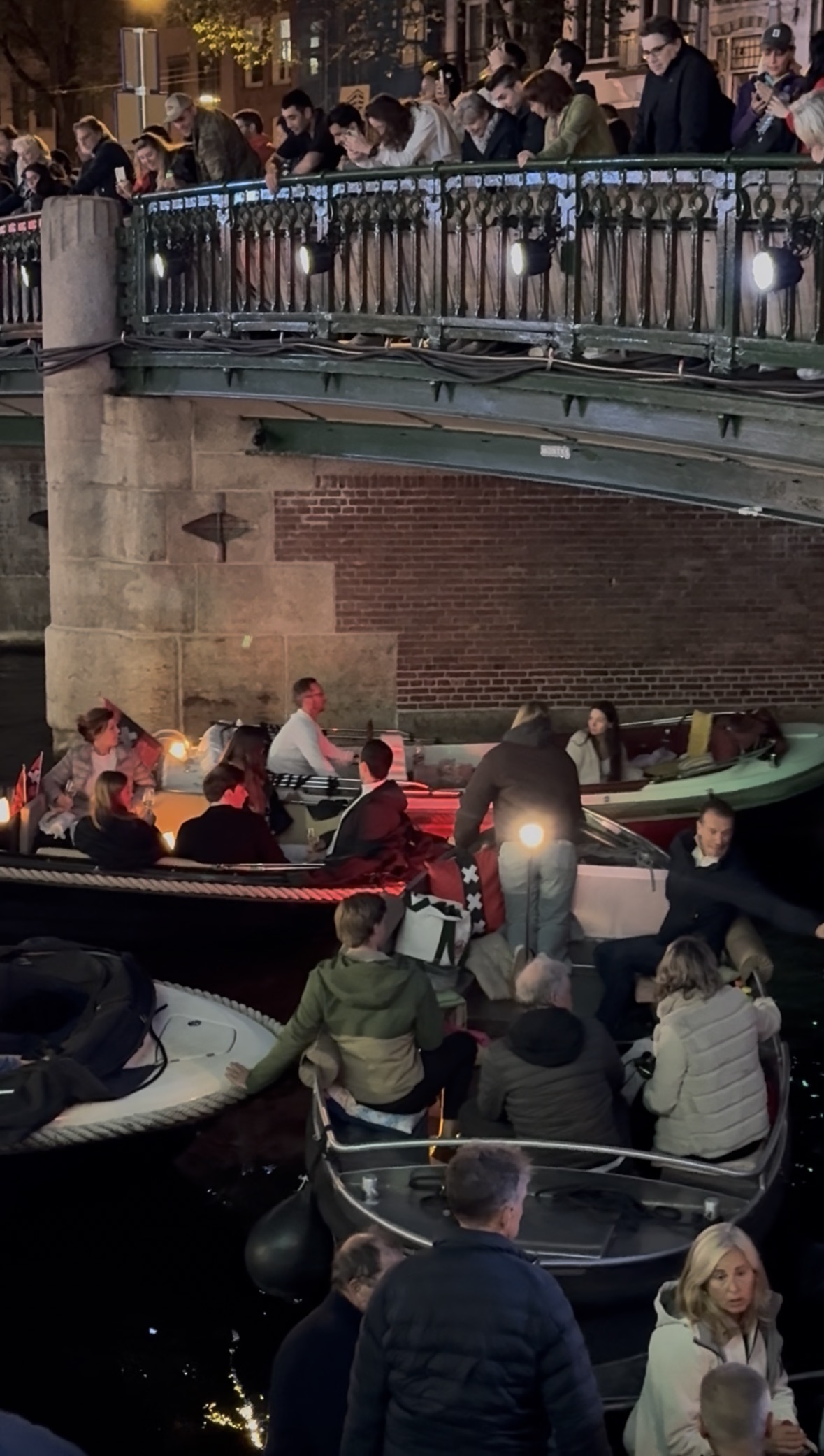
For the next half hour the Prinsengracht becomes a giant aquatic game of Dodgems. Boats reverse into gaps that don’t exist. People push off neighbouring vessels with their hands. Someone three boats away is shouting instructions to a person they have never met. Entire flotillas shuffle sideways because one tiny boat has committed to a three-point turn and apparently we’re all seeing this through now.
From the bridge, it looks like complete chaos. Except it works.
There’s a system in there. It’s just not the sort anyone would put into PowerPoint. It runs on eye contact, shouted instructions, local knowledge, mild peril and hundreds of tiny negotiations between people adjusting constantly to what everyone around them is doing. There are formal rules, obviously, but they get you only so far when you’re pointing backwards in a canal with someone’s bow six inches from your wine glass.
Organisations work rather more like the Prinsengracht at 11pm than anybody designing an operating model would ideally like to admit.
We draw the hierarchy as a pyramid, put one person reassuringly at the top, arrange everyone else underneath and call it an organisation. We map systems into boxes. We assign owners. We draw solid lines and dotted lines and spend quite a lot of money arguing about where they should go.
This is all useful, up to a point. The problem comes when we mistake the diagram for the thing it describes. Reality has an irritating habit of continuing to be three-dimensional after we’ve put it on a slide.
The mess isn’t necessarily evidence that there is no system. Sometimes the mess is the system.
This week at work
Organisations are way more complicated than their org charts.
Someone can turn up wearing one organisation’s uniform, carrying another’s lanyard, logging into a third’s systems with a password reset only the first can authorise, doing a job that half of them think belongs to somebody else.
Work runs through partners, contractors, shared services and joint ventures, and plenty of people hold more than one allegiance at once. There’s a chapter on this in the book, framed mostly around the gig economy and deskless work, but the same problem turns up anywhere separate organisations share most of a back office and almost none of a culture.
That’s a comms problem before it’s a technology one. Your channels have to fit the organisation you actually have, mess included, rather than the neat little pyramid with one person at the top and everyone else arranged obediently underneath.
This week I ran a workshop with comms and digital leaders in an organisation dealing with exactly this kind of complexity. We started with what a digital workplace actually is, and why it matters more, not less, when the organisation around it is changing.
It’s how change gets communicated, obviously. But it’s also how you unlock the value you were promised when you bought all those services in the first place. A service nobody can find is, for most practical purposes, a service you don’t have.
I introduced our graphic equaliser model: the idea that a digital workplace is a mixing desk with four faders — comms, knowledge, transactions, and community and collaboration — and every organisation runs a different mix. Some crank comms all the way up. Others lean heavily into tools and self-service. We spent time looking at where their balance sits now, and where it needs to move.
I love sessions like this because I learn as much as I share about the increasingly messy reality of how work gets done. I always say there’s no right balance, only what’s right for your organisation. What this one reminded me is that there isn’t necessarily one setting for an organisation either.
Different parts of the business need the dials in different places. Increasingly, so do individuals.
Which means the digital workplace has to flex around the organisation you actually have. That took us into the perennial question of what needs local control and what benefits from central planning.
It’s harder when there are multiple reporting lines, because budgets and approvals follow accountability, while work has the irritating habit of ignoring it. Publishing pulls hard towards shared: one system, different lenses. Discussion stays stubbornly local, because that’s where culture lives and nobody particularly wants theirs decided by committee. Planning sits awkwardly in the middle, because of course it does.
No amount of elegant architecture fixes the fact that organisations contain politics.
The dials get set by whoever holds the budget line. They get lived with by everyone else.
Also this week
I tore a hamstring in a HIIT class, which is what I get for going to HIIT classes.
It turned out to be relatively minor, but kept me out of the gym and mostly confined to the flat for the week. Last weekend I was hobbling around with a walking stick, mentally rearranging the next three months of my life around my exciting new identity as Person With Hamstring Injury. By Friday I was walking again, albeit not at my usual faintly aggressive pace.
Recovery was swift enough that I’ve decided to take personal credit for it, having contributed absolutely nothing beyond sitting still.
The one casualty was the line dancing class I’d signed up for as part of my ongoing efforts to Try New Things. I was fully prepared to attend and be heroically bad at it. Then I couldn’t go, so my potential as a line dancer remains mercifully untested.
Next time.
Saturday was the Prinsengracht Concert, one of those moments every year that makes me absurdly glad to live here. The city is both backdrop and main character: a stage built over the canal, thousands of people lining the water, boats packed in until the whole thing looks faintly impossible.
It ends, as it always does, with everyone singing Aan de Amsterdamse Grachten together — a song about how beautiful this city is and how nobody could wish for anything better than to be an Amsterdammer.
Can confirm.
Consuming
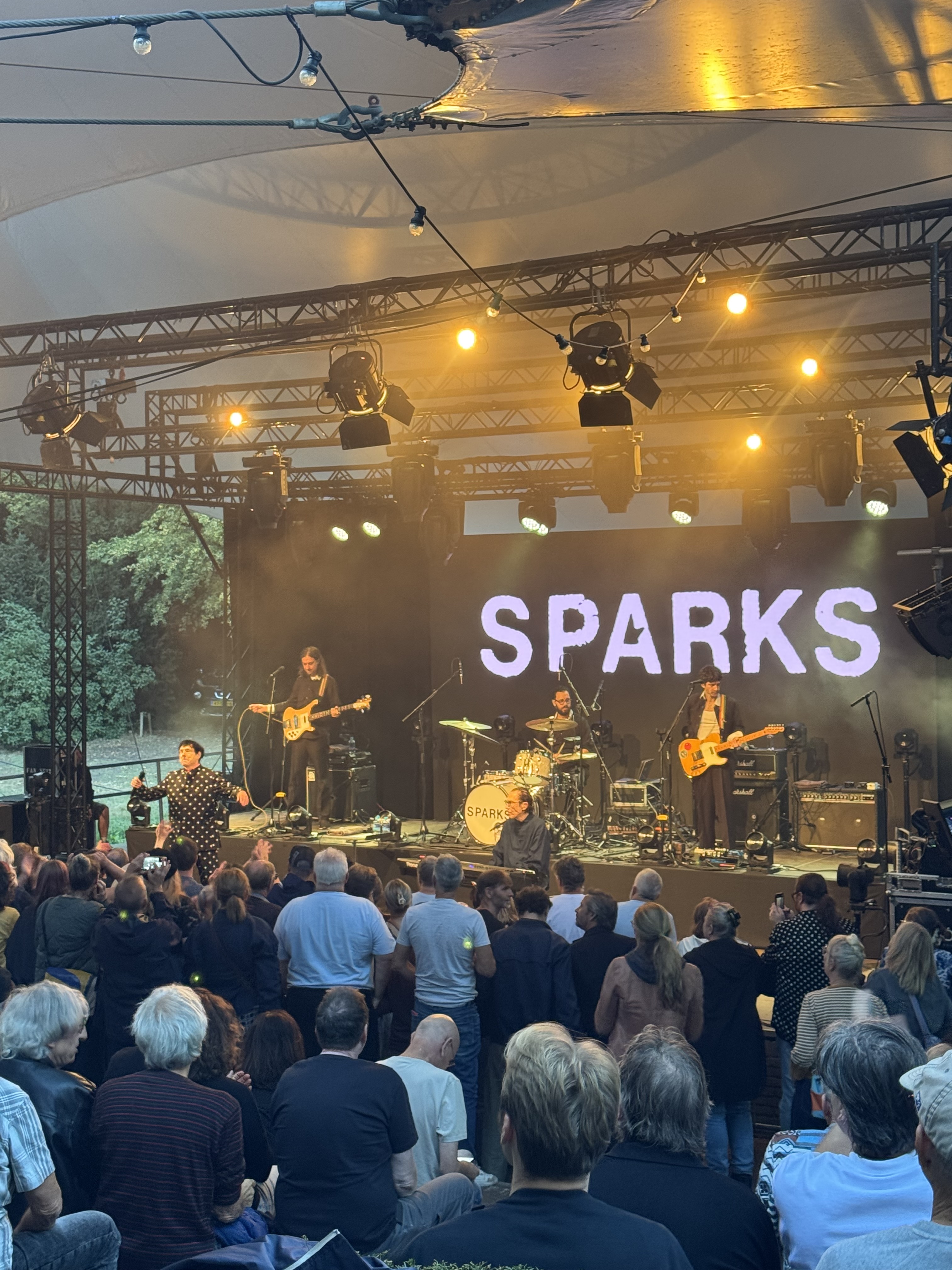
Saw Sparks in Nijmegen, for their only Dutch date this year, in a lovely outdoor theatre. We’d got ourselves in the mood the night before with The Sparks Brothers, Edgar Wright’s documentary: two and a quarter hours of people you already suspected of having excellent taste confirming that they do.
The gig was delightful right up until it wasn’t. They finished This Town Ain’t Big Enough for Both of Us and the heavens opened. They made it through Whippings and Apologies with rain sheeting off the canopies before the show was finally called off for safety.
Sixty years, twenty-odd albums, and I got about two thirds of a set. The Mael brothers have outlasted glam, disco, synth-pop, Britpop and several physical media formats, only to be defeated on Thursday night by Dutch weather.
I’ve also been transfixed by the Spirit Airlines story all week. Google has bought the bankrupt airline’s entire internal archive for $10 million: a hundred million emails, five hundred million Teams messages, seventeen million files, all to train AI on. Former employees are now in court trying to get themselves removed from the dataset.
It has absolutely everything.
What happens to how people behave at work once they realise the archive might outlive the company. The legal question of whether anything you wrote at your desk was ever really yours. Bankruptcy law colliding with data protection colliding with AI. Organisational complexity. Workplace technology. The lot.
And then there’s the bit I keep turning over, because I love nothing more than to be a contrarian, which is that this might actually make the software better.
Enterprise software has always been designed for an organisation tidier than any organisation that has ever existed. When I spoke to the Facebook team during the Workplace years, they seemed genuinely baffled that companies didn’t want information to be open in the way it was at Facebook. That openness was the product. It was also one of the reasons so many corporates couldn’t use it.
Microsoft, all these years later, still can’t cleanly accommodate someone holding multiple affiliations with one institution, never mind several institutions at once — which describes an enormous number of people I encounter through work.
Nobody has ever had a really good dataset showing how a large organisation actually functions, because all the interesting stuff is behind a firewall. The formal structure is easy. The useful bit is the messages, workarounds, accidental networks, weird permissions, duplicated effort, informal power and the seventeen people you have to ask before discovering that Sandra in Finance knows how it works.
Now, suddenly, there’s one on the open market.
The messiness is exactly what makes it valuable.
Which is also the problem. The upside depends on the data being rich, specific and human enough to reveal how work really happens. The privacy disaster is that it’s far too rich, specific and human to anonymise properly.
There’s no version where you get one without the other.
Connecting
Three this week, all people passing through.
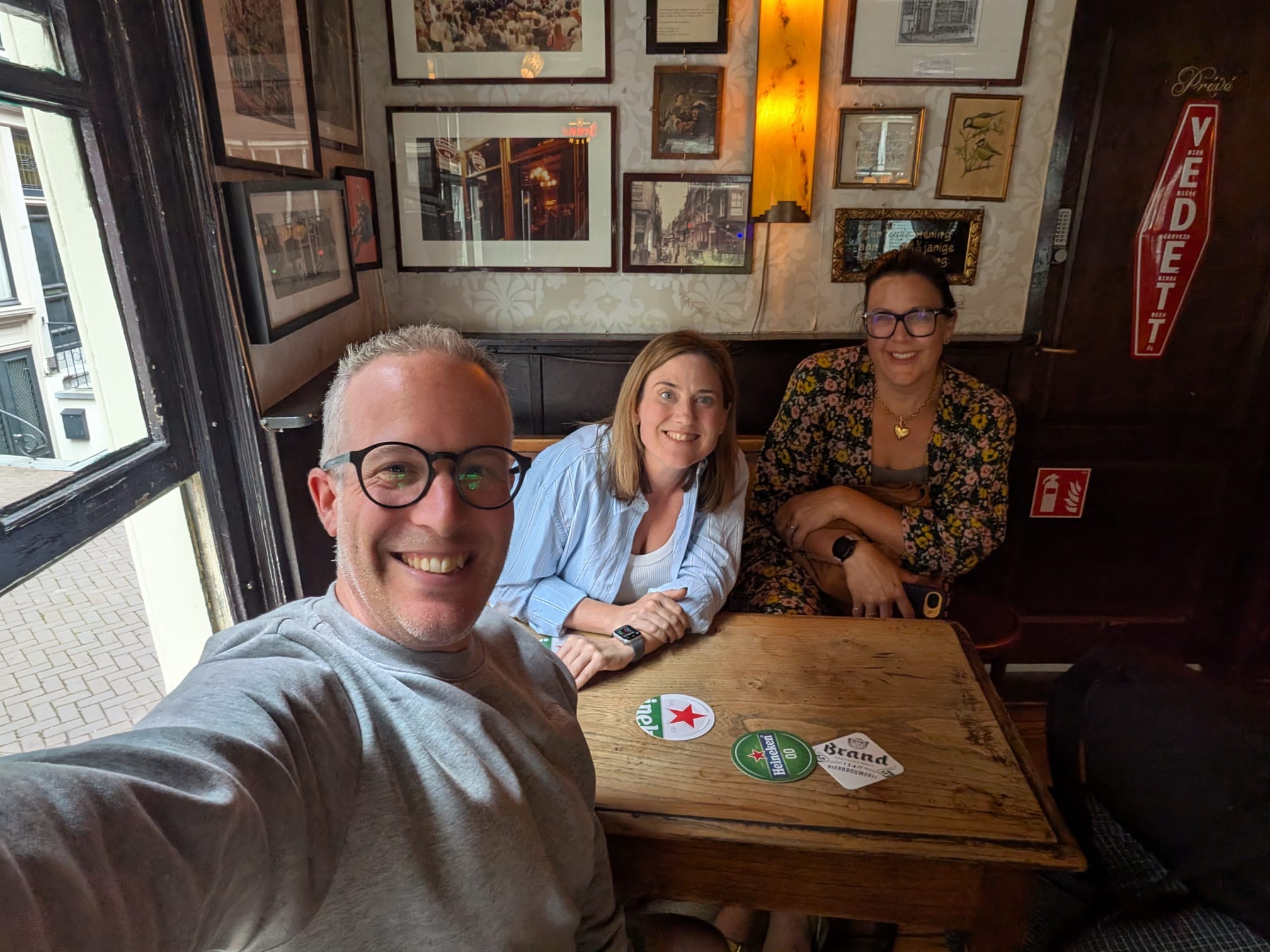
Mark Chapman, who runs an NHS intranet, was briefly in town. I failed to have a proper conversation with him at the book launch, just as I failed to have a proper conversation with almost everyone at the book launch, so we made up for it in my local by nerding out about intranets at considerable length.
Then Chris Higham, finally, in person. Chris and I are part of a group that formed on Twitter years ago around sharing our fitness ups and downs, then migrated to WhatsApp when the platform went the way it went. It’s still one of the most supportive gangs I’m in: the rare group chat that survived the collapse of its natural habitat (I wrote about that community in 2025/49)
He was over with his family on holiday, so I got to meet all of them too.
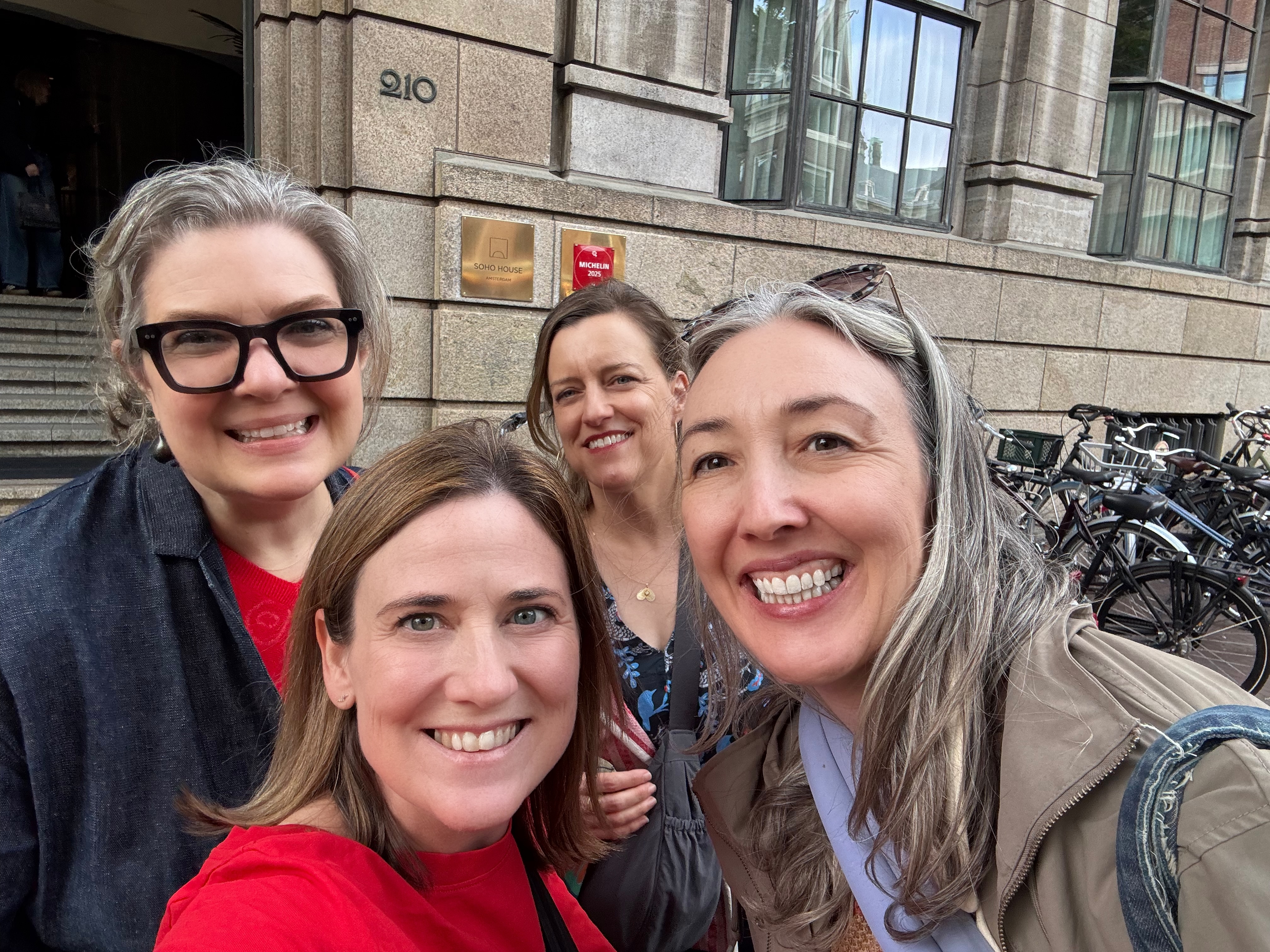
And yesterday, a walk-and-talk with Anne Ditmeyer, a Paris-based designer and facilitator I met at the Awesome Authors meet in London in May (see Weeknote 2026/21). She was in the Netherlands for a design event, so we walked and talked about unlocking creativity. Eexactly the sort of conversation that gets better once you remove the table.
She also introduced me to Bonnie Cauble and Sarah Pedlow, both creatives based here. Amsterdam continues its long-running campaign to make everyone in the world no more than two introductions away
Travel
Autumn has been sitting ominously in the calendar for a while now.
This week it begins: a quick trip to Bristol.
This week in photos