
I began this week at Metamorphosen at the Rijksmuseum, and Ovid’s transformations followed me everywhere afterwards.
“My purpose is to tell of bodies which have been transformed into shapes of a different kind,” he wrote. The exhibition traces two thousand years of artists grappling with his central insight: everything is in constant flux, yet nothing truly disappears. Forms shift, but essence persists. Chaos finds structure. Internal becomes external. The creator falls in love with their creation.
What struck me most was the question posed in the Chaos & Creation room: “From where does form emerge from formlessness? When does matter become animated? And is creation ever truly complete?” These felt less like ancient philosophical puzzles and more like the exact challenges I’d be wrestling with all week — helping organisations shape pilot communities from sprawling possibilities, watching AI tools cross the line from experiment to operational reality, seeing my own book transform from manuscript to physical object while readers transformed it again through their responses.
Ovid positioned himself as Arachne’s counterpart: a weaver of verses, binding everything to everything else. That’s the work, really. Taking the scattered threads — theory and practice, context and constraint, internal understanding and external expression — and weaving them into something coherent. Something that holds, resonates, delights.
But the exhibition also reminded me that not all transformation is benign. Metamorphosis, as the Jupiter and Medusa rooms made clear, can mean the loss of agency. Power often dictates who gets transformed and how. The Narcissus myth — falling in love with a reflection, “mistaking a mere shadow for a real body” — felt particularly relevant in a week spent thinking about digital literacy, social media advocacy, and the gap between what tools promise and what they actually deliver.
By week’s end, I was seeing transformation everywhere: platforms becoming pilots, internal voices becoming external influence, chaos becoming creation. Everything shifting, nothing disappearing.
This week at work
Helped an organisation plan their Viva Engage rollout — a perfect example of that Chaos & Creation question: from where does form emerge from formlessness? Right now we’re looking at what communities to include. Enough to test what we need to (governance, planning, resource, training, and impact on content/channel strategy), but small enough that it’s genuinely a pilot and not opening up to the whole company. Jon and I spent an intellectually brilliant day kicking the tyres on this one, reflecting on what we’ve experienced elsewhere, what people told us when we did the research for the book, what the theory tells us, and the context of this specific organisation and its needs. We’re both pretty happy with the rigour of the recommendations we made. And it’s stuff like this which means I’m still fascinated by this work, twenty years in.
We’re helping another organisation plan and budget for a platform proof of concept. Again, applying theory, practice and context to come up with an estimation model that we think stands up to scrutiny. The work of giving shape to the shapeless, making the invisible visible.
Spent two days at HR Tech Europe, and came away thinking about Jupiter’s transformations — gods taking on different forms to serve their own ends. The rhetoric was all about AI enabling humans, but when you dug into the actual solutions, most were designed to make HR’s life easier by pushing complexity onto employees. There were exceptions — Pandora’s Byron Clayton showed what genuine transformation looks like when you redesign work rather than just digitise it, freeing store managers from 12 hours a week of admin to get back on the shop floor — but they felt rare.
What struck me most was the ‘AI Proximity Paradox’ that Mercer presented: the more employees use AI at work, the more anxious they become about it. Getting closer to the digital reflection only to become more unsettled by what you see. Meanwhile, 42% of people don’t understand what value AI will bring them, but they’re three times more likely to adopt it when leaders communicate clearly. The bottleneck isn’t the technology. It’s us.


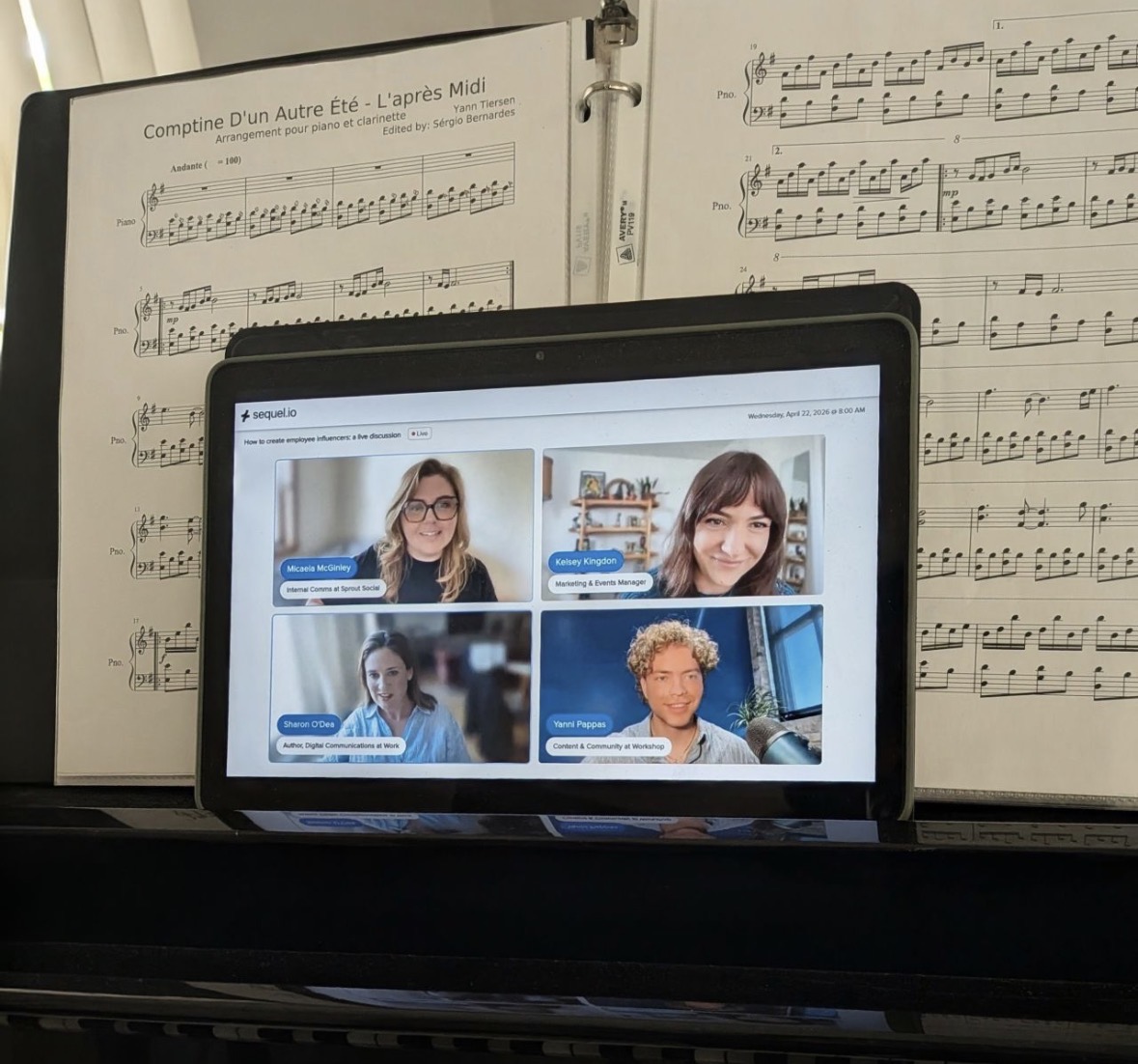
Did a brilliant webinar with Workshop on employee influencers — pure Arachne territory, this. The art of weaving internal understanding into external voice. Kelsey Kingdon, Yanni Pappas, Micaela McGinley and I spent an hour unpicking how internal comms is becoming external comms in 2026. How well a brand gets delivered externally depends on how well it’s understood internally. If your people don’t get your mission, vision, and values, then (as Yanni put it) you’re cooked. You can’t push for external advocacy without doing the internal work first.
People want stories, not to be sold to. And those stories come from lived experience, not from marketing. The other thing that landed: this isn’t something IC owns alone. Employee influencer programmes that work are cross-functional by design. When one team tries to own it, silos kill the programme along with it. My contribution: this stuff is inherently risky. Some things don’t land, things can go pop that you didn’t expect, and content can go viral for good reasons and bad. Employee influence is hugely powerful, but if you’re deploying it you have to be prepared to take the rough with the smooth — and support employees when it goes sideways.
Got the endorsement quotes in for our book. I might have cried a bit reading them. It’s weird, writing a book then handing it over and seeing what people think. A bit like Pygmalion, in reverse — you create something, fall in love with it, then watch other people bring it to life in ways you never imagined.
Also this week
Tomorrow is King’s Day. Which means the drinking starts this afternoon and runs through to about 7pm tomorrow. Nobody much cares whether you’re Dutch, or whether you have any feelings about the monarchy. Wear orange. Grab a beer. You’re in. Nationalism done about as well as nationalism can be


As I mentioned, I went to Metamorphosen at the Rijksmuseum earlier in the week. If you’re in Amsterdam, catch it before it closes next month — it’s genuinely worth the trip. The way it traces transformation across two millennia of art is remarkable, and (as this weeknote attests) you’ll find yourself seeing the themes everywhere afterwards.
Consuming
Two classics over the weekend. Priscilla, Queen of the Desert, because my husband had somehow never seen it. A neat loop back to Metamorphosen and the Hermaphroditus works — though I didn’t plan that. I first saw Priscilla when it came out, when I was about fourteen. Suffice to say it lands differently now. Which is its own kind of metamorphosis: the film stays the same, but I’ve been transformed by everything I’ve encountered since. What felt like pure spectacle at fourteen now reads as something deeper about identity, belonging, the courage it takes to become who you are.
And then The Hitcher, which David watched at fourteen and I’d never seen. Also set against vast, barren desert. That is where the similarities end. Where Priscilla is about transformation as liberation — drag as metamorphosis, the road as a place where you can shed old selves and try on new ones — The Hitcher is about transformation as menace. Rutger Hauer’s character reshaping everyone he encounters, usually fatally. Same landscape, completely different mythology.
Both films reminded me of something the exhibition kept returning to: we don’t just observe transformation, we’re constantly being transformed by what we consume. Every story changes us a little. The question is whether we notice.
Connections
HR Tech Europe was as much about the conversations in the corridors as the sessions on stage. Had a particularly good catch-up with Dr Dieter Veldsman, a Rotterdam-based HR organisational scientist and author. We ended up in a proper deep dive about organisational design — his observation that every company is essentially a reflection of its history of dysfunction really stuck with me. Which, he pointed out, is precisely what makes this work so interesting. And if you’ll excuse one more Ovid insight: we are all transformed by what came before, and the shapes we take now echo the forces that shaped us.

Also met with Ruxandra-Laura Bosilca, a mainstay of the IABC down in Brussels and one of the organisers of last week’s Strategic Communication Leadership Summit. A lovely, if far too short catch-up on an Amsterdam rooftop in the spring sunshine. We covered in-house vs consultancy, what vendors get right and wrong, comms platform buyers, and much else besides.
And Workvivo treated us to a splendid dinner at MOS on a glorious spring day at the Westerdok. Big thanks to Ciaran O’Malley for the invite (and the pronunciation lesson). Good insights from Michael Nord on change communication and Ingrid Meier on IC’s role in digital workplace deployment. Nice to catch up with Leo McCauley and Natascha de Waal and put faces to more LinkedIn profiles. There’s something magical about the transformation of digital connections into actual conversation over good food and wine in the Amsterdam sunshine.


Coverage
New piece out this week in Reworked on why organizations are building digital literacy and calling it AI literacy — when they’re not the same thing at all. Pure Narcissus territory, this. In Ovid’s telling, Narcissus falls in love with his own reflection in a pool. The more he gazes, the more he’s convinced the reflection is real, until he wastes away reaching for something that was never there.
Organisations are doing much the same with AI capability. They’re enchanted by the surface — the workshops, the adoption rates, the tool proficiency — while missing what actually matters. The core argument: digital literacy is about operating tools; AI literacy is about judgment. Knowing when to trust an output, when to push back, when to close the tab and do it yourself.
But most organisations keep staring at their reflection in the digital pool (look how AI-ready we are!) while the real capability dissolves beneath the surface. Ninety percent of people already use AI at work, most without telling their employers. The problem isn’t that they don’t know how to use it. The problem is that 92% don’t check outputs for accuracy, even though they express skepticism about what AI produces. That’s not a training gap. That’s a judgment gap. And you can’t close it with a Copilot workshop.
Travel
After eleven whole days at home I’m back on the road this week. London first, for meetings and book promo, then a few days in France. It’s my first time in Nice, so recommendations welcome. Especially if they involve good food and plenty of walking.
This week in photos


