I spent much of this week being reminded that systems have lives of their own.
You can appoint community champions, but the actual community will organise itself around somebody else. You can design an intranet around the company you think you have. Employees will build another one around the work they’re actually trying to do. You can ask whether AI can replace a chief executive. Then you’ll quickly learn the hard part was never making the decision; it was getting several hundred people to behave as though it was their idea all along.
And if you happen to inflate a giant Donald Trump on Amsterdam’s canals, the city’s seventeenth-century bridges will provide a piece of physical comedy no creative director could have improved upon.
Systems, it turns out, are always co-authored by reality.
This week at work
Two client conversations this week. Different organisations, different problems. Exactly the same mistake.
One is designing a pilot community. As always, the interesting conversations aren’t about technology, they’re about people.
Specifically, which people.
Not the loudest voices. Not the volunteers. Not whoever has Community Champion in their email signature. (We’ve retired the word champion, which is probably healthier for everyone.) The people you want are the ones who are already connecting the organisation without being asked. The colleague everyone seems to know. The person whose Teams chats somehow span six departments. The ones who bridge gaps that don’t officially exist. You find them by watching what they already do, not by asking for volunteers.
The other client wanted to know why their intranet wasn’t working.
It turns out it’s organised around the people who publish to it, not the people who use it. Search for something and you don’t land on “I need to book parental leave” or “How do I order a laptop?” You land on “HR Services” or “Corporate Operations”, because the architecture reflects the org chart rather than the work. One team became so frustrated they quietly built their own version elsewhere. Nobody approved it. Nobody budgeted for it. They just needed something that solved the problem in front of them instead of the one the organisation thought they had. These are some of my favourite projects because, on paper, nothing is obviously wrong. The platform is fine. The content is mostly fine. Governance exists. Ownership exists. Every individual decision makes perfect sense.
It’s like one of those suburban Frankenhouses assembled over forty years from planning permission, optimism and B&Q vouchers. The conservatory solved one problem. The loft conversion solved another. The garage became a gym for six months before the running machine became an expensive laundry drying rack, and the room was turned into an office. Every owner improved the bit immediately in front of them until the whole thing acquired the navigational logic of an escape room whose clues were designed by six different consultancies.
None of those decisions was irrational. Every extension solved a genuine problem. It’s only when you try to get from the front door to the garden that you realise the shortest route involves passing through six unrelated architectural eras and apologising to whoever’s on a Zoom call in what used to be the garage.
Organisations build digital workplaces in much the same way.
Nobody sets out to build something incoherent. It just accretes that way, one perfectly reasonable local decision at a time. Every team improves its own room. Every department hangs another sign. Every budget cycle adds another extension. Nobody is designing the journey. They’re decorating individual rooms.
Fixing it requires someone who can look across the whole floorplan and say, “Yes, that’s better for Finance, but it’s worse for everyone else.”
Which means you need two things in the same place: someone who genuinely advocates for employees, and someone with enough authority to overrule everybody else.
Most organisations have one or the other. Very few have both.
So the house keeps growing. Another extension. Another corridor. Another perfectly sensible decision that makes the whole thing slightly harder to live in.
Two client rooms. One week. Same lesson.
Also this week
The popup gym closed this week. I found myself milking every possible moment, signing up to five classes on five successive days. And even going to a gym closing party. I’m now a person who goes to parties at the gym. Who even am I?
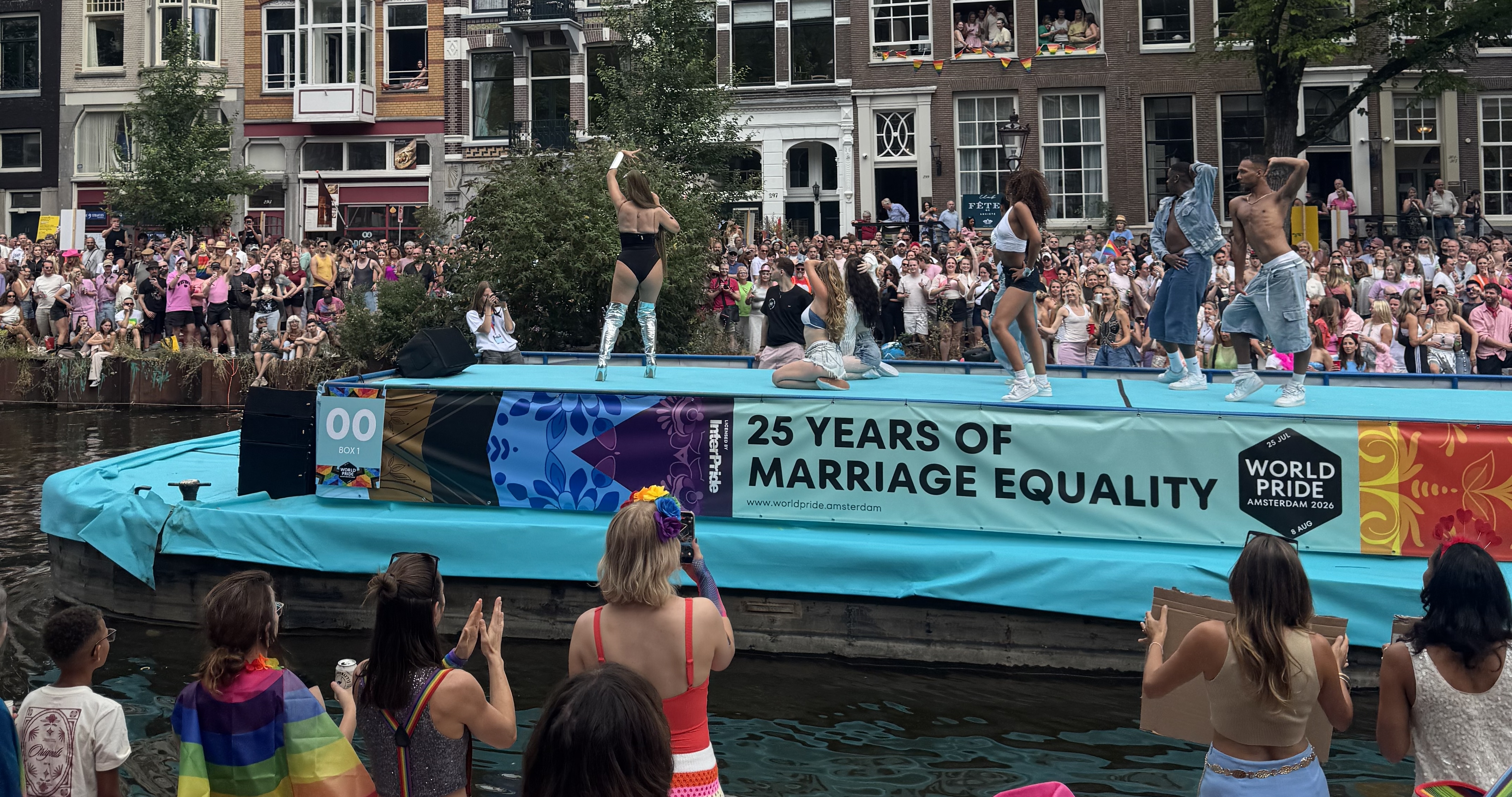
This weekend was Pride in Amsterdam. It’s one of my favourite weekends of the year, and this year’s had an extra layer: Amsterdam is hosting WorldPride, marking twenty-five years since the Netherlands became the first country to legalise same-sex marriage.
The city has been celebrating all week. Around the corner from me, at the Westermarkt, the festivities opened with the Drag Olympics, featuring events such as stiletto sprinting and the handbag toss. As with so many Dutch traditions, nobody seemed entirely sure whether this had always existed or had simply materialised because it was a good idea.
Yesterday was the Canal Parade. Eighty boats making their way down the Prinsengracht, representing every imaginable corner of the city’s LGBTQ+ communities, from the Ministry of Defence to Roze 50+ to Amsterdam’s museums turning up together in solidarity. Noticeably fewer corporate boats than in previous years, and all the better for it.
The best float, by some distance, was an enormous inflatable Donald Trump and Vladimir Putin locked in an embrace.
Amsterdam’s canal bridges are lower than many of the boats, so every single one has to deflate before passing underneath, then reinflate on the other side.
Which meant that, every few hundred metres, Trump and Putin would slowly crumple into one another, disappear beneath the bridge in a heap of orange and grey vinyl, then rise majestically back into existence for the next stretch of canal.
Nobody planned that joke, but the bridges just kept telling it.


Coverage
Allie Nawrat at Unleash asked me to weigh in on Skyfall AI’s plan to buy a small software company and install an AI as CEO.
I’ll never turn down an invitation to opine on this kind of thing, so I was delighted to pen an op ed in response. My take is that they’re testing entirely the wrong thing.
The experiment assumes the difficult part of being a chief executive is making decisions. It isn’t. Plenty of people can make decisions. The difficult bit is persuading several hundred other people — each with their own priorities, incentives and entirely reasonable objections — to act as though those decisions were sensible all along.
Revenue, churn and customer growth are the exhaust, not the interior. If your test company is small enough that everyone already knows everyone else, you’ve just removed the thing that makes leadership difficult in the first place.
Which is why I suspect they’re less likely to discover whether AI can replace a CEO than whether a small software company can survive six months with an unusually confusing org chart.
And, small housekeeping note: the book is now finally out in the US and Canada too. If you’ve spent the last few weeks apologetically explaining to North American colleagues that it existed but was being withheld from them for reasons nobody could satisfactorily explain, you can stop doing that.
Travel
None. I’m home, holding the fort while Jon’s in Canada. Quiet on this front for now. The calm, however, is temporary. The autumn diary is now filling up at a rate that suggests Future Sharon has made a series of commitments Present Sharon hasn’t properly thought through.
This week in photos




Pingback: Start with Discovery: how to find out what’s actually wrong with your internal comms | Sharon O'Dea