What’s setting social alight in 2017?

It’s a year since I got out my crystal ball and made some predictions for social media in 2016. Was I right? Partially.

It was indeed a steady-as-she-goes kind of year on social, with brands focusing their resources on a smaller number of channels rather than experimenting with new ones. Meanwhile, the platforms themselves have evolved, driven particularly by a desire to compete with upstart mega-unicorn Snapchat. Chat and real-time interaction grew. But the financial services sector has been slower to move than I predicted, so my suggestion that banks would finally embrace Instagram and move mobile wallets to social wasn’t as accurate.

You don’t need to be Mystic Meg to see where social media is going; it’s becoming more visual, more creative, more interactive – and more commercial. But that’s balanced by growing demands for quality and veracity. So what’s going to set the social world alight in 2017?

Going live

The biggest new trend this year was live video, which burst on the scene in 2015, but really took off this year with Facebook Live, YouTube Live and Instagram Stories all trying to copy Snapchat. Live social video was at the centre of several big news events, and it quickly became a key tool in the news producer’s armoury.

Forward-thinking brands such as the FT are already on board with this. My guess is that the ‘mass market’ will follow suit soon, as a means of giving audiences a view behind the scenes while delivering engaging content quickly and cheaply. The platforms themselves are starting to roll out support for pro users (such as Periscope Producer) and by the end of 2017 brands should have live video as a central plank of their social media strategy.

Twitter: turn it off or turn it up

It’s been a tough year for Twitter with its share price dropping following failed takeover talks. But it’s responded to rumours of its demise by pivoting from a social network to a real-time news and entertainment company and embracing its place as a second screen in an attempt to regain lost audiences.

As a result brands will question the value of Twitter as a delivery mechanism for content and links to websites. Some will close their channels, but more switched-on communicators will up their Twitter game to capitalise on the strong relationship between Twitter and TV.

Twitter audiences are smaller but highly influential compared to those on other channels. 35% of Twitter users regularly share their opinions on people and brands; these people are a third more likely to actually convince people of their opinions. They have a discovery mindset and seek content that is live, open and shareable so they can influence and engage others in an informed way.

Top-performing social brands can leverage this by using their feeds to provide the “pub argument ammo” this influential group want. That means shareable visuals which inform and educate, plus key facts that help them back up an argument.

Twitter’s not dead, but it’s a very different beast to 2008 so brands need to revise how they use it to make the most of its current strengths.

Enabling self-expression

In this year’s Internet Trends Report Mary Meeker charted the evolution of social tools that enable people to express themselves by creating an artefact – beginning with simple emojis through to Bitstrips and, more recently, Snapchat, with its simple-to-use lenses.

This trend shows no sign of slowing down, with apps like playground phenomenon musical.ly  taking off this year. In 2017 brands will need to find new ways to enable their customers to be creative if they want to win the battle for eyeballs.

Hybrid public-enterprise social

Facebook’s now well established as a customer service channel, but the long-anticipated launch of Workplace, Facebook’s first foray into the enterprise market, creates new possibilities for conversation to flow in and out of organisations seamlessly.

So for example a customer could raise a query on the brand’s public Facebook page, a customer care team could pick it up and use Workplace to investigate and discuss it, before responding to the customer via Messenger. Workplace’s app platform could make it easy to track conversations flowing between public and closed social spaces in order to deliver better customer experiences.

Quality filters

With the rise of fake news, inaccurate polls and political attacks on experts, 2016 has been a challenging year for the concept of truth – and nowhere more so than on social media. The tech firms have already announced drives to clean up their newsfeed, but this is likely to be a race to stay ahead of the spammers.

The desire for quality could push users to seek out trusted names to help them filter, using humans rather than algorithms. So while some have declared the reign of the celebrity influencer to be over, the demand for content quality could create a new generation of influential ‘quality filterers’.

Facebook have released Signal for journalists to help them with the task of curating content to improve content quality, and I expect further moves from all the main platforms to rebuild trust in shared content.

Inside-out advocacy

The dawn of the post-truth era brings new challenges for organisations and brands, who need to find more creative ways of getting their messages through to an increasingly cynical public. This year’s Ipsos-Mori Veracity Index highlighted how little faith the public have in business leaders, politicians, economists and civil servants – yet trust in ‘the ordinary man in the street’ remains strong. Brands can take advantage of that trust by equipping and encouraging ordinary employees to share on their behalf.

There are a host of social amplification apps on the market which allow comms teams to upload content for their employees to share. But this has to be a voluntary process – the employee needs to choose to open the app, choose content and share it on.

Faced with the need to make content appealing enough to be both read and shared, companies who want to leverage their employees’ networks will be forced to up their content game. 2017 could be the year companies start giving employees content as compelling and engaging as that given to customers.

Chatbots take off

Customers increasingly expect prompt service via social channels, placing pressure on companies to resource real-time social customer care. Artificial Intelligence (AI) can help manage that demand, in the form of chatbots – computer programs that you interact with by “chatting”, for example in threads in messaging apps. These are an important new human/machine interface, simulating intelligent conversation, answering queries and managing simple workflows, increasing the speed of engagement with customers.

Mark Zuckerberg opened the Facebook Messenger Platform to third party chatbots in April, and in the months since more than 30,000 have been built.

2017 will be a year of conversation, with customers talking to brands on Messenger, WhatsApp or Slack. Bots will enable that growth as they become more realistic and more human.

Chatbots are able to bridge the gap between services designed for humans (like text message) and those designed for machines, by breaking complex transactions into conversations. And these conversational interfaces will open up digital engagement to groups who have previously struggled to use online services, by making them more human in design.

Conclusion: convergence creating complexity

The most notable trend for 2016 has been the race for each of the main platforms to ape one another. Snapchat copied Facebook by adding Memories. Instagram encouraged users to share Snapchat-like content by adding Stories. Facebook is testing Snapchat-like disappearing messages and added Twitter-like trending topics.

This creates more complexity for users – and for brands, who now have to plan for multiple different content types within each of their channels. In the short term this gives communicators the option to experiment with different, visual content types to see what works. But by the end of 2017 I expect most will have worked out where they get the most bang for their buck and will settle into a more regular publishing pattern that’s more focused in order to reach the right audience with the right content.

What impact will Facebook at Work have on the digital workplace?

Ahead of its rumoured launch later this year, excitement has been building about Facebook at Work – the enterprise version of the billion-strong social network – among intranet, internal comms and digital workplace pros.

It’s not hard to see why. While social intranets have come on leaps and bounds in recent years, thanks to products like Jive and Yammer, there’s also a sense that ESN hasn’t yet been as transformative as many would hope.

facebook-work-ft

Facebook at Work brings the platform’s functionality into the workplace

With its familiar features and user experience, earlier adopters of FB@W have seen exceptionally high levels of adoption and use compared to Yammer, Jive and the like. If this can be replicated elsewhere it could be a real game-changer in the workplace.

There’s little official information out about FB@W, but with a growing number of early adopters on board more details about its functionality and specs are starting to emerge, and I, for one, can’t wait to get my hands on it. I’ve seen a preview and there’s no two ways about it – it looks awesome.

I’m keen to discuss what some of the implications might be for comms, so I’ve arranged to discuss in a live videocast on Blab with scarlettabbott’s Tony Stewart and enterprise collaboration champion Luis Suarez. And we’d like you to join us too. You can jump on your webcam and join us on the video, or ask questions via the Q&A panel.

We’ll be discussing:

  • What we know about Facebook at Work and what it means for the ESN space
  • How communicators might use it
  • What impact it might have on organisations
  • What the challenges may be to successful roll-out

We’ll be live here via Blab.im from 3pm BST (10am ET) on Wednesday, 10 August. Subscribe and join the conversation then, or leave a comment below and we’ll try our best to answer as many questions as we can.

What the 2016 Meeker report means for the digital workplace

Each spring analyst Mary Meeker releases one of the most hotly anticipated slide decks of the year (arguably, the only hotly-anticipated slide deck…). Packed with stats on adoption and use of internet technologies, over the past decade it’s become the most comprehensive analysis of the State of the Internet around.

Her 2016 report was released a few days ago (1 June), and I’ve had a chance to pick out some trends which I think may create demands on digital workplace professionals in the coming years.

Arise, the Snapchat generation

In last year’s report Meeker noted Millennials were no longer an opportunity or threat to prepare for, but now the majority in the workplace.

This year she talks for the first time about Generation Z – a group she describes as “tech innate”, using five screens at once. While Gen Z aren’t yet making themselves known in the workplace, they’re only a few short years away from doing so.

Gen Z, Meeker notes, have a notable preference for image-based platforms such as Snapchat over text-based ones. In my last blog post I warned against lazy generational generalisations – and that’s borne out by the report too.  While Snapchat use has ballooned amongst younger people, use of it and similar image-based tools is growing (albeit not as fast) among all age groups.

That’s because images work; they impact us both cognitively and emotionally, which makes them able to tell a story in the blink of an eye. By embracing the power of images and design we can make digital internal communication more effective. But at the same time this creates challenges; image-based communication is difficult (often impossible) to index for search, and problematic for accessibility. Proceed with care.

Messaging is massive

There are now an astounding three billion messages sent daily on Snapchat, Facebook (inc FB Messenger), Instagram and WhatsApp.

And a significant proportion of messenger-based conversation will be about work. Most DW practitioners will admit that WhatsApp has become the Swiss Army Knife of enterprise collaboration. With employees now carrying more advanced and more usable technology in their pockets than they’re given by corporate IT, they’ve voted with their feet and opted for shadow IT on an unprecedented scale, particularly tools like WhatsApp and Slack.

Too many corporate IT teams have their heads still firmly in the sand on this one. It’s particularly challenging for those in regulated industries to admit their employees are eschewing corporate channels for untrackable personal tools – but it’s now far too widespread to ignore.

Beyond conversation

With Facebook now over a decade old, people have become more sophisticated in their use of social tools, which they now see as delivering far more than simply messaging with friends. The growth of business-focused conversation is driven in particular by Asian IM2.0 apps WeChat, Line and Kakao.

People aren’t content to be passive consumers of information anymore; SnapChat is simply the latest in a long line of tools which enable self-expression and creativity.

Corporate communicators need to consider ways to embed and leverage this innate need to create and converse in their communication processes and tools. Lengthy news stories haven’t cut it for a long time, and they’re unlikely to win in a battle for attention with a sponsored Snapchat filter.

Messaging apps are fast becoming platforms for commerce, and it follows they will soon expect to be able to transact in a similar way using their enterprise tools. Smart companies need to start thinking now how they can use things like Slack integrations to deliver this.

People have become adept at filtering out unnecessary information, demonstrated by the explosion in use of adblockers that Meeker notes. 81% of people will mute video ads – and chances are they’ll do the same with your dull corporate internal comms video too.

But good content still works, if it’s relevant. People have come to expect hyper-targeting, and they expect something of value in exchange for their attention. This requires corporate communicators to have a radical rethink of the way they create and share information – an app or mobile intranet isn’t likely to do the job.

You talkin’ to me?

One of the most talked-about stats in this year’s report was a prediction, from Baidu’s chief scientist Andrew Ng, that 50% of searches would be via voice or image search by 2020

Voice recognition accuracy has come on leaps and bounds, averaging around 90% accuracy – a fact that hasn’t gone unnoticed by users. Already 65% of American smartphone owners use voice commands.

The growth of voice interfaces has a huge commercial and productivity benefits; the average human speaks at 150 words per minute, but can only type at 40 words a minute. Moreover, freeing people from keyboards makes connectivity vastly more convenient when on the move, and opens up greater possibilities for information to be more targeted and contextual.

If voice interfaces and voice search goes mainstream as predicted, people will quickly expect the same from their enterprise tools and systems. How can your digital workplace adapt to a switch in primary interface from keyboard to microphone?

Have you read this year’s Meeker report? (If you haven’t, here’s the slideshare). What were they most interesting – or controversial – points for you?

We’re all Millennials now

Another week, another report on how the demands of the millennial generation are disrupting long-established companies and industries. This week it’s the turn of Oracle, who have produced a report on banks’ urgent need to redesign themselves for the future.

Like the slew of reports that preceded it, Oracle’s Banking is changing… with or without the banks report concludes that established players are facing an existential crisis. Millennials demand more from their service providers, it contends. Banks have been slow to change, but there are a host of FinTech challengers poised to grab their custom.

Study after study shows that banking is the industry most at risk from disruption, but it’s hardly alone – insurance, law, accountancy, real estate, retail and… well pretty much every industry is on the verge of collapse under the weight of millennial demands.

Every day, hundreds of new articles and blog posts about millennials appear. Despite this, no one seems to have a clue what a millennial really is. The mental image it conjures up is of a young person, replete with a printed shirt, reasonable beard and a taste for craft beer. Yet the definitions are much broader than that; even the Wikipedia entry highlights the lack of consensus:

“There are no precise dates for when the generation starts and ends; most researchers and commentators use birth years ranging from the early 1980s to around 2000.”

Overall, the earliest proposed birthdate for millennials is 1976 and the latest 2004.

I was born in 1980, which means I’m either a millennial or I’m not, depending what definition you use. This incoherent infographic explains why I am so awesome:

According to this I’m also unproductive and self-obsessed, so I couldn’t help myself procrastinating further by finding out one way or the other. Pew Internet have a helpful diagnostic which told me I’m 86% millennial. That I listen to Radio 4, have a few grey hairs, live in the suburbs and spend my weekends gardening in my allotment suggests something rather different.

All manner of often contradictory behaviours are typically ascribed to this group. They’re simultaneously narcissistic and self aware. Selfish but socialist. Lazy and entitled, but lacking access to secure jobs and housing. Careerless but ambitious. Fat but fit.

All of this is philosophically damaging in the extreme. My own experience of being – or not being – a millennial highlights just how meaningless the term has become. This demographic window includes people who are pushing 40 as well as those who are still at school, yet are portrayed as a single and very different cohort who are about to disrupt everything.

Millennials’ expectations, we’re told, are shaped by the experience of being digital natives and growing up in a consumer society. A study from PwC on how millennials view work found:

  • They place a really high value on flexibility – 66% want to work from home
  • They also value workplace culture – they want a work environment that emphasises and enables teamwork and collaborative working, and a sense of community.
  • They want transparency and two-way communication and expect to be able to input on decision-making
  • They want recognition for their work and the contribution they make

Millennials have high expectations of their consumer experiences, too. Oracle’s banking report recommends that banks invest heavily in delivering the omni-channel experience that the next generation of customers demand, using data to develop and deliver products that suit millennials’ lifestyles.

Those lifestyles aren’t, however, looming on the horizon for corporations and governments to prepare for; they’re already here. The oldest millennials are, like me, in their 30s, married with a mortgage. They’re leading organisations. Making purchasing decisions. Changing the world by designing amazing products.

Millennials already make up the majority of the workforce in much of the world. By 2025 three quarters of working people will come from this generation.

What’s strange, then, is how millennials continue to be portrayed as ‘other’. Their expectations – of flexibility at work, for example, or banking services that better meet the needs of the modern consumer – might be second nature to millennials, but Gen X can and increasingly do demand these too.

Millennials might have grown up in the era of instant communication, one click purchases and 24 hour delivery, but they are far from the only users of these services. Brand loyalty might be a mystery to them, but consumers from Generation X (and older) aren’t averse to voting with their feet either. Millennials are posited as the smartphone generation, but half of all Apple products are sold to baby boomers.

Rebecca Onion wrote last year that “Overly schematized and ridiculously reductive, generation theory is a simplistic way of thinking about the relationship between individuals, society, and history. It encourages us to focus on vague ‘generational personalities,’ rather than looking at the confusing diversity of social life.”

By decoupling consumer and employee demands from age brackets, we could remove the sense of otherness that has come to characterise future-scanning reports into millennial behaviours. These trends aren’t ones for the future, but for now.

The desires and consumer needs of millennials are those of the mainstream, and that trend will only increase. Successful brands are those which establish appeal across generations. Conversely, those organisations which continue to view millennials as different to the mainstream will quickly find they fall behind.

We’re all beginning to expect personalised well-designed services, delivered across devices and channels around our needs as customers. Those trends might be most visible amongst millennials, but they’re almost as commonplace amongst those born in the sixties, who are at least a little bit millennial too.

As notable modern philosopher Kanye West, who is almost 39, said at last year’s VMA awards, “we the millennials, bro”. And he’s right; when it comes to consumer behaviour, we’re all millennials now.

Seven signs of the social media snake oil salesman

Being on the internet doesn’t make you a social media expert any more than going for a jog makes you an Olympic athlete.

Yes, anyone who goes for a run is more qualified to talk about running than someone who sits on the sofa; but simply having a Twitter account doesn’t mean you know how to deliver real business outcomes using social channels.

Yet while it’s easy to tell the difference between a truly talented and experienced athlete like Mo Farrah  – who is considerably faster than your average Joe – and someone (like me) who finishes a marathon in over five hours, it’s not so easy to quantify someone’s expertise in something as subjective as social media.

As organisations recognise that making a mark in the social space is essential, they’re looking to hire in expertise – but often they have no idea what they’re looking for. And this provides rich pickings for a growing army of social media charlatans, peddling bad advice to unsuspecting punters.

How can communicators, marketers and executives spot – and avoid – these types? I asked my network: what marks a social media ‘expert’ out as a chancer? Suffice to say, this generated some Strong Views, which can be grouped under seven themes. Here’s the seven sins of the social media snake-oil salesman – and how to spot them.

1) Robo-posting

There’s a host of web services which post to social media on your behalf. Used well, these can be valuable – but they can’t be a substitute for real two-way interaction. Buffer, for example, can be a useful service for sharing links to interesting blog posts, allowing users to schedule posts in to create a steady stream rather than spamming your followers.

But if someone’s just spending half an hour a week lining up a stream of links, only sharing headlines – quite possibly without even reading the posts themselves – they’re no more useful to the audience than a bot. The giveaway here is if they seem to post all day, every day, but rarely reply or engage in any real conversation.

“Thanks for the value add. At least follow web best practice 101 and make it easy for your reader to get the crux of the message.”
Marged Cother

But mark of the true amateur, however, is the use of spammy services such as Rebel Mouse – what Anne McCrossan called “robo-posting, content-aggregating, click-baiting waste-of-attention platforms.”

Screen Shot 2016-03-08 at 21.09.58

Stephen Waddington agreed, “Get out of my feed. You can’t automate a conversation.”

2) Quantity over quality

Social isn’t a numbers game – it’s about generating value for your brand or company. This means giving the audience something of value to them – insight, information, even just a laugh – in exchange for their attention. It’s a value exchange.

Steer well clear of anyone who advises generating huge volumes of low-quality content – think “ooh, it’s Friday” pictures – to post multiple times daily to grow reach. You’re almost always better off posting one good piece of content daily than ten bits of crap – and don’t let anyone tell you otherwise.

Instead, look for people or firms who will help you develop and deliver content that your audience will find useful, engaging or interesting. The target here isn’t volume – of content, or engagements – but delivering outcomes such as conversion or brand awareness/consideration.

3) Self-describing as a guru

“People that write how to articles and guides that have plainly never actually worked in a crisis, managed trolls, planned a campaign or created a measurement framework.”
Stephen Waddington

“My feeling is that I/we will be the judge. It is not for them to declare themselves a guru.”
Jonathan Phillips

Like hotels called ‘Palace’ or countries with ‘Democratic’ in their name, it’s only necessary to mention this if it’s not immediately obvious from their reputation.

Look past the LinkedIn headline “Joe Bloggs – Social Media Marketing Expert” and keep an eye out for extensive, real-world experience managing social media – and showing tangible results from that.

Closely related this this are the constant ego-promoters:

“Resharing content that mentions you. Don’t get me wrong we all do it occasionally. But I’ve nothing but contempt for people who constantly reply to tweets with the RT comment function”
Stephen Waddington

4) Suspicious follower counts

There are two legitimate ways to get a big Twitter following: join in 2008, or be a celebrity. If someone’s not famous, and not a Twitter old-timer, yet has more than 10,000 followers, then often it’s because they follower-farmed or bought followers in order to inflate their influence to those who don’t have the nous to spot it.

Social media is not a numbers game: “reach” is meaningless. 10,000 followers gains you nothing if those followers aren’t real people who might spend real money.

fake-followers

Be sure to look at someone’s follower list. Are their followers real people with photos, descriptions and followers of their own? If they have a large number of followers with no profile picture, low follower numbers and/or little obvious reason to follow the person in question, it’s likely they tried to buy a following. And if they’re willing to do something so embarrassing with their personal brand, they shouldn’t be trusted with yours.

5) Sucking at search

If you’re hiring anyone, or considering an agency to provide any digital service, the very first thing you should so is Google it/them. Firstly, do the first three to five results clearly relate to them? If someone can’t even get their SEO act together to clearly own the first page of results themselves, they won’t be able to do the same for you.

Next, look at the successive few pages. Any individual who claims to be a digital specialist but isn’t visible – positively – on Google is either bullshitting, or has something sufficiently awful to hide they’ve made the effort to have it removed. Either way, it’s a big red flag.

Finally, take a look at both the agency and any named individuals they offer you to work on your account to see how they manage their social presence. If they don’t have one at all, or they have a Twitter account they barely use, that’s a warning sign.

“An eyebrow is always raised when I hear ‘but I don’t use social in my personal life…’. Say whut?”
Tony Stewart

You wouldn’t hire a Head of Press who said they didn’t read the news. Likewise, it simply isn’t credible for someone with responsibility for social/digital media not to have an active social presence. To really succeed on social you need to really get it – and that means using it, gaining a deep understanding of the community you’re trying to engage with, and demonstrating that through your own and your agency/company’s digital footprint.

6) Offering second-hand expertise

Alarm bells ring when a supposed expert relies on case studies they weren’t involved in in their sales pitch or conference deck; it’s often a sure sign they lack hands-on experience of their own.

“My issue is with those where the main parts of the conference speaking and/or training isn’t delivered from first hand knowledge” said Stuart Bruce. “Some of it inevitably won’t be and can’t be… But they should at least offer some inside knowledge gained from speaking to the people involved.”

“The same is true with ‘bad’ case studies where the reality of what happened internally isn’t what the gurus on the outside are saying as they throw criticism without understanding of the realities of operating in challenging environments”.

If someone offers a case study that’s delivered second-hand, challenge them on what inside insights they’ve sought to add value for you.

7) Claiming there are hard and fast rules for social media

Social media is ultimately about people, and like anything that relates to human behaviour, there really are no hard and fast rules.

Take, for example, the one I made above about robo-posting. I detest it, so much so that I have paper.li and all Facebook quizzes muted. And yet there are real and powerful use cases for both of these things, in the right context.

But no one can tell you that your brand is best conveyed on social by, say, posting six times a day at these specific times, because every audience will be different.

“There are no blanket rules or guidance – best time to post, when to use images, frequency of posting, this network or that network. It’s always going to be different as it depends on what your objectives are and the make-up of your community/audience/stakeholders (delete as appropriate).”
Stuart Bruce

The only hard and fast rule is that you should listen, try, measure, learn and iterate. Post different types of content at different times, measure what works – and by works, I mean delivers actual outcomes, not just ‘reach’ – and keep on improving.

People who promise to deliver big social media results using shortcuts – like robo-posting, or follower-farming – could give you some good social media stats, but these are numbers which offer little real-world value for your brand and reputation. “We should be focusing on KPIs and measurement that relate back to business objectives, not to pathetic 0.5/2% engagement rates” said Julio Romo. “What about the 98% who don’t engage?”

Why do people fall for it?

“We should be calling out these snake-oil tradesmen. But then again, is all this their problem? Or is it a case that there is still a basic understanding of social within many organisations?” Julio added.

That’s a large part of the problem – if the people who are buying, commissioning or hiring in social media expertise don’t know their digital arse from their elbow, it’s no surprise there are chancers ready to cash in.

If you were to task me with buying a car, I’d make a crap job of it since I don’t drive and know nothing about cars. I’d have to bring in people who do know about cars to help me choose. But when people fall for these chancers they’re doing much the same – admitting they lack the expertise themselves and attempting to plug the gap. So the problem is perhaps that those buying don’t know what to look for.

Maybe that’s where organisations like CIPR, CIM and BCS can help – each of these organisations can offer accreditation in their respective areas. As social is changing every profession/discipline, they have a role to play in championing good practice; by evolving their certification and advisory offers they can help buyers navigate their way to worthwhile social media advice.

Meanwhile, snake-oil salesmen give true social media specialists a bad name. To protect our own reputations and that of social media as a practice, the rest of us should be braver and call poor practice out when we see it.

Many thanks to Stuart Bruce, Paul Clarke, Amanda Coban, Marged Cother, Carol Ferro, Anke Holst, Ingrid Kohler, Anne McCrossan, Julio Romo, Tony Stewart, Steve Waddington, Steve Way, Louise Woollam for their input on this post.

#hashtagfail: What to do when a social campaign goes bad

Inviting audiences to share their content or comments via a hashtag campaign has long been a social media staple. But that comes with considerable risk that the campaign could go sour – at best failing to inspire engagement, at worst inviting outright ridicule.

The latest brand to invite Tweeters’ fury was IBM, who this week launched a well-meaning but nonetheless ill-considered campaign inviting women to consider careers in STEM by hacking a hairdryer.

The response from women on Twitter was a storm of rage and ridicule:


While IBM have provided a textbook example of User Generated Fury, there’s a lot others can learn from their response. First, they apologised – quickly and unreservedly, acknowledging why people felt the campaign was offensive.


They also deleted the offending tweet. While this opens up brands to accusations of trying to rewrite history, or pretending the incident didn’t happen, it also limits the damage. A ‘offending’ tweet can continue to be in circulation – and generating ire – long after the apology is issued. This was a tough call to make, but in my view the right one.

Many commentators are surprised that IBM, longtime champions of diversity in tech, made such an elementary error at all. Where I think they fell down is in failing to anticipate the response. They could and should have foreseen that a tactic that perpetuates gender stereotypes might go down badly in a campaign about combatting those stereotypes.

If you’re planning on any hashtag campaign, invest some time in planning. Before launch ask your entire team to think of all the ways in which it could go wrong.

Conducting a campaign pre-mortem like this helps you to identify and mitigate the risk things will go wrong – and help you plan what to do if your hashtag becomes a bashtag.

Hashtags are still one of the most effective ways to build engagement and participation with a campaign. While #HackAHairdryer highlights the risks in running social campaigns, it also shows that a swift apology can limit the reputational damage. Spend some time planning to avoid and manage disaster and proceed with caution.

Have you had a social campaign go south? What lessons did you learn? Let me know in the comments below.

The email-free future is here. It’s just not evenly distributed yet.

It’s over five years since Facebook COO Sheryl Sandberg predicted email is probably going away, and yet I returned from holiday this week to a bulging inbox. So what went wrong?

Here I explain why email alternatives haven’t yet made the breakthrough – and what needs to happen to really see an end to inefficient email culture.

3893900302_50ce67f110_o

Underestimated the need for culture change

Cultural barriers in moving from email to enterprise social have been wildly underestimated. Email has had a long (20 year +) period of dominance, and has found its way into a vast range of tasks (many of which it’s inappropriate for, but nonetheless). Old habits die hard, and email is quite some habit – taking up 28% of employee time. Intranet expert Sam Marshall once commented that only two things will survive a nuclear winter – cockroaches, and email.

Email, for all its faults, offers privacy, preservation of silos and hierarchy, and the hoarding of knowledge – all things which fit with traditional ways of managing business. For enterprise social networks to really make a difference they need to form part of a massive change management programme – one that sees the ESN as a small part of a change to make the organisation fit for the future.

If an organisation is serious about embracing openness, meritocracy, flexibility and collaborative working, as a means of making itself more agile and innovative, and engaging its people, then an ESN will enable that. But the organisation needs to lead that change – the tool is merely a means of delivery, and can’t be seen as the culture change itself.

Few organisations have done this successfully yet. Most have barely started. But as hardly a day now passes without another news story about how traditional industries and business models are being disrupted by smaller, newer players – firms who are already embracing those values and working in open, collaborative and innovative ways – big business has to adapt or die. That culture change isn’t a nice to have: it’s existential.

The tools sucked

Back in 2010, the tools to go email-free just weren’t widespread enough; few enterprises had rolled them out, and where they had they were found wanting. Let’s be blunt here: they sucked compared to what was available on the web.

Enterprise social tools lacked powerful enough functionality to make people ditch their long-held habits. They were typically rolled out organically, which meant they relied heavily on enthusiasts and failed to gain critical mass.

All that has changed, though. Social intranet products such as Sharepoint, Jive and IBM Connections have continued to grow and evolve their functionality. At the same time, products like Salesforce, Oracle and SAP have moved on from token inclusion of social functionality to offering fully social systems. And a host of new entrants like Slack have come along to shake the whole enterprise collaboration market up, forcing everyone to raise their game.

The current crop of enterprise social tools now offer substantial and realistic alternatives to email with functionality and usability that are as good as anything offered to consumers.

The challenge, then, is ensuring the organisation has the right tool or set of tools. And that means focusing on user needs…

Lacked understanding of user needs

Too many intranet projects are conceived and designed from the corporate centre, designed without a detailed understanding of how, when and why people work – so that social fits the way people work, rather than expecting people to change the way they work to use social tools.

In this (old) blogpost, Andrew McAfee suggests that the continued use of email when superior alternatives are available is an example of the 9x problem. That is, that people are generally averse to change, so they overvalue what they have by a factor of three, and undervalue alternatives by 3x. So something needs to not just be better than the alternative for people to be convinced to change, but it needs to be 9x better.

The number one driver of adoption is utility. Intranet and digital workplace professionals need first to understand what people do and how they work – and why they use email – then select and configure tools so they provide a compelling alternative – one that users perceive as genuinely useful enough to be worth investing their time in learning.

Poor integration

All too often social intranets are yet another in the plethora of workplace portals, presenting users with a hot mess of interfaces and user experiences. It’s no surprise that people reached for the comfort blanket of Microsoft Outlook.

Email dominates because it’s familiar, and it’s made its way into almost everything we do at work. Email doesn’t force people to think about what tool to use – and nor should your digital workplace. The current generation of enterprise social tools are easy and cheap to integrate with each other, and with other systems. Crack that and present a coherent, integrated digital workplace that doesn’t require users to think, and you reduce the barriers to change.

Too inward looking

Finally, they didn’t extend beyond the firewall, forcing people to go back to email if they want to collaborate with anyone outside of the organisation. In this day and age collaboration can’t just be inward-looking; it will necessarily involve third parties like agencies – and ideally customers too.

With most vendors offering robust cloud-based solutions, there’s no longer a need to limit collaboration to inside the firewall, nor to force people to go back to email to collaborate externally.

The future

These five factors can explain why predictions about the imminent demise of email have failed to come true. While the tools have improved markedly, implementations must focus on user needs so that users feel social tools are substantial and realistic alternatives to email.

As William Gibson commented, the future is here… it’s just not evenly distributed yet. While the tools now exist to deliver on Sheryl Sandberg’s prediction of an email-free future, without significant investment in culture change email will persist.

Photo credit: Daniel Voyager


Social media lessons from Ed Balls

Today marks four years since Shadow Chancellor Ed Balls accidentally tweeted his own name, and inadvertently became an internet phenomenon.

It was back in 2011 when Balls was shopping for the ingredients for a 14-hour pulled pork recipe in Asda that an aide suggested he search for an article on Twitter which mentioned him. Balls began typing in his name, but a phone call distracted him and he accidentally hit ‘send’, to the delight of the Twittersphere.

Balls didn’t delete the tweet afterwards, apparently because he didn’t know he could. It has since been shared over 37,000 46,000 times. Tweeting Ed Balls became an internet meme – spawning photoshopped pictures, celebrity endorsements, media coverage and even fame on London’s tube network.

In 2013 internet users began marking the anniversary of the tweet’s now-legendary publication, tweeting Ed Balls at 4.20pm GMT. 28th April is now known as Ed Balls Day.

What can we learn from this?

  • Memes and social media backlashes can come from anywhere. While Balls is in the public eye, even private individuals can find a single tweet can make them a target for mockery or even hate. Balls was lucky; most people just found it funny. However, social media mistakes may have serious consequences. Once made, those mistakes are not easy to fix. Be mindful of what you share on social media. This story about comms professional Justine Sacco’s very ill-judged tweet is a salutatory lesson.
  • Tweet in haste, repent at leisure. Ed Balls’ attempts at multi-tasking made him the butt of many jokes. Take a moment to proof your social media posts, particularly if it’s anything important or serious. (That includes checking the links. I once tweeted a link to some underwear I was buying online when I meant to share a news story. #awkward.)
  • The internet never forgets. Balls’ eight-character mishap happened four years ago, but it’s still very visible. Be mindful of your digital footprint. Social media has not only made us more accessible to one another, but also more accountable. Your online presence can be an asset or a liability. Any remark you post in the public domain can be found, mocked, distorted or misinterpreted – even years later.
  • Acknowledging mistakes can earn you (some) respect. Four years on, the offending tweet is still up. And that Balls has accepted and even joined in the (largely good-natured) ribbing has earned him a little respect (alongside the inevitable laughter at Twitter incompetence).

UPDATE, 4.20 GMT: Ed Balls responds from the campaign trail:

Will QR codes help consumers get cheaper energy?

man scanning qr code

Energy Secretary Ed Davey yesterday announced that in future all energy bills will carry QR codes, which will allow consumers to quickly see where they can get a cheaper deal.

Announcing the move, Davey added that forcing providers to add codes to bills would give people “quick, straightforward way to compare the best deal for them with a simple swipe of their phone”.

And in doing so, he revealed he’s probably never used a QR code. If he did, he’d realise that it isn’t simply a case of swiping one’s phone at all; they’re actually not that simple to use, which is why they’ve failed to take off with the general public, and why this move is unlikely to help many people switch provider.

Here’s how I can look up a QR code on my iPhone:

  • Put in pin code on phone
  • Open up QR app (which, like most people I don’t have on my phone, but let’s assume I did)
  • Scan code, usually more than once
  • Redirected to browser
  • Browser takes me to page

Which is at least two steps longer than just opening up a browser and going to a website using a clean URL. In that time, the user’s attention is lost – moved on to checking Facebook, or texting their mum.

QR codes have a reputation problem. They’ve been around for 18 years, and for about seven as the supposed saviour of conversion marketing, as a mechanism for getting people to click through from physical things to URLs. Problem is, the overwhelming majority of implementations have been woeful. So where people have used one to access content, they’ve been disappointed, and so been put off doing so again. As they experience more and more bad implementations, their patience for trying again has worn thin.

An even greater proportion of people haven’t even got that far. To less digitally-inclined smartphone users, the QR code itself, with its futuristic look, could be offputting – which makes them precisely the wrong mechanism to target a group who have already shown they’re not willing or able to use a comparison website or switch to paperless billing in order to get cheaper prices.

Emotion is important in communication, and an unfamiliar mass of black-and-white pixels can elicit fear and confusion rather than delight and engagement in people who already lack confidence online (and that’s before we even touch on the bigger issue of the 6.7m adults in the UK who have never been online at all – because IT literacy is so intimately bound up with social exclusion and reading literacy)

The most recent research I can find says that just 10.8% of UK smartphone owners have ever used a QR code. Other research shows that while smartphone ownership continues to grow, QR code usage has remained flat, suggesting use is limited to a small group of technophiles.

Technology, rather than user behaviour, is at the heart of the problem here. Neither Apple nor Android phones come with a native QR reader – meaning 94.5% of smartphone users need to download an app in order to use them, creating further barriers to usage. You can’t just wave a phone over it and go. The user has to recognise it’s a QR code, know what to do with it, be convinced to do so, and then take action.

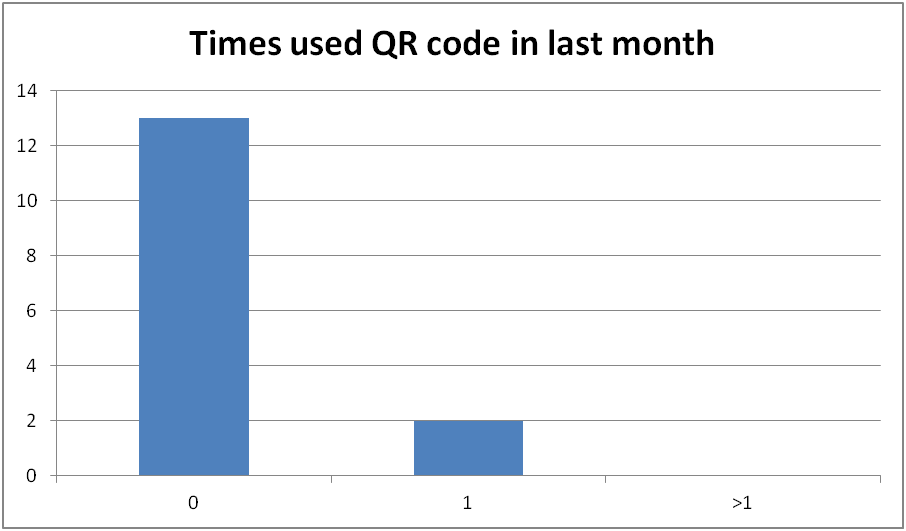
I conducted an informal survey on Twitter, asking how many times people had scanned a QR code in the last month. Here are the results:

qr bar graph

Number of times people have used a QR code in past month.

Column 2 (once in the past month) includes one person who “only did it to prove how rubbish they are”. And bear in mind that regular Twitter users are already more likely to be a regular, confident smartphone user than someone who gets a paper gas bill.

As I’ve blogged about before, QR codes are all too often thought a simple solution for bridging the online-offline marketing divide, with littleconsideration given to the logistical and emotional barriers to successful usage. They do have some uses, and some commentators suggest their use in mobile payments may revive QR.

Efforts to signpost people toward information on better pricing are to be applauded. But I’d suggest QR codes on bills aren’t the answer here, because of the logistical, emotional and confidence barriers that prevent people using them, and because trust in QR codes has been eroded through years of marketing misuse.

tl;dr version: will QR codes help people get cheaper energy? No, I doubt it.

Photo credit: Tramell Hudson (Flickr, Creative Commons)

Edit: Terence Eden has responded to the challenge and come up with the argument for QR codes. His post is well worth reading.

Social media, serendipity and the power of trivia

For most of us – and certainly anyone reading this blog – social media plays a significant role in our lives. We keep track of our friends’ lives through Facebook updates, message them on Twitter, see what they’re up to on Foursquare, and ‘like’ their photos on Instagram. I do this more than most, since social media is a big part of my job; my friend Richard commented that he doesn’t need to ring me anymore as he can find out exactly what I’m doing, thinking and feeling by looking at my various updates online.

A couple of weeks back my colleague Keith wrote an interesting blogpost, wondering if this stream of minutiae is bad for us, akin to obesity for the mind. He asked “is it possible that we have filled our brains with information, images, adverts, arguments, thoughts, news, features, blogs and opinions, to the extent that our brains aren’t functioning as they used to?”

The stream of updates about unimportant things, from lunchtime burritos to Daily Mail click-bait, are thought by many to be distracting us from the reading of improving books or forging of real-life relationships.

thinking man

Keith certainly isn’t the first person to ask if the sharing of trivia is affecting the way that we think. Plato argued the technology of writing would destroy humans’ ability to remember. 17th century lecturers complained that their students spent too much time in coffee shops catching up on news and gossip. Even the walls of Pompeii featured graffiti from Roman Jamie Olivers exclaiming ‘I baked bread today’.

As Tom Standage argues wonderfully, the sharing of tidbits of information in a peer-to-peer way is by no means a 21st century development, and nor either is the suggestion that this has a negative impact on wellbeing.

I’m an internet optimist. Sure, the internet gives us plenty to be worried about, from privacy worries to the impact on older industries and the economy. But in my lifetime the 20th century model –  in which mass-produced media were piped at us, to be passively consumed at a set time via a small number of TV or radio channels – has been completely transformed. The 21st century has seen a diversification in media in which has given us access to a wider array of information sources than we’ve ever had before.

While some may argue that this overwhelms people, I’d argue that on balance being informed via a wider range of sources is a good thing. The web gives us access to more information than we even knew existed, as well as the power to publish ourselves. Yet far from overwhelming us with a torrent of news, the amount of time younger people spend consuming news has gone down. It’s been suggested that we’re simply becoming more efficient, able to learn more in less time.

Yet it’s also wrong to say the web hasn’t had an impact on the way we think. When I’m talking to a friend or colleague and we’re not sure of a specific point, one or other of us will reach for our smartphone and settle the argument immediately. I don’t remember; I research.

On the one hand there’s a large body of evidence which suggests that the increasing complexity of the media we consume is leading to increased cognitive capacity and rising IQ scores. But there’s also a healthy academic debate taking place over how our behaviours are adapting to the changing information environment.

Just as printing put paid to the one-valued skill of memorising entire books, communications technology is changing what we choose to commit to memory.  For example, studies have shown that regular users of GPS devices begin to lose some of their innate sense of direction. It would seem we’re putting our faith in external storage, and reallocating our mental energy.

This is the same phenomenon Socrates described, in which writing “will implant forgetfulness in their souls: they will cease to exercise memory because they rely on that which is written, calling things to remembrance no longer from within themselves, but by means of external marks.”

What’s different is the ease of access to these external marks, such that it’s available to anyone with a smartphone in seconds. The question is whether this reliance on external storage and recall (‘exomemory’) is such a bad thing. What Socrates failed to see was the incredible opportunity created by access to knowledge greater than that our own heads can hold. As Amanda Palmer noted, we can only connect the dots we can collect. The out-housing of our collective intellectual capital has exponentially grown those collections of dots.

Having a network of information sources creates greater opportunities for serendipity. Some of the most useful things I’ve learned in recent years are bits of digital lint in my browser’s belly button.

Euan Semple made an interesting comment on Facebook today about location updates. Seen by many as a social media irritant, the ambient knowledge of knowing when someone’s in town also facilitates the arranging on real-life meetings. Similarly. the answering of questions about where to find lunch creates bridging capital, which helps us to establish trust in others.

The internet’s not going away; it’s speeding up, and growing at frightening speed. With the web being the gateway to our collective hive-mind, the ability to access and analyse information from the sources it provides has become an essential skill.

It’s said that in the West our environment is obesogenic – that food is so readily available that it encourages overeating. But just as you don’t have to eat everything, you don’t need to read everything you see either. The problem is not that we have too much information at our fingertips, but that we haven’t fully developed the tools and behaviours to help us manage it effectively.

Yet it’s the very technologies that cause the problem – search engines and social networks – that are also the solution.  Through knowing and using a wide range of sources, effective searchers are quickly able to sort the wheat from the chaff in our exomemory.  By establishing a network of trusted sources, I can quickly find a person or organisation who can give me the answer I need. By sharing and reading just the right amount of trivia, we create trusted connections – and learn what to scroll past.

Socrates argued that, exposed to writing, people would become “hearers of many things, and will have learned nothing; they will appear omniscient and will generally know nothing”.

The harsh light of history has shown this to be wrong. The human mind is a wonderful thing; by freeing up those synapic connections that might previously have been used to remember bus timetables or phone numbers, or discuss the 1989 first division football scores, we can put them to better use creating or connecting in ways that open up new possibilities for us all.