Most internal communications planning operates on the charming assumption that organisations are fundamentally stable places, occasionally interrupted by change. There’s business as usual, with its newsletters, intranet stories and meticulously colour-coded content calendars, and then there’s The Crisis, during which everyone abandons the calendar and runs around looking for the emergency distribution list. Half the people on it have left, the other half haven’t opened an email all week, and someone from Legal would like to review the holding statement.
This was always a deranged way to think about organisations. Now it’s bordering on wilful denial. Instability isn’t an unfortunate interruption to business as usual. It is business as usual. Yet we continue to talk about transformation as though it’s a journey with a destination, rather than a series of wearyingly unpredictable events punctuated by steering committees. Nobody knows what’s coming next, and the reassuringly precise roadmap presented at last month’s town hall isn’t going to change that.
The job, then, is to build communication that can flex: channels people already use and trust, in a digital workplace designed to adapt as the organisation changes around it. That work happens in the good times. You can’t build trust once the crisis has started, however enthusiastically you update the CEO’s talking points.
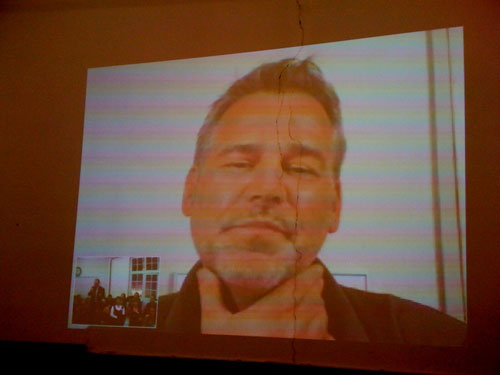
This was the argument of my recent keynote at Dan PR in Ljubljana, organised by Marketing magazin under the bracingly honest theme A World Without Stability. I can’t give anyone stability back. Nobody can. What we can do is build communication that holds anyway.
The future arrived wearing a knitted hat
In Nihonbashi, Tokyo, I was once shown around by a tour guide who sat on my shoulder. It was a small robot in a knitted hat, from a café called DAWN, and the person guiding me was a pilot working remotely: someone living with a disability that would make a conventional job difficult or impossible.
Japan has a labour shortage. It also has people who want to work and have been shut out of work. DAWN connects those two problems. Walking around Tokyo with a robot on my shoulder should have felt futuristic. It didn’t. It felt completely ordinary, which is generally how the future turns up: not with a fanfare, but on your shoulder, wearing a hat.

I wrote much of Digital Communications at Work, the book I co-authored with Jonathan Phillips, in Japan. Many of the forces starting to reshape work in Europe — ageing populations, labour shortages, automation — aren’t the future there. They’re already the present. Japan is a useful corrective to the sort of futurism that involves putting 2035 on a PowerPoint slide alongside a stock photo of someone prodding a holographic interface.
And these forces aren’t arriving one at a time. Demographic change, geopolitical volatility, AI, eroding institutional trust and the fragmentation of work are accumulating and colliding. None is going to wait for the previous transformation programme to finish, or for the steering committee to approve the next phase.
Look at who counts as ‘internal’ now. Employees, yes, but also contractors, frontline workers, supply-chain partners, remote workers and people who move between organisations and projects. Access to information becomes uneven. Context becomes inconsistent. Some people feel close to the organisation; others barely feel part of it at all. Yet plenty of internal communication still assumes an employee sitting at a desk, logged into a company laptop, with enough control over their working day to read a message whenever we decide to send one.
As we put it in the book, “A communication strategy that assumes equal access will, inevitably, exclude.”
The robot in Tokyo wasn’t interesting because it was a robot. It was interesting because somebody had designed a way for a person to participate who would otherwise have been excluded. The technology was infrastructure, not the purpose. Any industry rather more interested in selling technology than asking who it actually helps might want to reflect on that.
Build something that holds
Many organisations still approach communication as a publishing operation. They have messages to distribute, channels to fill and calendars to maintain. The success measures tend to reflect that: how many things went out, how many people opened them, how many clicked. We’ve become tremendously sophisticated at measuring the production and distribution of material without really establishing whether any of it made a blind bit of difference.
But when the ground moves, nobody cares how many intranet stories you published last quarter. They care whether they can find out what’s happening, understand what it means for them and reach someone who can help. An impressive open rate tells you very little about whether someone understood the message, trusted it or could do anything useful with it. You can open an email halfway through a shift, discover you need to complete a task on a system you can’t access, and still count as a communications success story on somebody’s dashboard.
That’s an infrastructure problem, not a copywriting problem.
In Digital Communications at Work, we describe five layers of a communication ecosystem: Plan, Collaborate, Publish, Distribute and Discuss. It’s a way of seeing how information moves around an organisation, rather than looking at each channel in isolation, which is what happens when every department has its own platform, its own budget and a persuasive account manager.
Once you’ve mapped those layers, you can ask an uncomfortable question: what if one disappears tomorrow?
We worked with a human rights charity whose people operate across countries run by authoritarian regimes. They know that social networks can be switched off, sometimes along with the entire internet. For them, relying on a WhatsApp group wasn’t just a question of convenience; it was a vulnerability.
They reduced their dependence on platforms most likely to be withdrawn and made regular local backups of essential materials, so people could still access what they needed without a connection.
Most organisations aren’t operating under those conditions. But the underlying question applies to everyone. If email and Teams disappeared tomorrow morning, where would your people go? If your intranet was unavailable, how would you reach your people? And how many of your supposedly business-critical processes turn out to depend on a spreadsheet maintained by someone who’s currently on holiday?
If the answer is ‘I’m not sure’, you’ve found something worth fixing (ideally before the next incident review).
Resilience isn’t something you buy during an emergency. It’s built through the dreary work of mapping dependencies, agreeing fallbacks and testing whether they work. Nobody gets excited about a backup distribution list until the day they need one, by which point it’s a little late to discover that nobody owns it.
Holding isn’t enough
It’s relatively easy to notice when something breaks. Far harder to notice when it stops being useful. Communication also has to adapt to changes that happen slowly enough for everyone to convince themselves that nothing much is changing.
Working patterns shift. New technologies appear. Organisations merge, restructure and acquire new populations of employees. The channels that worked brilliantly five years ago become less useful, while the people responsible for them continue filling them with content because that’s what the communications plan says they should do.
This is where organisations tend to confuse the channel with the job it was supposed to perform. The intranet, the newsletter, the employee app: these are ways of meeting people’s information needs, not ends in themselves. Yet we become extraordinarily attached to them, particularly after spending eighteen months and a substantial amount of money getting them approved.
In Digital Communications at Work, we argue for separating publishing from distribution. Keep a reliable source of truth, with content that’s accurate, owned and maintained. Then allow the channels carrying that information to change as people’s needs and working habits change. The information should be dependable. The means of reaching it should be adaptable.
That matters even more as AI assistants and agents become another way people access workplace information. Your content may increasingly be consumed and interpreted by machines before it reaches a human. If your policies are duplicated, contradictory or three years out of date, AI won’t magically fix the problem. It may simply repeat the wrong answer more efficiently, with the sort of confidence previously reserved for a senior manager explaining a system they’ve never used.
Flexibility isn’t an annual technology strategy exercise. It’s a habit of asking whether the channels you have still serve the people using them, and being prepared to stop doing things that no longer earn their place. Which sounds straightforward until you discover how many apparently indispensable communications exist primarily because somebody important once asked for them.
Resilience without adaptability leaves you maintaining an increasingly obsolete system. Adaptability without resilience gets you chaos with a new logo.
You need both.
Prepare the ground before you move the tree
On the Goto Islands, I stayed at Ako House, an old Japanese house restored by a man who bought it for one reason: to save the enormous old ako tree in the garden. He didn’t buy a house and happen to get a tree. He bought the tree and took on the house to protect it.
Japanese has a word for preparing a tree to survive being moved: nemawashi. Literally, it means digging around the roots, loosening the soil and preparing the tree so it has the best chance of surviving the move.
In organisations, the same word describes the work of consulting people before a decision becomes official. Talking to the people affected, understanding their concerns and allowing their input to shape what happens next. Not the ceremonial consultation that takes place once the decision is effectively irreversible, but the kind where somebody might actually have to change their mind.
We tend to do this backwards. Leaders make a decision, communications is brought in to prepare the announcement, and the people whose working lives are about to change hear about it once everything is settled. Then everyone is terribly surprised when they resist, and comms is asked to develop an engagement campaign to address the negativity. Perhaps with a colourful graphic explaining the benefits.
The groundwork isn’t the announcement. It’s the conversations that should have happened before it.
This is where trust becomes infrastructure too. People are more likely to believe what they hear during uncertainty if they’ve had reasons to trust the organisation when things were relatively calm. That means channels that work, information they can rely on and leaders who communicate even when they don’t have a polished answer. It also means being prepared to tell people things they might not want to hear, rather than treating every difficult message as a problem to be solved with more positive language.
Three sentences do an enormous amount of work: here’s what we know, here’s what we don’t know yet, and here’s when you’ll hear more.
‘We don’t know yet’ isn’t weakness. In a period of instability, it can be one of the most reassuring things a leader says, provided they do follow through on the third sentence. It’s certainly more useful than an elaborately worded assurance that the organisation remains committed to its people while declining to explain what is actually happening to them.
The same principle applies to the communication systems themselves. Agree what people absolutely must know, how you’ll reach them and who’s responsible for making sure it happens. Do it before the emergency, because when everything is moving, there won’t be time to build the relationships, the governance or the distribution mechanisms from scratch.
And no, buying an emergency notification platform is not a substitute for people believing the messages it sends.
Our robots are not AI
Back in Tokyo, there’s one detail about the robot in the knitted hat that I haven’t mentioned. The café’s website makes a point of saying: “Our robots are not AI.”
In an industry currently determined to put AI into absolutely bloody everything, including things that were working perfectly well before, this feels positively subversive.
Everything valuable about that tour was deeply human: the planning, choosing what to show me, the conversation we had, the connection we built. The technology’s job was simply to carry a person to where they were needed.
That’s a useful way to think about workplace communication, too. Technology can carry information further, faster and in more formats than ever before. AI is making that easier still. But carrying information isn’t the same as helping people make sense of it, and producing more content isn’t the same as building trust. If it were, the average organisation would have achieved perfect mutual-understanding nirvana by now.
I can’t tell you which change is coming for your organisation. Neither can your CEO, your IT department or your favourite LinkedIn futurist, although the latter will probably sell you a framework for it. What you can do is prepare for a range of possibilities, rather than betting everything on one prediction.
Build channels people actually use. Keep the information behind them reliable. Make sure the system can survive the loss of a platform and adapt when working habits change. And establish the relationships that will carry communication when people most need to trust what they’re hearing.
None of this can be bolted on after the ground has moved. It’s built in the calm, through the deeply unglamorous groundwork that rarely makes it into a conference keynote but determines whether communication works when it matters. It’s considerably less exciting than announcing a new platform or launching a transformation programme, which is probably why organisations keep doing those instead.
The ground will keep moving. The question is whether what you’ve built can move with it.
This essay draws on my keynote at Dan PR 2026 and ideas explored in Digital Communications at Work, co-authored with Jonathan Phillips. If you’d like me to explore these ideas at your event or with your leadership team, see my speaking page.