Weeknote 2026/44

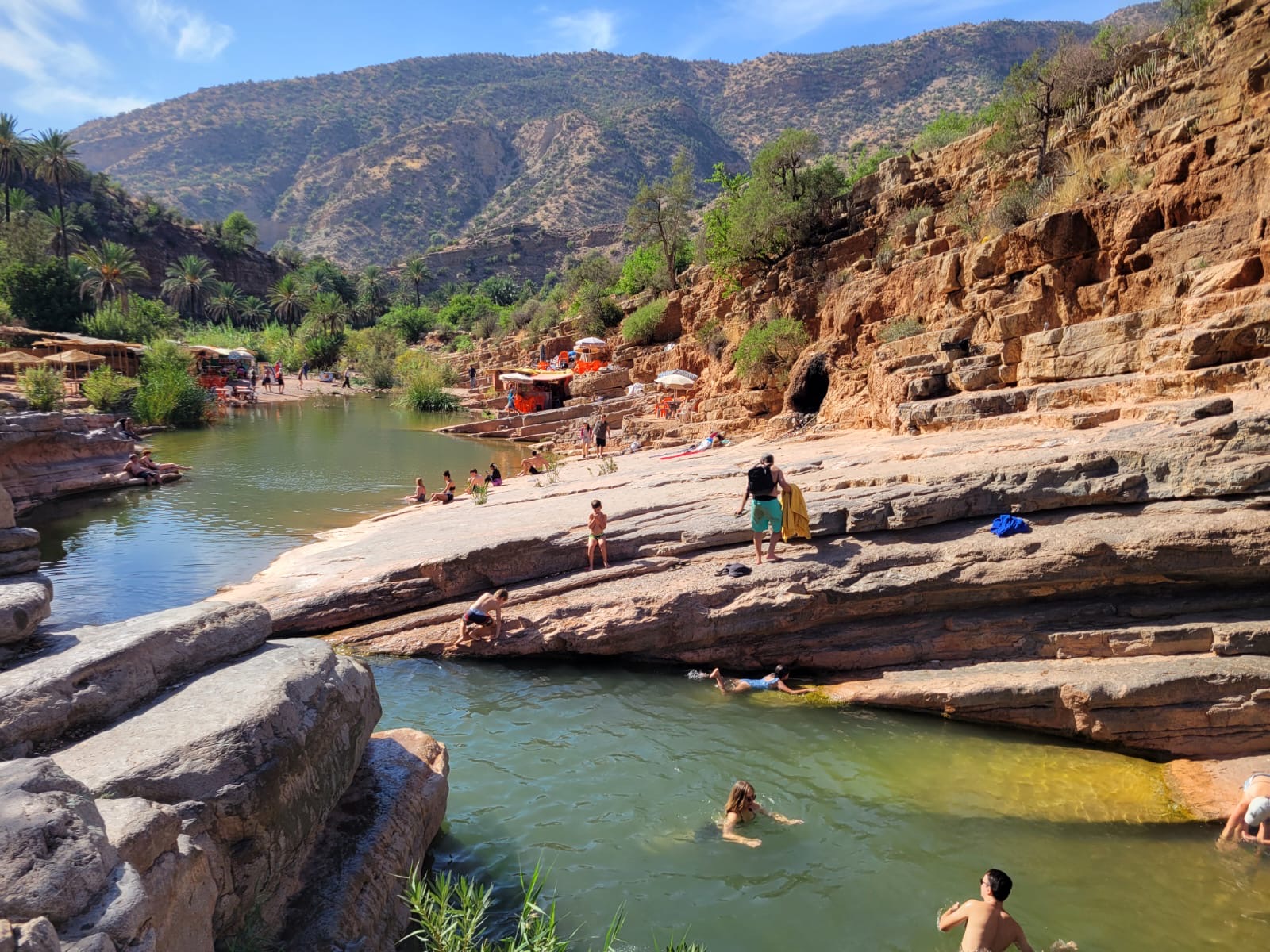
Paradise Valley in full: a green river winding between palm trees and pale rock slabs, swimmers and sunbathers along the edge, café umbrellas on the bank, and dry mountains rising beyond.
Paradise Valley, Morocco

There are two ways to make something simpler. One is to understand it well enough to work out what matters. The other is to bin everything that makes it complicated and hope nobody notices.

I’ve spent much of this week attempting the first approach. Three discovery projects have reached the point where we stop collecting information and start deciding what it means. This involves taking a giant pile of evidence, much of it contradictory, and reducing it to something someone else can reasonably be expected to read, understand and act on.

Too much detail and you’ve produced an expensive filing cabinet. Too little and you’ve produced a confident-looking PowerPoint presentation with scant relationship to reality.

Outside work, I’ve been thinking about the stories we simplify, too. At a digital nomad festival in Morocco, I heard experiences that made the familiar narrative of location-independent work look embarrassingly narrow. I’ve started reading Cory Doctorow on what happens when we optimise work for machines and leave humans to deal with the consequences. And I’ve been writing about an AI industry that’s getting extremely good at making individual employees more productive without necessarily making organisations work any better.

Different examples of the same problem. When we simplify something, who decides what matters? And what happens to everything – and everyone – that doesn’t make the cut?

This week at work

At the start of every discovery project, somewhere around slide six of the kick-off deck, Jon and I show clients a diamond.

It’s the Design Council’s Double Diamond, or at least the first half of it. The shape widens as we explore the problem from every angle we can find: interviews, surveys, analytics, card sorts, the shared drive nobody has opened since 2019 but which contains the definitive version of the communications strategy. Then it narrows again, as we make sense of what we’ve found and work towards a decision.

We warn clients that the widening part will feel messy. It’s meant to. The urge to jump straight to a solution is strong, particularly when somebody has already seen a demonstration of a platform they quite fancy buying. Resisting that urge is much of the job.

What we don’t dwell on is the line down the middle.

This week, three projects reached it at once. Interviews wrapped. Platforms reviewed. Surveys and card sorts done. And the charts. My God, the charts. AI-assisted data visualisation of such exquisite filth that I briefly considered marking the report NSFW.

The widest point of the diamond is also the point where you’re holding the most information you’ll ever have. Then you have to put most of it down.

That’s what synthesis actually is. Not adding things up, but taking things away so the remainder makes sense.

Six themes become five, because two of them were the same theme wearing different hats. A category that everyone insisted was essential turns out to be needed by nobody, because something else already does the job. Another gets a new name, because the old one described the furniture rather than the reason anyone goes looking. Two slides get hidden because they say what the slide before them said, only less well.

Twenty-five people tell you, each with complete confidence, which channel is for what. Unfortunately no two of them agree.

And somewhere in there, a score out of five has halved itself on the journey from spreadsheet to slide. You catch it at the last minute and resolve, again, to stop doing maths after nine at night.

None of this shows up in the finished report. Clients see the five themes, not the sixth one that didn’t make it. They don’t see the hours spent deciding whether something is a finding, a symptom, a cause, an unresolved territorial dispute between two departments, a grudge dating back to the 2018 restructure, or just a thing somebody said very insistently in an interview.

You can put a cover page on a transcript, but it doesn’t make it insight. Although I’ve seen people try.

The right-hand side of the diamond ends in a word we put on the slide in the same size font as all the others, as if it were equally easy: decide. Next week the readouts begin, and the hard part becomes someone else’s.

Also this week

The rest of the week went the other way.

I went to my first digital nomad festival. I spend about half my life on the road, entirely by choice, so I suppose I qualify. But I’ve never quite fitted the digital nomad mould. The usual proposition is to earn a Western salary while living somewhere considerably cheaper. I maintain a home in Amsterdam and an office I use about 40% of the time, while spending half my life travelling. All the inconvenience of a nomadic lifestyle, with the economics of a particularly badly run property portfolio.

I’ve also avoided the events. Too many seem to involve digital nomads selling courses on marketing, personal branding and making money remotely to other digital nomads, who presumably intend to make their money by selling courses on marketing, personal branding and making money remotely to yet more digital nomads. It’s a business model with the structural integrity of a pyramid scheme but considerably better weather.

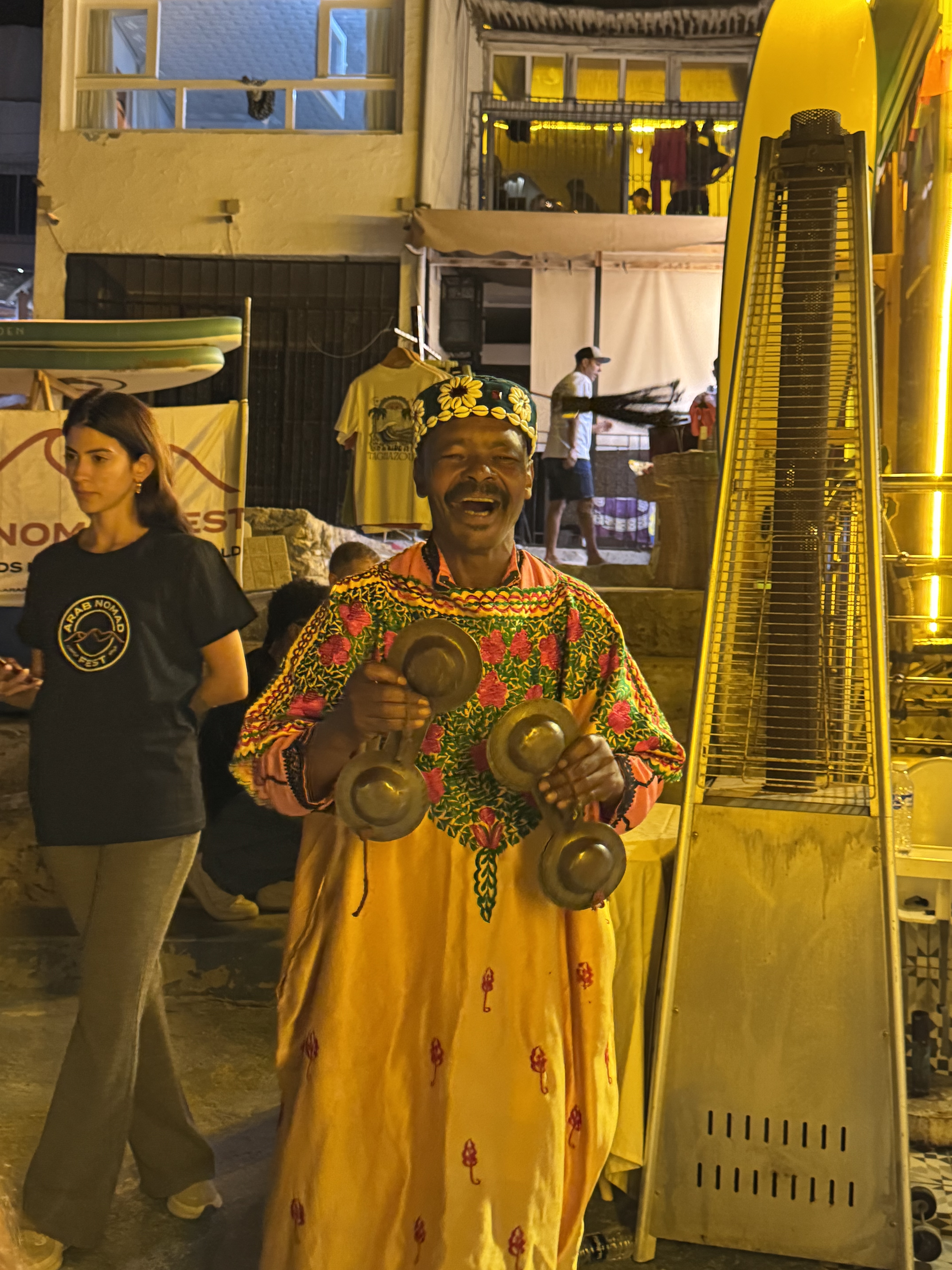
Arab Nomad Fest, in Taghazout, was different. Less about helping privileged graduates speed-run gentrification by taking their European salaries to low-cost beach towns. More about bringing opportunities to people who might otherwise be shut out of them.

On Tuesday I gave my talk, on working out loud and treating asynchronous work as a discipline rather than a hack. Afterwards, someone thanked me for reframing working across time zones as a strength to sell, instead of a problem to solve.
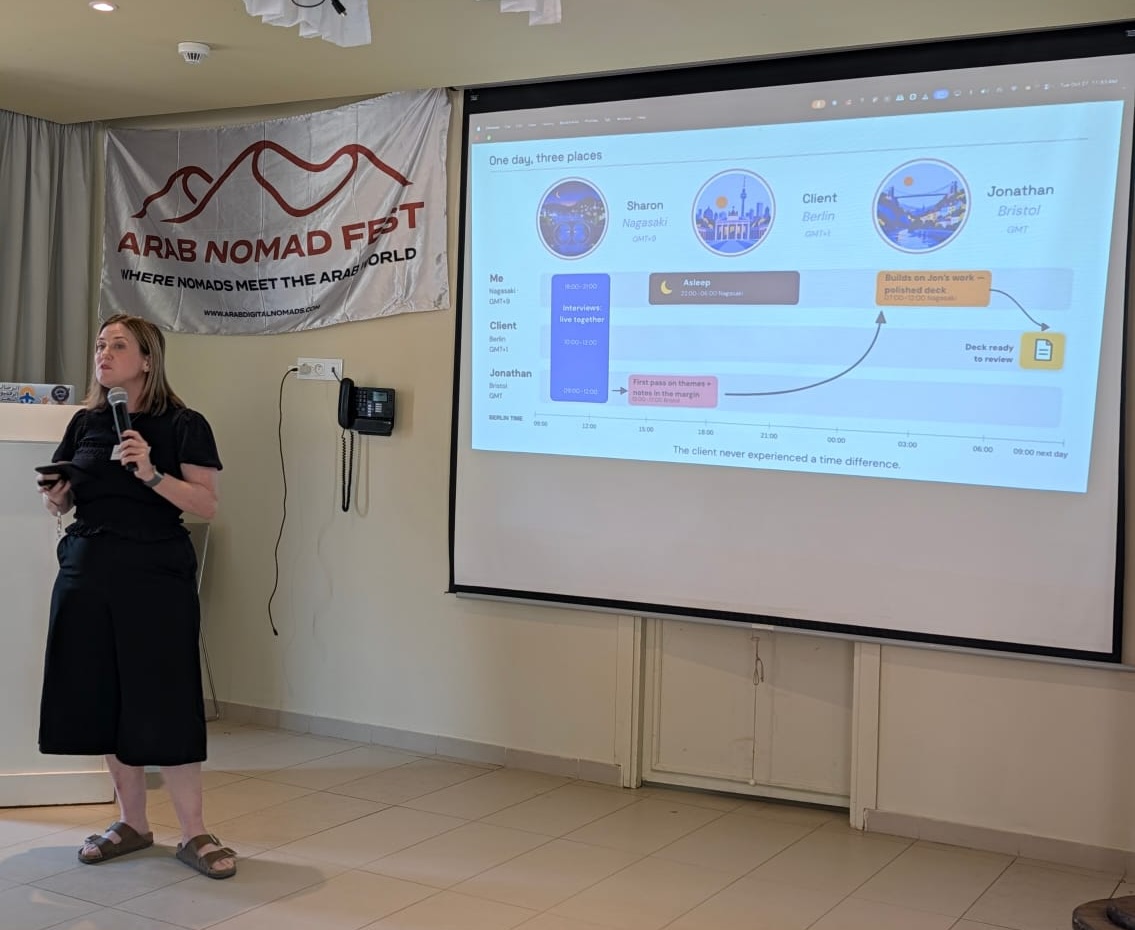
Me speaking at Arab Nomad Fest beside a slide titled “One day, three places”: me in Nagasaki, a client in Berlin and Jonathan in Bristol, with work handed between time zones. Caption: “The client never experienced a time difference.”
Me speaking at Arab Nomad Fest

Then I sat back and let other people widen the aperture.

Nasser Saqer Almohannadi has been to 218 countries. He managed this over forty years without quitting his job in Qatar’s energy sector: two big trips a year, carry-on only, printed copies of every document, and a wife who ran the logistics and has passed a hundred countries herself. I’m somewhere short of half his total, and had been feeling quite pleased with myself. He’s completed the game, and my immediate response was to start calculating how many countries a year I’d need to visit to match his score. I’ve turned someone else’s lifetime achievement into a personal performance improvement plan.

Maria Cuesta, who runs a community app for nomads, pointed out that nomads tend to cluster. They find other nomads, work alongside other nomads, and rarely get to know the places they’re actually living in. She talked about Facebook groups with 18,000 members, where the main thing people have in common is that they’ve joined the same Facebook group. That’s a flimsy foundation on which to build a community.

And then there was Arab Nomad Fest founder Muhammed Alard, who grew up in Damascus and talked about the invisible tax of a weak passport. A Syrian passport gets you into just 26 countries without a visa. Every application means weeks of paperwork. Payments don’t go through. Potential clients decide it’s easier not to bother. For most of the room, remote work is a lifestyle choice. For him, it was a means of survival.

“The internet didn’t ask for my passport,” he said. “It asked for my skills.”

Last year he returned to Syria for the first time in fifteen years, and made a film about it.

When he finished speaking, he didn’t try to sell the room a course. He asked us to hire people from places like the one he grew up in.

Consuming

I’ve started Cory Doctorow’s The Reverse Centaur’s Guide to Life After AI. A centaur is a human using a machine to extend their capabilities. A reverse centaur is a machine using a human to extend its own. Same ingredients, different employment prospects.

It’s a useful way of thinking about the increasingly fashionable promise to keep a ‘human in the loop’. This sounds reassuring, conjuring up an experienced professional exercising judgement, asking difficult questions and occasionally pressing a large red button marked STOP. In practice, the human may have neither the authority to challenge the machine, nor the expertise to understand what it’s doing, nor the time to check before the next automated decision arrives.

Congratulations. You’ve created an accountability sink with a login.

I’ve only read the opening chapters, but it’s already made me think differently about the workplace AI conversation. We spend an enormous amount of time asking what can be automated, and considerably less asking who gets to decide, whose work gets better, and who inherits the mess when the machine has finished being efficient.

Coverage

For Strategic, I wrote about why comms has a cope problem.

Within three weeks I attended two very different conferences. At Unily Unite in London, the reassurance was everywhere: on panels, in presentations, over coffee. AI might change the tools, but the fundamentals of communication would endure. We’re special smol beans, you see, and our spectacular people skills will protect us from disruption.

At UNLEASH in Paris, among 7,000 HR people, I didn’t hear anything remotely like that. When SAP said its recruiters were now doing 95% less admin, the room applauded.

Same technology. Two professions. One discussing what was already changing, the other reassuring itself that it probably wouldn’t have to.

Of course the purpose of communication doesn’t disappear because we’ve invented new tools. But confusing the enduring purpose of a profession with the permanence of its current jobs, methods and skills is a dangerous mistake. And it’s one thing to tell yourself that comforting story. It’s quite another to stand on a conference stage and encourage thousands of other professionals to believe it too.

We’ve somehow managed to turn professional development into a group therapy session for people who don’t think they need to develop.

The editor told me to let rip. I did, within the bounds of professional decency. But I seem to have kept some in reserve.

Published

Nobody buys shared. Workplace AI is being built to make individuals more productive and processes more efficient. What’s missing is the layer underneath: the shared facts, decisions and understanding that allow an organisation to function as something more than a collection of individually optimised employees, each enjoying a bespoke relationship with their own little robot.

There’s a perfectly good commercial reason for this, if by ‘good’ you mean ‘entirely predictable and deeply unhelpful’. Vendors sell to functions. Functions buy with their own budgets. Shared understanding belongs to everyone, which means nobody has a cost centre for it, a business case to fund it, or a vice-president whose bonus depends on its existence.

Meanwhile, we’re building systems that can give every employee a personalised answer without ensuring they’re all working from the same reality.

Extremely clever parts. Increasingly questionable whole.

Travel

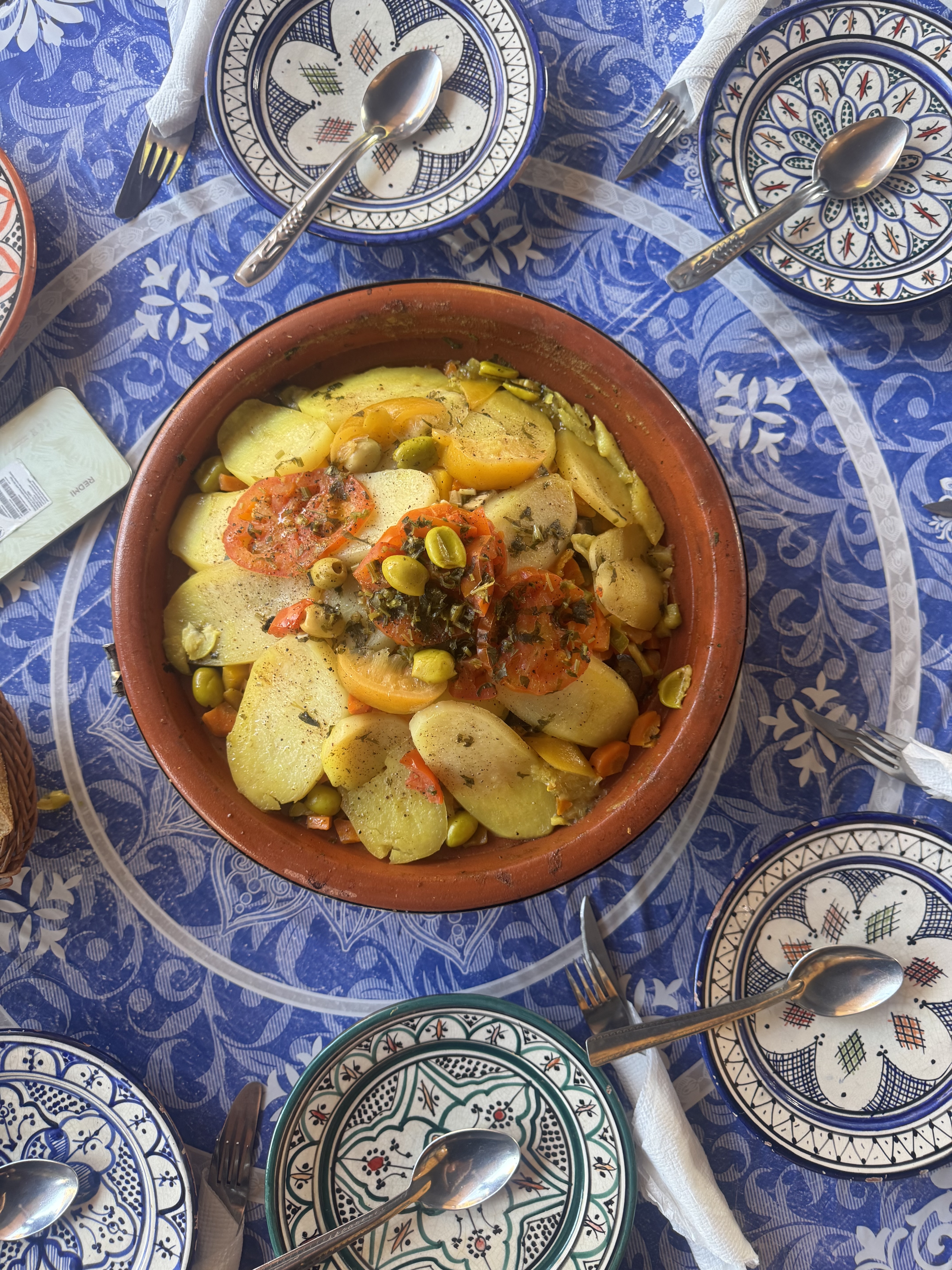
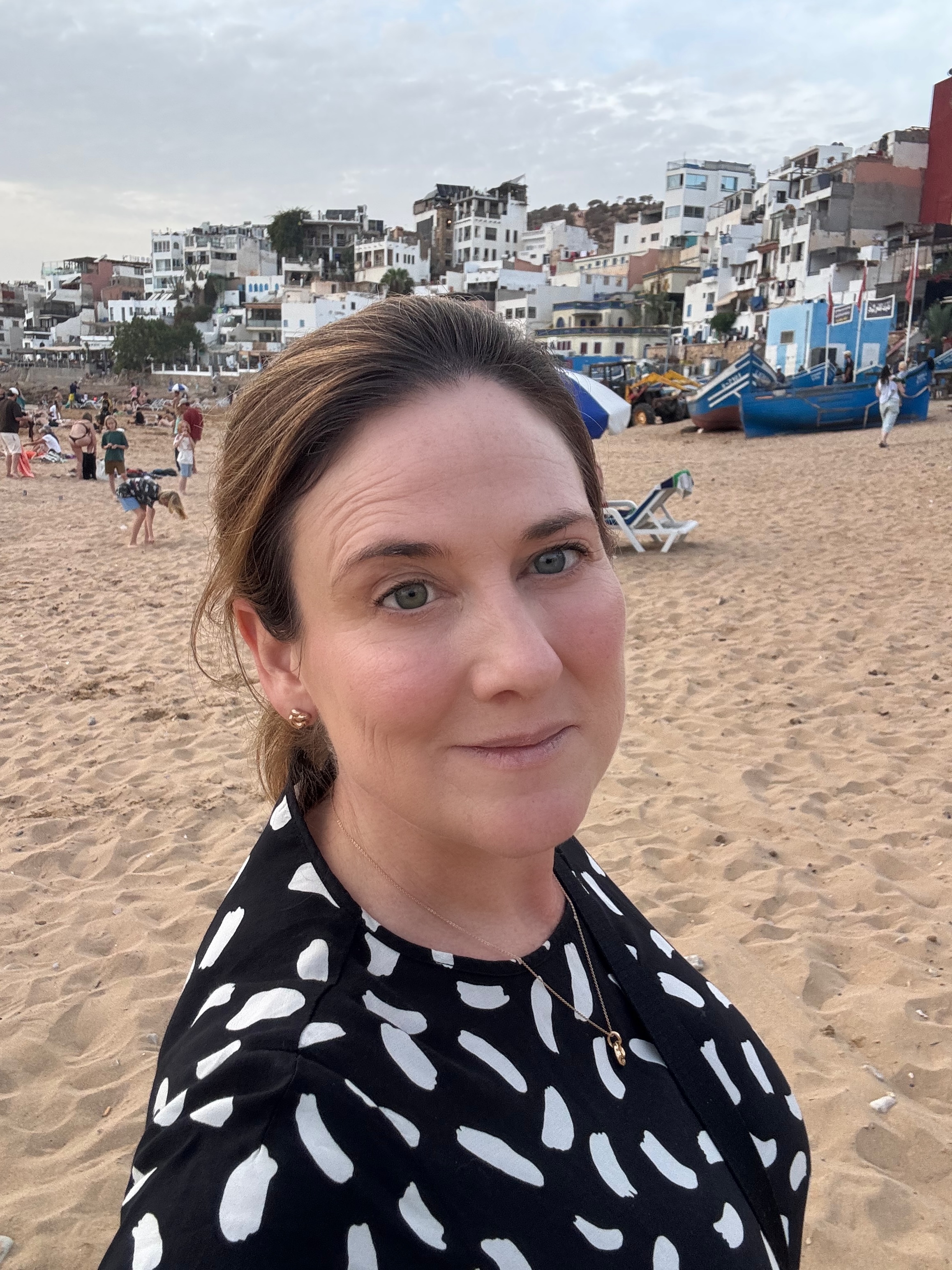
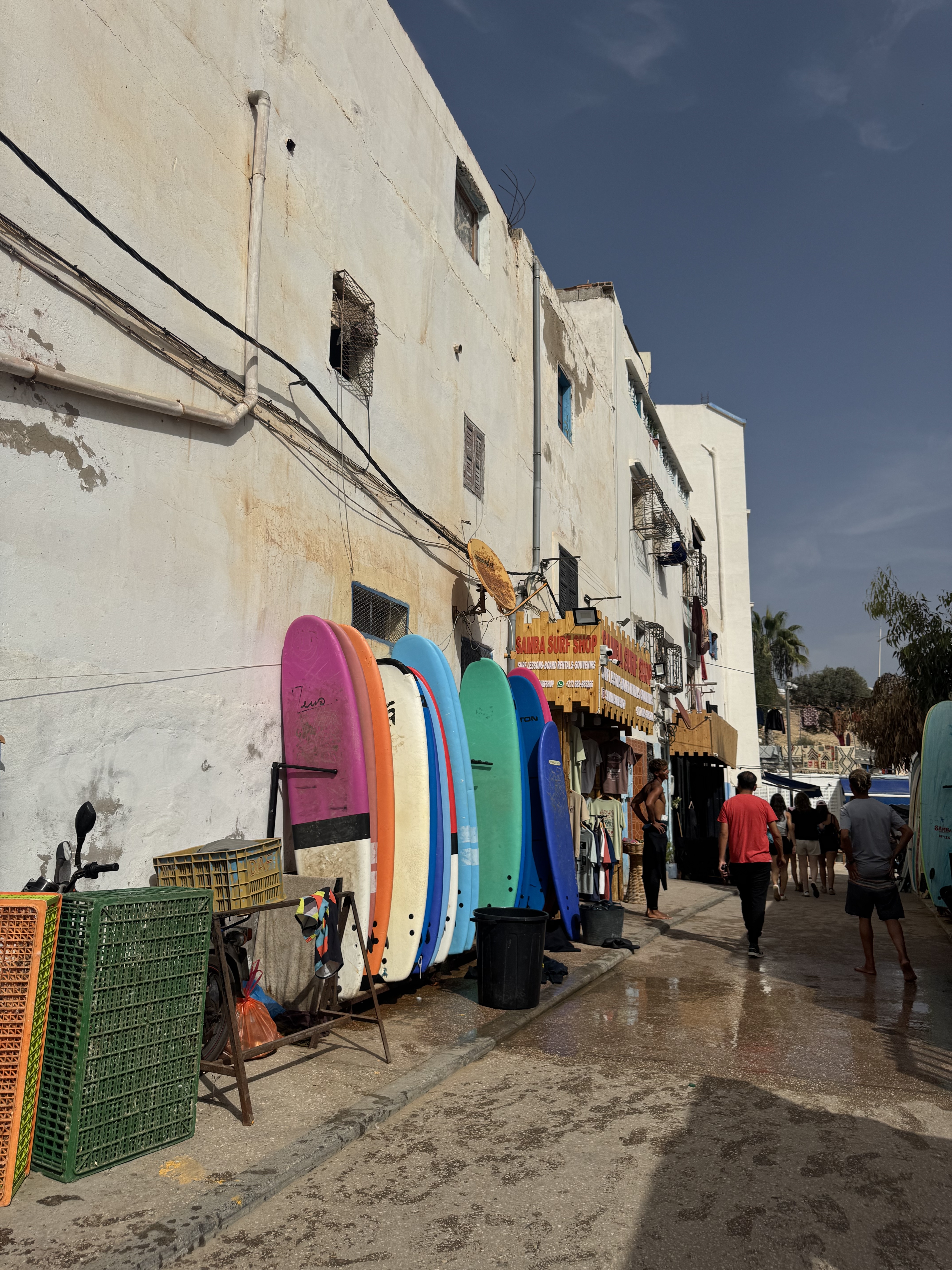
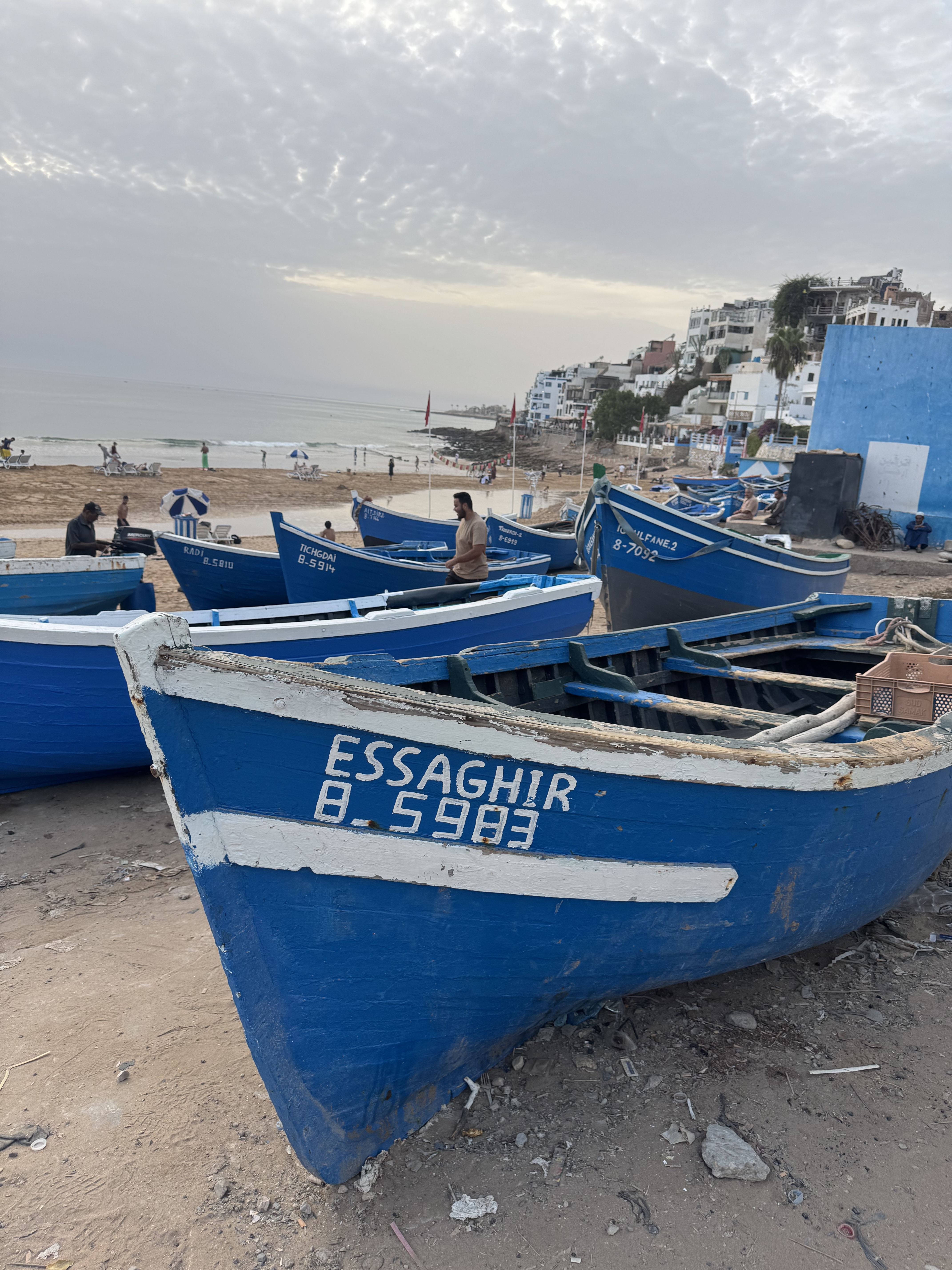
Still in Morocco. Outside the festival, this has been my first proper experience of the country. Sleepy seaside surf towns, cats everywhere, camels, street dogs, and a quantity of tagine that must surely put me on some sort of national register.

One evening I was reading on the roof terrace of my little hostel when the owner came over and announced that I must have dinner with them. I explained that I’d already eaten. He considered this information entirely irrelevant. I’m now familiar enough with Moroccan hospitality to know that further resistance would be both futile and impolite. I was having another tagine whether I liked it or not.

I liked it.

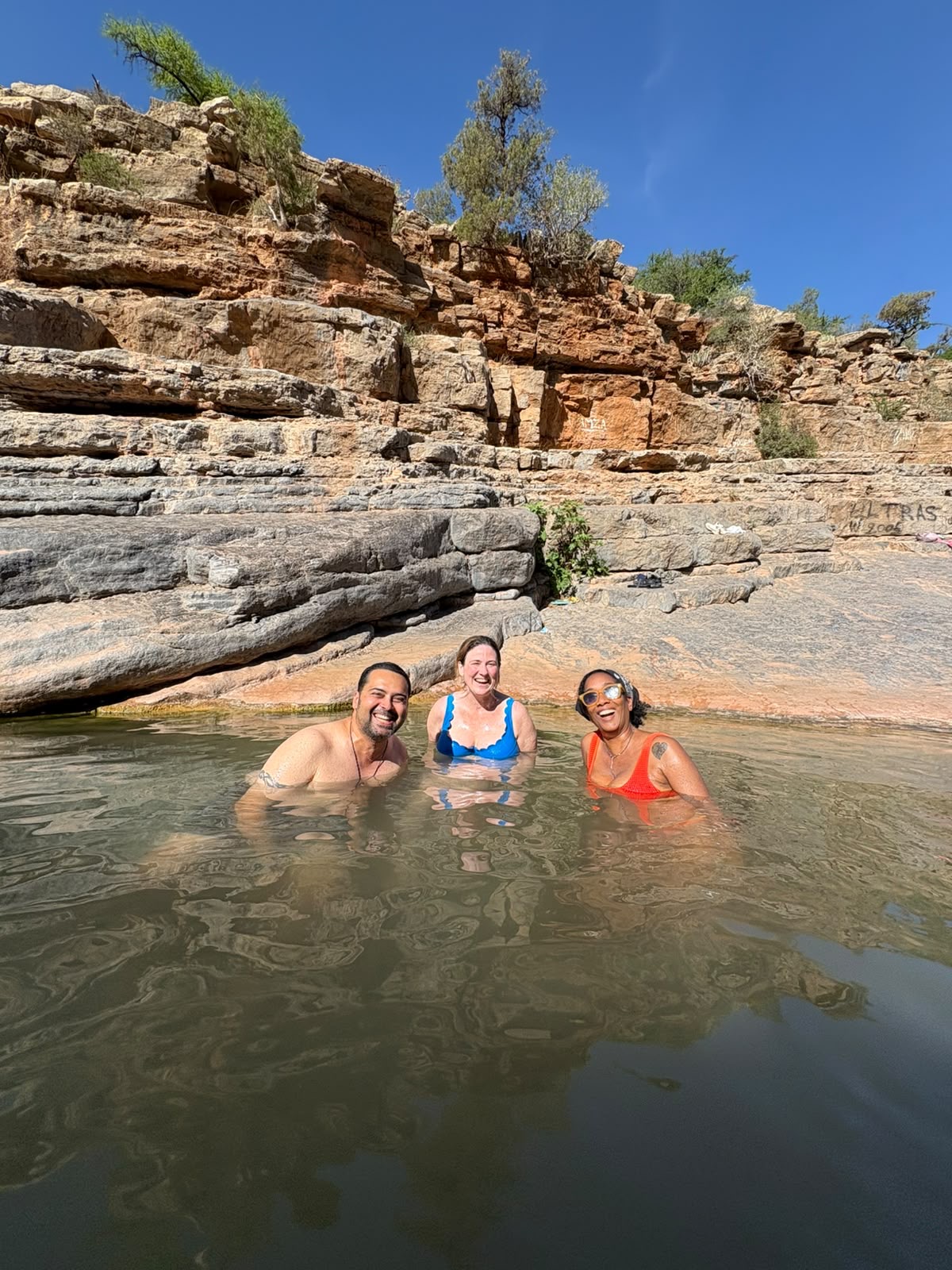
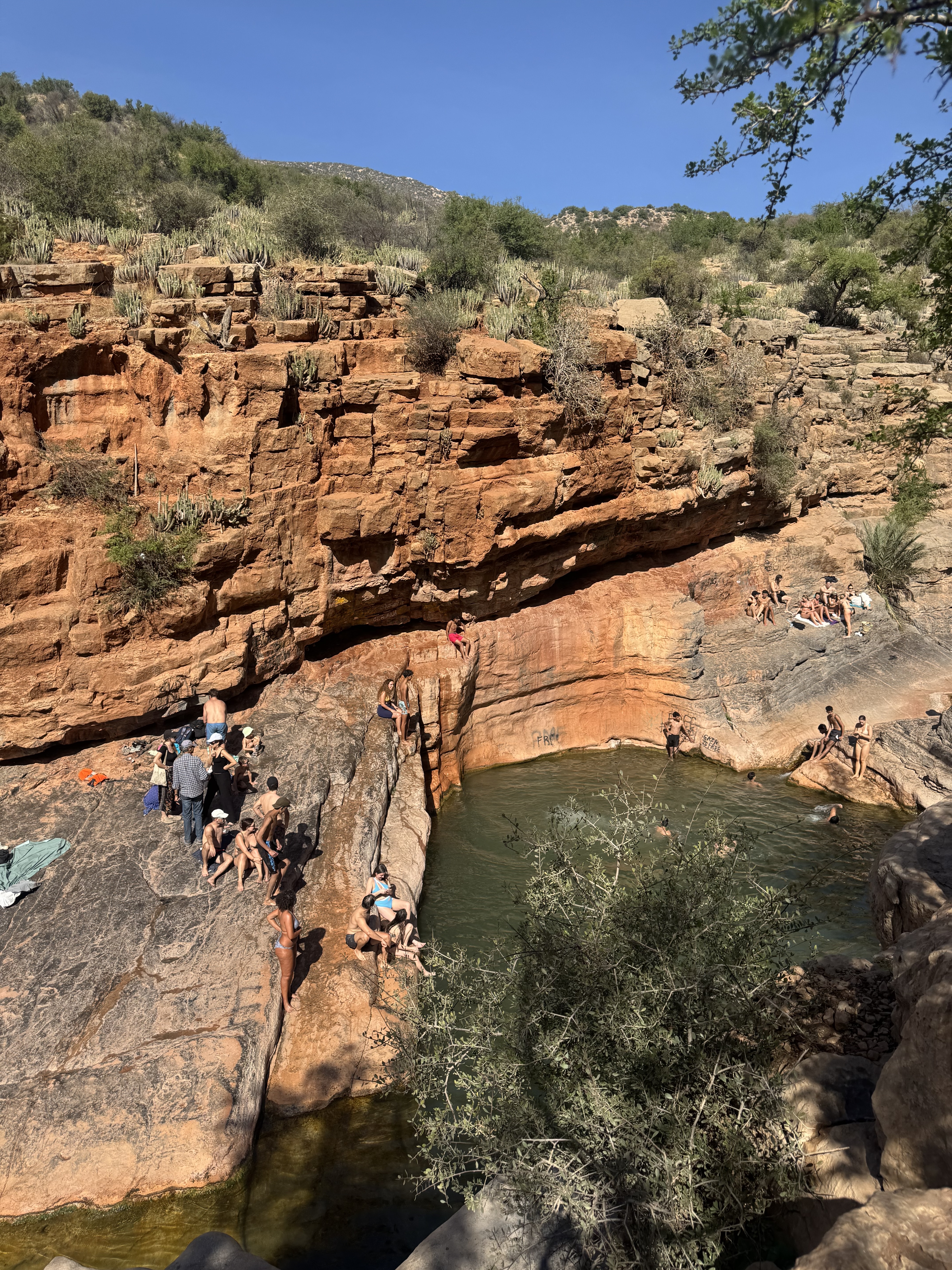
On Saturday I went to Paradise Valley. Not quite as paradisiacal as the name suggests, but pleasant enough. I swam in the river, slid along the rocks with childlike, leisure-centre glee, and was deposited in a pool at the bottom. Ate another tagine, obviously.

Shortly after this goes out, I’ll be face down in a hammam, being pummelled by someone who presumably knows what they’re doing. If I emerge with any skin left, I’ll consider it a success.

The day after giving a talk on how to make working across time zones a competitive advantage, I sent the same meeting invitation three times because the clocks had gone back and I’d lost track of what day it was. In desperation, I asked Google what time it was in Morocco. It gave me three different dates, two different times, and a confident AI-generated explanation of a time-zone change that hadn’t happened.
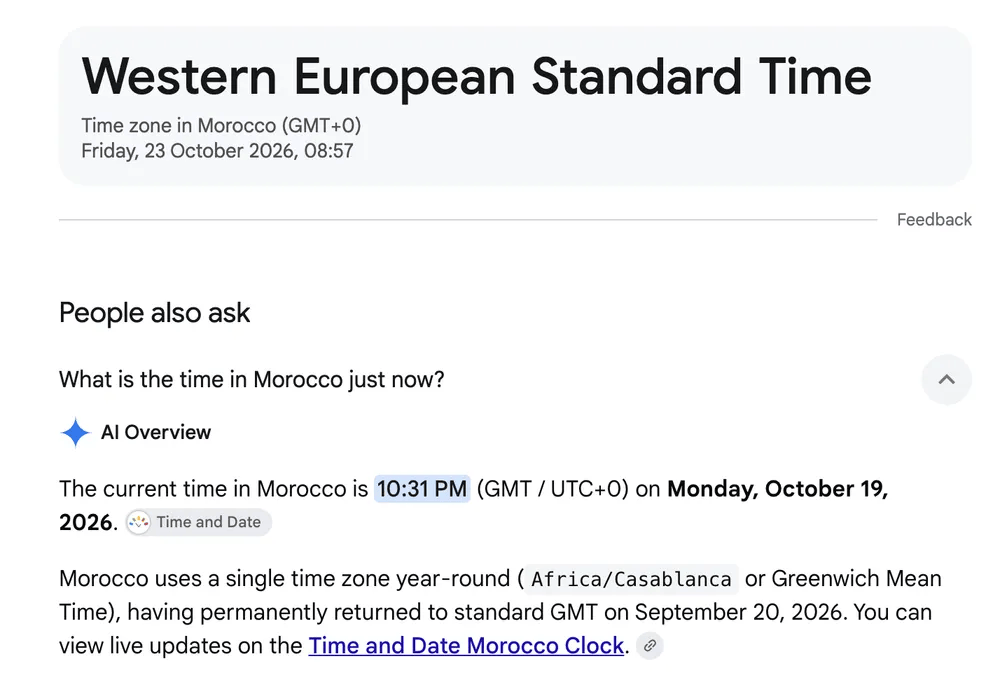
Google search results giving three different dates and times for Morocco, with an AI-generated summary describing a time-zone change that never happened.

So that’s me and a trillion-dollar technology company, both defeated by the concept of Tuesday.

This week in photos
Weeknote 2025/47

A woman walks down a city street with a small robot on her back, showcasing a blend of technology and urban life.
Exploring Tokyo and the future of the work

This week was spent under Tokyo’s pulsating screens, where the pavements hum, the escalators chirp, the traffic lights sing, and you’re permanently one missed step away from being swept into a tide of humanity. The city doesn’t so much greet you as flip your settings to 11 and leave you buzzing like a faulty transformer.

If you’ve never experienced it, it’s hard to explain the sheer scale of the sensory assault. It’s immediate and total. Visually, the city is a chrome-and-neon deluge: vast video boards loop hyper-real animations that bathe the crowds in shifting washes of cerise, cobalt and electric green. Every surface is broadcasting something — a brand, a warning, an offer, a jingle — all competing for your attention at once.

The soundscape is its own kind of madness: pachinko parlours spilling manic 8-bit cheer into the street; “don-don-donki Don Quijote” worming its way into your skull; the rhythmic clatter of the Yamanote line overhead; clipped, polite announcements issuing instructions you’re too overloaded to follow; the constant shuffle and thrum of tens of thousands of footsteps. It’s a multi-layered wall of noise you feel as much as hear.

Even the air has texture: a metallic tang of exhaust, the savoury steam of yakitori stalls, the strangely comforting detergent-clean fragrance that leaks from department stores every time their doors sigh open.

It’s an unrelenting, high-definition reality that demands attention. Your brain simply cannot keep up with the bits-per-second being hurled at it. You become both anonymous and hyper-stimulated. You’re a single vibrating nerve ending plugged into a city-sized nervous system.

As a dyed-in-the-wool city girl, I was both in love with it and completely exhausted by it. Exhilarated one minute, brain-fried the next.

But every night, as my circuits started to smoke, I slipped back to Shimokitazawa: a low-rise pocket of sanity I’ve stayed in so often it feels like popping on a familiar jumper. Gentrified? Absolutely. But still human-sized, warm, and (crucially) horizontal. After a month in slow, sloping Nagasaki, Shimo was the space I needed to transition into Tokyo without short-circuiting entirely.

Evenings in Shimo were the antidote to Tokyo’s intensity: smoky teppanyaki counters frying okonomiyaki bigger than your face; tiny wood-panelled izakayas with fogged-up windows; a six-seat local bar where the drinks are strong, the welcome quiet, and the conversation optional. In a city that overwhelms by design, Shimo made the whole thing survivable.

The rest of the week unfolded as a tour of contrasts — human, urban, sensory and technological. The kind of juxtapositions Japan does with unnerving ease.

I went to two gigs: one in Shimokitazawa, one in a suburban burger restaurant, both showcasing that deeply Tokyo magic trick of creating tiny, intimate worlds inside the sprawl. There’s a particular joy in finding these pockets where no one cares that you’re foreign; you’re just another person there for the music.

I finally made it to the Yayoi Kusama Museum (worth the booking hassle, worth the hype, worth the wait). I wandered through Tokyo’s parks in full autumn drag, riotous maples showing off under cold blue skies. I slurped heroic amounts of ramen in small rooms filled with smoke and laughter.

I made the pilgrimage to TeamLab Planets, something I’d avoided for years because on paper it is precisely the sort of place I should hate. Big Influencer Energy. The kind of venue where you fully expect to be elbowed aside by someone wielding a ring light like a weapon. I arrived ready to roll my eyes so hard I’d sprain something.

Wading through warm water in a mirrored room has no business being as good as it is. Nor does being surrounded by giant drifting flowers; on paper it’s pure gimmick, yet there I was, perilously close to having feelings. It’s sensory overwhelm with actual depth: playful, deliberate, and mercifully not designed solely for people who say “content creator” with a straight face.

I also did something rather lovely: a walking tour of Tokyo with a palm-sized robot perched on my shoulder, remotely operated by someone with a disability, working remotely from elsewhere in Japan. Fun, surprisingly polished, and a little glimpse into a future of work I’ll write much more about another time.

And then there was Kagaya. I genuinely don’t know how to describe Kagaya Izakaya without sounding unhinged. It’s nominally a dinner, but in reality: a one-man piece of performance art that veers between slapstick, surrealism and something approaching group therapy. At various points there were puppets. There were costume changes. There were props I’m fairly sure violated several fire codes. The man has the timing of a seasoned comedian and the energy of someone who’s drunk six cans of Monster and made peace with chaos.

The food was excellent, but also completely beside the point. If David Lynch ever opened a pub, it would be this: unsettling, hilarious, oddly tender, and impossible to explain to anyone who wasn’t in the room. I’m still trying to process it tbh.

He asked that we don’t put videos on the internet, and I absolutely respect that. Some experiences deserve to stay unmediated, uncaptured, held in the moment rather than flattened for the feed. Kagaya is very much one of those. So this one solitary snap it is.

Kagaya sitting at an easel, looking at the viewer with a surprised expression, wearing a green checkered shirt and a black hat, in a cozy, wooden interior.

Amid all this, I published my first reflection from Nagasaki: an article for Reworked on what organisations can learn from the digital nomad movement. It’s the first of what will no doubt be many pieces. Now that I’m briefly still, I finally have space to breathe, process, reflect and write. This whole experience has given me a lot to think about; I’ve barely begun to scratch the surface.

I also made a reel summing up my month — forty-odd one-second clips stitched into a fever dream of trains, temples, islands and neon. The algorithm seems determined to bully me into becoming better at video, so… apparently that’s a 2026 project.

Between it all: the shopping. So much shopping. Tokyo retail isn’t an activity; it’s an endurance sport. One minute you pop into Don Quijote “just to have a look”, and two hours later you’re on floor 5 of 8, dehydrated, overstimulated and clutching two baskets filled with matcha KitKats, face masks, Totoro purses, Super Mario bag charms, Ichiran ramen kits and a hair towel you saw on TikTok. You’re seriously considering upgrading to one of those little basket trolleys so you can start a third.

You have lost all sense of time. You have no idea if the sun is still up. The shop jingle has played for the 756th time and permanently lodged itself in your skull. Every surface flashes something at you; every aisle whispers “buy me.” You are borderline delirious. You reach — helplessly, inevitably — for another Hello Kitty coin purse. Bic Camera, Yodobashi Camera, Donki… they’re all the same fever dream: capitalism at its most chaotic, joyful and unhinged.

And then — abruptly — Amsterdam.

Back home, I battled the jetlag and stayed awake long enough to see The Hives at AFAS — a band I’ve been going to see for over two decades. I’ve seen them in a tiny venue in Malmö, a community centre in Warsaw, a big corporate venue in London, and everything in between. Pure, chaotic rock-and-roll energy that hasn’t dimmed a watt in 20 years.

And honestly, after six weeks in Japan, stepping out into the Dutch winter (a hard, unfriendly zero degrees) and trying to remember how to be a person in my own life again… that helped. A reminder that some rhythms — loud guitars, shared joy, a band giving absolutely everything — travel with you.

And that’s it. My final weeknote from Japan.

Six weeks that shifted how I think about work, community, belonging and pace. A reminder that cities are laboratories, that culture is generous, that work has a future if we’re imaginative enough, and that slowing down long enough to notice is half the point.

Not quite the end of the story, I suspect. But definitely the end of this chapter.

This week in photos

Weeknote 2025/46

A wooden torii gate leading into a lush forested area, with people walking beneath it, symbolizing a traditional Japanese threshold.
Torii gates: thresholds between worlds

There are weeks that feel like a straight line, and weeks that feel like a series of thresholds. This one was the latter: a chain of quiet crossings, each nudging me from one state of mind to another.

Japan has physical markers for these moments: torii gates. Step beneath one and, in theory at least, you leave the human world and enter the realm of the kami. But what I’ve learned this month is that thresholds don’t have to be dramatic to matter. Sometimes they’re a shift in perspective; sometimes they’re the soft double-click of a chapter ending.

My week has been full of these liminal moments. Some planned, some unexpected, all adding up to a sense that I’ve stepped from one space in my life and work into something else. I can’t name the new thing yet, but I can feel its outline.

At the shrine where I took that torii photo, it wasn’t the gate that caught me so much as the details: the heavy shimenawa rope; the tassels; the zig-zag shide strips hanging like paper lightning. I learned they symbolise rain, renewal, and the hope for a good harvest. Not a passive hope, but an active one: may what begins here find nourishment enough to grow.

I don’t yet know what will grow out of the past month, but the soil is definitely shifting.

A traditional torii gate adorned with shimenawa rope and tassels, surrounded by dense greenery, symbolizing a threshold between the human world and the spiritual realm.

The first threshold of the week wasn’t spiritual, though; it was the lobby of a Fukuoka hotel, where my husband David arrived after a long flight from Amsterdam. After a month on the far edge of Japan — working odd hours, accumulating tiny cultural recalibrations — seeing him appear felt like briefly stepping back into my own life. Or at least the version of it that comes with an Irish lilt and knows how I take my tea.

But before that, Fukuoka delivered a different kind of homecoming.

I met up with my friend Tony, whom I first encountered on the intranet scene in the early 2010s, back when we were all swapping SharePoint hacks and governance war stories. It was a rooftop bar in Singapore in 2015 that shifted us from acquaintances to friends, and we’ve crossed paths in London, Berlin (their adopted home), and now, improbably, Japan.

We spent the evening eating ramen, hammering Taiko no Tatsujin in an amusement arcade, and laughing with the sort of abandon you reserve for people who have witnessed your more ridiculous professional eras. The universe also arranged for us to turn up in almost identical outfits, resulting in a “fit check” video under the glow of claw machines. I even won a Taiko plushie, prompting an entirely undignified amount of joy.

It reinforced something I keep relearning: home is, more often than not, people rather than places.

And once David arrived, Fukuoka became another kind of home. We did what we always do in a new city: walked, talked, ate too much, and tried to understand the place through its smallest details. Fukuoka is warm, open, generous — but after Nagasaki’s sleepy intimacy, even a soft re-entry into big city life was A LOT.

And then: sumo. I’d expected drama, ritual, weight. And I got it. But I hadn’t expected quite so much theatre. Watching the wrestlers step into the ring felt like watching a centuries-old operating system running beautifully on modern hardware. Ceremony and precision, every movement carrying the residue of repetition. The crowd swung between reverence and sudden, explosive joy. One of the most choreographed human experiences I’ve ever seen.

Sitting there, I realised sumo isn’t really about the moment of impact. It’s about the build-up — the stamping, the salt, the slow escalation toward inevitability.

Another threshold. A step, a breath, a brief clash.

Fukuoka reminded me that not all thresholds mark endings. Some are reunions, reconnections, or simply the recognition of who you are when you’re with the right people.

A few days later I was back on Gunkanjima — Hashima, the Battleship Island — for the second time in three weeks. The first visit had been full of big narratives: industrial rise and collapse, whole communities uprooted, the human cost of rapid change. The story you expect the island to tell (and which, indeed, I did in weeknote 45).

This time I tried to notice what doesn’t make the documentaries. The angles of collapsed staircases. Plants punching their way through concrete. The wind’s low hum as it threads through broken windows. The guide’s almost affectionate way of describing buildings on the verge of collapse. A single gull perched on the rusting rail of a former school, as if taking attendance.

Gunkanjima isn’t just a monument to abandonment; it’s also a lesson in what remains.

The first time, I saw it as a symbol of disruption — what happens when the world changes faster than people can adapt. This time, it felt like a study in endurance. Not resilience in the motivational-poster sense, but the plain, unsexy persistence of things that refuse to disappear.

The walls crumble, but the city is still legible: market square, shrine, apartment blocks. The sea eats the edges, but the island keeps its shape. Even absence has structure.

Thresholds aren’t always about stepping forward; sometimes they’re about looking again. A second reading. A different angle. A willingness to listen for the other story.

Gunkanjima, this time, wasn’t a cautionary tale. It was a reminder that endings — even violent ones — don’t erase what came before. Some places, and some experiences, leave an imprint that outlasts their usefulness.

Another threshold crossed. Not forward this time, but deeper.

And then it was time for the nomads programme to end. The final days had that familiar end-of-term energy: admin, emotion, last lunches, shared folders, and the sudden urge to squeeze in just one more conversation with people you’ve only known for a month but who now sit firmly in the rhythm of your day.

I’ve done enough programmes to know most are neatly bounded. This one wasn’t. It was lived. Embedded. Threaded through Nagasaki in a way that made leaving feel like stepping out of a parallel life.

We’d spent a month meeting city officials, entrepreneurs, artistans, students, elders watching demographic change unfold, and families who opened doors tourists never find. A decade’s worth of experiences in four weeks. Not in a TikTok bucket-list sense, but in the sense of having been allowed inside something special.

The team behind it all — industrious, warm, omnipresent without being intrusive — created a space where curiosity sparked easily. Where conversations stretched from marketing tactics to the future of urban economies without anyone blinking.

And then came the final night: a goodbye dinner with speeches — the heartfelt, slightly wobbly kind that only happen when something genuine has happened. Laughter in corners. That soft ache that sits under any meaningful ending.

In that moment, I realised we’d all adopted a very Japanese habit: the long goodbye. All month, whenever we visited workplaces or workshops, people would bow and wave until we were fully out of sight — round the corner, down the road, onto the bus, they’re still waving.

On our final night, we did exactly the same. Waving, hugging, bowing, waving again, stretching the goodbye because no one wanted it to end.

But naturally, it didn’t. Nomad cohorts don’t do tidy exits. We spilled into the night and ended up in a bar: karaoke massacred with enthusiasm, pool played with debatable competence, photos taken that we’ll be grateful for later. Messy, joyful, perfect.

These aren’t just programme peers now; they’re the sort of friends you’ll bump into again in Berlin, Bangkok, Lisbon, or some godforsaken airport you never meant to be in. Nomads orbit like that.

By the time the evening finally fizzled out — karaoke ringing in our ears, pool balls still clacking — I could see how many storylines were quietly forming. New collaborations. Ideas not quite ready to declare themselves. Questions hitching a ride into the next phase of the book.

Not outcomes. Just beginnings pretending not to be beginnings.

So yes, bittersweet. Sad to leave, of course. But I’m also carrying an inconvenient amount of… hope? Perspective? Mildly chaotic inspiration? Whatever it is, it’s coming with me.

Another threshold crossed. Not grand, but the sort that matters later.

Leaving Nagasaki for Tokyo felt like stepping out of a quiet room and straight into a speaker stack. One moment I was waving increasingly ridiculous goodbyes in a café — then crying in an airport like a woman in a low-budget travel documentary — and the next I was in Shinjuku Station trying to remember how to function in a city built entirely from escalators and LED screens.

Tokyo is always a jolt, but after a month of islands and low-rise neighbourhoods, it hit differently. Buildings stacked on buildings. Trains layered like geological strata. Enough neon to power a small European nation. My brain, still tuned to Nagasaki’s warmth, tried to cope and promptly threw an exception error.

But in the middle of all that intensity was a tiny moment of calm: a visit to Kanda Myojin Shrine, where Tokyo’s tech industry goes to have its ventures blessed. In Akihabara’s chaos — all anime billboards, maid cafés, shops selling cables of brief but unquestionable necessity — I bought a charm for digital safety and asked for a blessing for my business. A thoroughly modern pilgrimage: startup meets Shinto.

Oddly grounding, too. A reminder that even in a hypermodern city, people still seek rituals to mark beginnings or ask for protection as they step into the unknown. Another threshold, just with better branding.

The rest of Tokyo unfolded as it always does: exhilarating, overwhelming, impossible to process in real time. Even buying water felt like an extreme sport. Every sign shouts. Every pavement pulses. Every crossing demands confidence you may or may not possess.

But beneath the sensory overload was something gentler. A sense that this, too, was part of the transition. If Nagasaki was the month-long inhale, Tokyo was the exhale — abrupt, glittering, impossible to ignore, but ultimately part of the same breath.

And somewhere between Shinjuku’s chaos and Meiji Shrine’s calm, I realised I wasn’t overwhelmed because Tokyo is too much.

I was overwhelmed because the past month had meant more than I’d let myself admit.

This week in photos

Weeknote 2025/45

A distant view of Gunkanjima, also known as Hashima Island, featuring abandoned concrete buildings and a rocky hill under a clear blue sky.
Gunkanjima, or Battleship Island (photo by me)

I began the week on a boat bound for Gunkanjima, a ghost island that was once the most densely populated place on Earth. From the deck, it looks like a floating city, a tangle of concrete blocks rising from the sea. A century ago, thousands of miners lived here, stacked in dormitories above the tunnels they worked in below. Coal fuelled Japan’s industrial revolution, and this tiny island was its engine room.

Then the coal ran out. Within months, the residents were gone, leaving behind schools, cinemas, playgrounds — lives interrupted mid-sentence. Nature has reclaimed it now: trees sprout from window frames, waves gnaw at stairwells, concrete smashed by annual typhoons. The tour guide called it “a monument to progress” though it looked more like a cautionary tale. Every industrial revolution leaves ghosts. You wonder what ours will look like. Server farms in the desert, perhaps, or data centres left humming to themselves long after we’ve moved on.

The week turned from from ruins to road trips. On Monday, on a whim, we headed north. First, the glass sand beach at Omura, the most Wes-Anderson train station imaginable glowing under a pink sky, then dinner in a tiny onsen town where hot-spring footbaths line the street. At one point I found myself perched at one with my laptop — the most literal interpretation yet of “working from anywhere.”

Finally we set off to catch the final night of teamLab: A Forest Where Gods Live, an installation we’d only discovered the day before. The exhibition had been running for months in the ancient Mifuneyama forest, but Monday was its very last evening. So we threw plans to the wind, piled into a rental car, and drove through the dark.

By the time we arrived, it was pitch dark, save for the moon hanging over the park — a vast garden of ancient stones and trees, half-swallowed by mist. teamLab had transformed it into something otherworldly: waterfalls of light cascading down boulders, azaleas blooming in digital colour as you passed, and koi fish made of pixels swimming in rippling ponds.

It wasn’t just beautiful; it felt sentient. The light shifted as you moved, responding to your presence. A trunk would glow, then fade. A rock would bloom briefly, then fall dark again. The boundary between nature and code dissolved. The forest felt alive; half divine, half designed.

And because we’d arrived at the very end (the last night, actually the very last hours) there was an added sense of fragility. Soon it would all vanish. The lights dismantled, the cables packed away, the forest returned to its unlit self.

Tuesday brought another hidden world: a private bar tucked inside a 200-year-old house. The barman, dressed entirely in black, spoke softly through an interpreter, his enthusiasm and knowledge palpable. He talked us through his gin collection, explaining why drinks taste better from crystal glasses — not as a gimmick, but as a philosophy. I’m not entirely convinced. But each pour was deliberate, reverent even. The house itself was a work of understated beauty: all tatami mats, dark beams, and the scent of cigarette smoke and stories.

Experiences like this keep catching me off guard here. Not curated, not for show, just shared out of sheer generosity and pride. The kind that make you feel lucky to have stumbled into them.

Wednesday was back to work: an interview with a journalist from the Asahi Shimbun about global nomadism, the future of work, and this curious experiment I’m part of. Then a meeting with a digital workplace vendor (because I am, unapologetically, a massive nerd for such things) before rounding off the day at Stadium Onsen for a sauna and cold plunge. A uniquely Japanese ritual I’m fast becoming addicted to; equal parts mindfulness and mild masochism.

At a community gathering that evening, Ryota (one of the programme team) told us about okagesame: the unseen labour that allows things to happen. The work that doesn’t seek attention. The shadows that make the light visible. The concept lodged in my head and hasn’t left since.

Thursday might have been my favourite day so far. A group of local women invited us to dress in yukata (lighter, day-wear kimonos) and even did our hair before taking us on a photo walk around town. There’s something special about seeing a place through someone else’s eyes, especially when they’re so proud to share it.

I did find myself wondering, briefly, whether this edges into cultural appropriation. Everyone here insists it doesn’t, but no one can quite explain why. Perhaps context matters: who’s offering, who’s receiving, and whether the exchange is rooted in pride or parody. Either way, it felt genuine.

I felt radiant for once. And, having weighed myself at the onsen the day before and realised I’d quietly hit my target weight, it was nice to see a photo of myself and not immediately wince. Small victories.

That evening we drove back to Omura for a taiko drumming workshop. Loud, joyful, and communal. You can’t play taiko alone: it’s about rhythm and synchronicity, trust and timing. Again, that theme of unseen coordination. The collective effort that makes something beautiful look effortless.

By Friday, Nagasaki had been overrun by Pokémon Go players. Thousands had flown in for an in-game event, chasing digital creatures through real streets. I didn’t have a ticket, but it was fun to watch the city buzz with people of all ages.

That night, a “quick drink” with my fellow digital nomads — people I’ve only known a couple of weeks — turned into a late night out, which turned into ramen at 3am. Connection happens fast here. Different languages, different backgrounds, but the same impulse to stay up too late laughing and being heroically bad at darts. Proof, maybe, that even in a world intently staring at its phone, what we crave most is still human connection.

Saturday unfolded in two acts: a morning of small, personal triumph (I bought my first pair of UK size 8 jeans in about twenty years and cannot stop smiling), then a remarkable evening. Our group met the Mayor of Nagasaki to share feedback on making the city more nomad-friendly — the visible, civic part of this grand experiment — before heading to dinner hosted by kenban, Nagasaki’s geisha. The food exquisite, the music ethereal, the laughter unguarded. A glimpse of a world few Japanese people ever see. Another gift, freely shared.

Now, as I write this, I’m on the shinkansen slicing across Kyushu, fields and mountains blurring past, heading to Fukuoka to meet my husband for our anniversary. I’m thinking about how much of life — and work — runs on okagesame. The invisible scaffolding. The people who hold things up without ever being seen. From the miners who built Gunkanjima to the engineers who built TeamLab’s dreamscape; from the barman who polishes crystal glasses to the local women who tie silk sashes just so; from the quiet work of Ryo, Shelly, Tam, Nanami, Doy-Chan and the Nagasaki Nomads team to the simple pleasure of a shared meal, everything depends on what’s hidden.

It’s funny, really. You come halfway across the world to think about the future of work, and end up learning from a miner, a barman, and a forest full of lights. Turns out the future isn’t an app. It’s appreciation.

This week in photos