Is the homepage dead?

Amongst the bits of digital lint that landed in my browser’s belly button last week was an intriguing blogpost which argued that the company homepage is dead, killed off by the rise of social media.

“There is a new Web”, John Brandon argued, “and it’s the Web of social media and links, not the Web of domains and dotcoms”.  Businesses need to accept this reality and figure out how to make it work.

And to a certain extent he has a point. The social web has transformed the way consumers find information. It’s been a long time since your actual domain name mattered; Google is everyone’s homepage now. But that simple fact means that your website still matters.

Every page is the homepage

While it’s certainly true that the number of people typing http://www.yourdomain.com and arriving at your homepage has dropped like a stone, the number of people visiting websites hasn’t. They don’t arrive through the front door anymore, but via search directly to the relevant content.

That means every page on your site is as important as your homepage. So it needs to make the right impression, answer the visitor’s question, guide them through to a specific transaction, or whatever function the content needs to serve. And it has to do all of that quickly as over half of website visitors will spend less than 15 seconds on a site before deciding whether it’s worth engaging with any further.

The actual homepage still matters too. People may not arrive through the front door, but if they’re seeking out more information on your company, chances are they’ll take a look at it. It serves both as a means of navigating to more information, and creating proof that the company is one they’re comfortable doing business with. Just as you’d keep the porch tidy and the front lawn mowed if you were selling your house, you need to keep your homepage up to date if you want to create the impression you’re a thriving business you need your homepage to reflect your brand and narrative with steady flow of relevant content.

Content without context

There is a shift happening in the way people consume content, with a growing proportion of content now read on other platforms. I read the blogpost that inspired me to write this one within Flipboard, for example, rather than on the website that published it.

That shift means your web content needs to be produced and published in such a way that makes it easy to read both on-site and within aggregators – and performs the function you want it to even when stripped of the context your site design and navigation provides. That means thinking carefully about content design, taking into account changing patterns of consumption that the mobile web has created, and of the user needs at the point of consumption.

Why not just put your content on social media?

The article’s author argues companies could skip having a website altogether. If you’re selling widgets, he contends, you’re better served having people go straight through to Amazon to buy them.

But what if you’re not selling widgets? His suggestion that legal or insurance firms looking to attract clients can use Facebook instead seems a little naive, given the awareness-consideration-conversion process that typically precedes a transaction in the world of financial or professional services. Put simply, people just don’t buy such services that way. They seek out information, go away and have a think about it, seek out information from elsewhere, and come back later, with conversion potentially taking place via a different channel (some marketeers call this the Zero Moment of Truth).

If I were looking for a new credit card, for example, I’d start with search, maybe look on a product comparison site, Google around to see if there are large numbers of people complaining about the provider on social media. But I’d also look on the firm’s own site to get authoritative, updated product information, for example on introductory offers, as information on social media or third party sites can often be out of date, or laid out in ways that are difficult to consume or understand.

Of course a brand’s social media presence matters. But web and social aren’t a zero-sum game – being on one doesn’t negate the need to manage content on the other. Quite the opposite; they need to reinforce one another in order to gain the best returns on investment in content.

The rise of the walled garden brings new challenges

One of the arguments for being on social is to extend the reach of content and drive traffic back to your site. But this is shifting as social networks are developing ways to keep users within their ecosystem.

Facebook have long encouraged brands to publish to the platform rather than link out – for example using Facebook native video rather than sharing a YouTube link. They’ve developed this further in the past year with the arrival of Instant Articles, where articles are published to Facebook directly, ostensibly to speed up the user experience. Twitter is said to be getting in on the same game, with a new feature allowing content of up to 10,000 characters said to be coming in the first quarter of this year. While these developments will inevitably impact on the volume of referral traffic, they won’t do away with referrals altogether.

All of which places new and increased demands on digital teams. While the mechanics of publishing have been getting easier every year, the demands for digital expertise have not as the number of channels and touch points continues to grow, as does the competition for eyeballs online. Gaining most value from this increased channel mix means understanding the ways in which people consume content on each platform, and designing it accordingly so that it delivers its intended objective – wherever the audience finds it.

The homepage isn’t dead. It’s multiplied exponentially, and so too has the challenge for those managing digital content to ensure every interaction is as good and well-thought-through as the homepage of old.

300 Seconds in London and Manchester

It’s hard to believe we came up with the idea of 300 Seconds just a few months ago, as a way of helping women in digital to gain confidence and experience in speaking in public. We hoped that by giving speakers the opportunity to gain experience and develop their skills, we could help to tackle the lack of diversity at tech events. 

Our first two events were amazing, packed with great new speakers confidently and articulately sharing their stories and experiences on a wide range of subjects – proving that there’s a vast well of talent out there for conference organisers to tap into. We’re blown away, too, by the individual success stories we hear from our participants – of gaining confidence, of going on to present to big crowds, of new jobs gained.

So we’re absolutely stoked to be hosting not one but two 300 Seconds events this week. This week is Internet Week Europe, a week-long celebration of Europe’s thriving digital industry, and what better way to celebrate than to share stories and successes in our trademark quick-fire format?

Shoreditch

Just a fortnight ago I met up with Rosa Birch, one of the women behind Ada’s List, a new online community for women in tech, and together we hatched a plan to bring 300 Seconds to the first ever Ada’s List meetup. So we set ourselves the challenge of organising our biggest event yet in under two weeks.

The Ada’s List and 300 Seconds teams have been working hard to bring together a line-up of speakers that meet our mission: giving women in tech a platform to showcase their skills and a space to share stories, advice, tips and knowledge. We’re also really lucky to have Internet Week’s Festival Director Caroline Waxler, who will be over from New York, open the event for us.

Tickets are free and I’m pleasantly surprised at the number of people who have signed up. Men are most welcome too. If you’d like to join us, there’s still time to RSVP via Eventbrite.

Our speakers have been confirmed and are:

We’ve managed to get some great sponsors too, so huge thanks to them: AccentureDXWMade by ManySleepio, and Swiftkey.

Other details are:

When: 12th November, Tuesday, from 6.30pm to 10pm
Where: The Village Hall, Shoreditch Works, 33 Hoxton Square, London N1 6NN

Read more about the Women in Tech meetup

Manchester

At the same time, Ann and I have been busy since the summer planning our first 300 Seconds outside London. BBC R&D’s Ian Forrester had been looking for ways to improve diversity at tech events for some time, and invited us to bring 300 Seconds to Media City in Salford.

They said: “Working with BBC North, BBC R&D are proud to be part of an initiative that aims to give support and a voice to those who find it a challenge to make themselves heard, and to promote the role of women in the digital community.  We know that the north-west is home to some fantastic talent, and we’re excited to welcome them to MediaCity to share their ideas and insight with us.”

Read more on the BBC R&D blog.

Our speakers are:

Details:

When: 14 November, from 6pm
Where: MediaCityUK, Salford

A handful of tickets are still available.

Read more about the Manchester event.

Introducing 300 Seconds: a series of talks by women, for everyone

In the weeks since I blogged about the lack of diversity at tech events, the debate about women speakers has continued, with TechCrunch’s Disrupt NY attracting criticism recently for its overwhelmingly male speaker bill.

We held a positive and popular session on the issue at UKGovCamp (kindly liveblogged by Alex Blandford), and a couple of weeks ago Teacamp was devoted to Digital Women – their most attended event to date, with more than 100 people coming along (see this excellent write-up from Martin Belam).

At both of these sessions, the focus turned toward what positive, practical steps we can all take to raise the profile of women in digital, build leadership skills and increase the diversity of voices and experience in our industry debate.

One such initiative is The Women’s Room, an online database of female experts willing to give media interviews, founded after the Today Programme twice interviewed men about women’s issues, claiming they hadn’t been able to find any female experts. This has quickly grown to list over 2,000 qualified and experienced women from a wide range of fields.

After UKGovCamp, my favourite digital divas and I got together  to discuss what practical steps we can take. As we see it, two of the biggest barriers to women speaking at conferences are a lack of confidence or experience, and that conference organisers naturally look to those who have a track record of speaking at previous events. So we hit upon an idea which will tackle both of these.

Screen Shot 2013-04-11 at 15.25.46Introducing 300 Seconds, a new series of lightning talks that are interesting… but short. Our aim is to hear more about the personal and professional passions of our peers in the digital community. Be inspired. Learn something new. Meet. Chat. Engage.

Standing up in front of strangers and talking for half an hour can be daunting. But 300 seconds, well that’s not so bad, is it? If you aren’t used to standing up in front of people, it’s a great way to practice your presentation skills in a safe and friendly environment.

300 Seconds could also be the place to test out a new presentation you are working on. Maybe you do this all the time, but want to tell people about something new or exciting, or a new angle on a familiar topic.

We launched 300 Seconds less than two weeks ago, and have been overwhelmed by the response . The 50 attendee tickets and 12 speaker slots were snapped up within days, and we now have a waiting list of people who’d like to attend.

We want the first event to be a success, so we’re looking for a larger venue which will allow us to open the event up to more people. Can you help? Do get in touch if you can.

We’re already looking at holding further events. If you’d like to help out (with your skills, contacts, sponsorship, or venues), let us know. If you’d like to speak at a future event, or hold your own 300 Seconds event in your region, look out for details and registration on 300seconds.co.uk.

Hello again

Forgive me, dear readers: it has been seven months since my last blog post. Perhaps you’ve been wondering where I am.

Mostly I’ve been blogging elsewhere – over at Intranetizen.com I’ve been wittering on about a bunch of intranet-related topics. Knocking out one blog post a month is proving a little easier when I have three fellow editors giving feedback and telling me to publish.

Here’s a few of my recent posts:

But while it’s given my content a bigger audience, it has given me less to talk about here on my own site, and even less time to write anything.

I’ve also been busy talking about intranets in real life too. I spoke at IntraTeam over in Copenhagen back in Feburary, and at Advanced Intranets and Portals in Amsterdam in May. Back in June I had the great pleasure of co-hosting IBF Live’s 10th anniversary special, where Deutsche Bank’s John Stepper and I presented our top ten intranet mantras.

I was also honoured to join the advisory board for Jane McConnell’s Digital Workplace Trends Survey, collaborating (online, of course) with a stellar group of digital workplace practitioners to plan the next survey and to interpret the results when they come in. The survey goes live in a few weeks’ time and I’m already looking forward to seeing the findings.

But the biggest change has been in my work life: in April I left my role at UK Parliament and joined Standard Chartered Bank as Senior Manager, Online Communications. As well as being a huge change of scene, it’s also a change in focus, as my new role covers external as well as internal online projects. It’s been a busy few months and an exciting new challenge, working with such a huge and diverse global audience across a wide range of channels.

So between working, running, and blogging elsewhere, and life generally getting in the way, this little corner of the web has been sadly neglected. Sorry. While I plan to continue blogging about intranets and the digital workplace over at Intranetizen, I will try and keep this blog up too, with (occasional) musings on digital communications both internally and externally. Watch this space.

October update

Well, it’s been a busy month for intranet professionals – especially me!

I began the month with the happy news that my mobile intranet intranet at Parliament won an Intranet Innovation Award – a gold award for frontline delivery. I was presented with a lovely trophy by James Robertson at the most recent Intranetters meet-up.

Later that week I spoke at Interaction, a new conference from the folks over at Interact Intranet, who bought together intranet experts from across the UK, Europe and further afield. It was great to hear from so many industry thought leaders, many of them for the first time (such as Mark Morrell and Janus Boye), as well as meet other intranet specialists and swap war stories over coffee.

In my presentation, I shared my experiences developing a mobile intranet for Parliament – which I’ll blog about at some point soon.

Finally, this month I joined the team of writers at Intranetizen, one of the leading blogs in the industry. In my first post for them, published this week, I look at the latest award winning intranets and argue that their focus on delivering precisely what their users need is what makes the end product so good — and so impossible to scale.

I’m looking forward to sharing my thoughts on intranets and more over on Intranetizen as well as here.

UKGC10 session four: The future of journalism

Eve Shuttleworth proposed this session in response to a question that arose earlier in the day: Where is journalism heading, and how do press offices need to change in response?

The web professionals session I went to earlier touched on the same issue – how do we develop the skills we need within our web and communications teams to respond to changing media demands?

Journalism has changed enormously over the past decade or so. News organisations large and small have woken up to the web, and are developing a wider range of rich media content. Local papers as well as national ones are using audio, video and interactive graphics to enhance their stories.

This has led to a huge cultural shift in news, with print and web journalists being located together and badged as content producers. The overwhelming feeling in this session was that communicators need to adapt in a similar way.

Press officers can’t focus solely on writing and selling-in written press releases; we need to take a broader approach to content, producing material for the corporate website as well as complete asset packages for the media to use.

Several of the group gave examples of journalists accepting their video content, although there’s a clear divide between the specialist and local press and the big boys on the nationals.

Major national news organisations are reluctant to take video material from the government (and rightly so in my view). But local and regional press are poorly resourced and more inclined to accept PR material.

Someone asked: the budget-slashing job cuts and subsequent culture of ‘churnalism’ that one sees in much of the regional press is beginning to creep into the national press too, in response to the poor advertising market and declining sales. Does that mean even major news organisations will start accepting complete packages from us too?

There was deep unease about this from much of the group; while an under-resourced press makes PRs life easier, it’s not exactly indicative of a free press performing its fourth estate function of holding government to account.

Many of us said we’re troubled by the lack of critical analysis press releases get. All too often, journalists will take a press release, find any contrary opinion, and present this as reasoned analysis. This over-simplification of debate does neither communciator nor journalist credit; it’s rare that there are two sides to every story. Usually there are at least three or four, and sometimes there really is just one.

This isn’t the fault of journalists, but of proprietors who have cut editorial teams, merged titles and slashed budgets so there simply isn’t enough journalistic resources to get out and report the news. One press officer said “make life easier for journalists and they’ll bite your hand off”.

Sarah Lay gave a great example of how they did this during the local elections in Derbyshire. Making a wide range of material available to journalists online meant that they recieved more coverage than they’d normally expect, yet had to take fewer calls from journalists. That’s a win-win for everyone (especially Sarah and her team, who took home a PR Pride award for this).

89% of journalists are using blogs and social media to research their stories, and it follows that the public sector need to engage with these too. Communciations teams need to keep an eye on blogs, Facebook, etc so problems can be identified and dealt with early before they become more reputationally damaging.

Alastair Smith explainined how Newcastle City Council managed a story which sprung up on Facebook. By responding to the group and offering to meet and talk about their concerns, they managed to turn what was a negative story into a positive one that helped the campaign group get what they wanted.

Communications teams just aren’t set up to respond to social media. Reporting lines for press releases usually require signoff from senior staff and politicans, a process which can take days – a timescale incompatable with the demands of social media.

Neil Franklin told us how he used to manage the Twitter feed at Downing Street, arguing that communicators need to be realistic about responding in a timely manner.

I suggested we borrow the concept of ‘presumed competence’ used by the Foreign Office. Back when an ambassador was sent to Ouagadougou and not heard from for months at a time, their masters back home had to assume they were capable of getting on with it. Social media has the same disconnect between local demands and ability to get sign-off from the centre. We may find it easier to respond to social media if we have a set of agreed ‘lines to take’ that we trust our teams to deliver, and refer upwards only by exception.

Whatever you chosen approach, organisations need to develop a policy for dealing with social media comment. Michael Grimes adapted the well-known US army model into this very useful process model for dealing with social media comment.

Others said it was difficult and unhelpful to have two different approaches to responding: It’s just media, and media is social. We need to have a vision for content generally, and plan our resources accordingly.

Someone added that we need to think about tone, and “don’t treat citizens as journalists”. While it’s true we speak differently to journalists as customers, the rise of the citizen journalist – and initiatives like Talk About Local – mean the distinction between the two is blurring.

Someone talked about this Clay Shirky article, which argues “we will always need journalism, but we won’t have journalists”. The fourth estate is vital in a democratic system, so if we’re seeing less meaningful analysis of our work by the traditional media, then we should welcome it from non-traditional sources.

Online journalists, of the traditional as well as citizen variety, are becoming as much curators of content as creators, aggregating content from the wider web and bringing it to the attention of their networks. Communications teams should try and emulate this in what they produce, for instance by linking to related articles or useful background information.

Eve Shuttleworth said the Ministry of Justice is starting to monitor blogs and social media to get a feel for what the issues are, but has not yet made the decision to respond. One of the issues they’re grappling with is whether press officers should respond as the organisation, or as themselves.

Identifying individuals could have security implications, especially where issues are controversial.

All of this points to an urgent need to reassess the service we provide. We need to develop a vision for how we provide content, and ensure we can resource this in a way that meets the media’s diverse and changing needs, the needs of the audience and those of the organisation.

UKGovCamp 2010: it was epic

Yesterday’s UKGovCamp was predictably excellent. It was a genuine pleasure to spend the day with such an amazing group of inspirational people and hear about the great things they’re doing to make UK Government a little bit better

UKGovCamp2010

UKGovCamp is an informal ‘unconference’ event, for people working in public sector tech and comms. This was the third annual barcamp, and like the previous two took place at Google’s London HQ (which we were under strict instructions NOT to photograph). 

There were lots of great sessions, and in each timeslot there were at least two I wanted to go to. I was glad, then, that there were so many active social reporters there and I was able to get a feel for what was going on in all the other sessions via the Twitter stream and the Tumblr. I especially like Paul Clarke’s Flickr stream, even if he did get a picture of me pulling a really unattractive face.

I took notes in most of the sessions, and I tweeted *a lot*, so I’m going to write those up into blogs on each of the sessions individually.

The Epic Visionary raffle was won by the lovely people at Learning Pool, and raised a very respectable £303 for the DEC Appeal for Haiti.

Massive thanks to Dave Briggs for organising the event, Huddle, Opportunity Links, Learning Pool, IDeA, Polywonk, Timetric, the Dextrous Web for sponsoring, and Hadley Beeman for sorting out the post-camp drinks.

Epic Visionaries FTW!

Tomorrow is the third annual UKGovCamp, when over 100 web people from across government will meet at Google’s offices in ThatLondon to share ideas on how we can use technology to change government for the better.

It’s because of that vision, tenacity and willingness to get up early on a Saturday morning to talk about websites that the UK Gov Web community adopted the nickname Epic Visionaries.

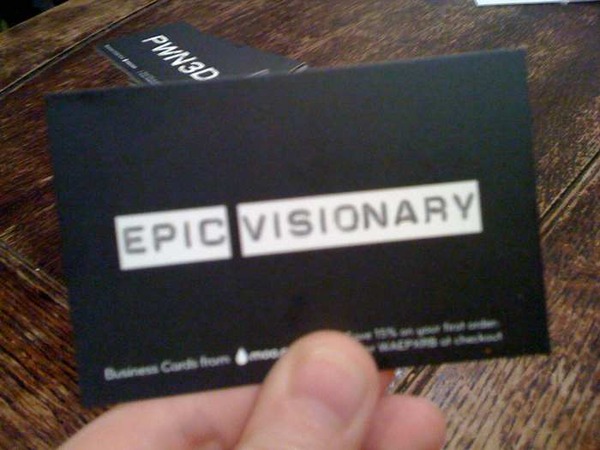
Epic Visionary by moo.com: all this can be yours

With so many Epic Visionaries in attendance, I’ve decided to raffle off the domain name I own – epicvisionary.com – at tomorrow’s event, in aid of the DEC Haiti Earthquake Appeal.

The nice people at Moo.com have very kindly turned this into an excellent prize package. The winner will not only get the epicvisionary.com domain, but also:

  • 1 x 50 Pack of Business Cards (Classic or Green stock)
  • 1 x 100 Pack of MiniCards
  • 1 x 20 Pack of Postcards
  • 1 x 90 StickerBook
  • FREE Standard UK Shipping

That’s an additional £50 worth of prizes with which you can show off your Epic Visionary status.

Tickets will be a fiver a strip, with all proceeds going to the DEC Haiti Earthquake Appeal.

For those that can’t make it, you can donate to the DEC Appeal here, and follow the unconference action via the UKGovWeb site. There’ll also be a bunch of active social reporters there on the day who you can follow on Twitter, Flickr, Google Wave, Tumblr, and doubtless all over the interweb.

Keep an eye on the #ukgc10 hashtag. I’ll try and blog on the event next week.